
Exodus begins with Israel under a death sentence and ends with the LORD dwelling among the people He redeemed. How did Jacob’s family move from Pharaoh’s protection to slavery, and why did God rescue them through Passover blood and the Red Sea? To follow the answer, we need to begin where Genesis ends and see how the LORD keeps His promises.
From Joseph to Pharaoh’s Oppression
The book begins with oppression, but the LORD rescues Israel and brings the people out of slavery to worship Him. Pharaoh’s defiance becomes the setting in which the LORD makes His name known. Exodus teaches us about God through events that happened to real people in history. Both the judgment and the mercy are real.
Joseph had been sold into Egypt by his brothers, but God raised him to authority and used him to preserve many lives during famine. Jacob’s household then settled in Goshen under Pharaoh’s protection. As generations passed, Joseph and his brothers died while the family multiplied into a large people. Exodus continues the promises God made to Abraham, Isaac, and Jacob; it does not begin a separate story.
The change appears in one short sentence. A new king arises who does not know Joseph. The text does not blame Joseph, and it does not say Israel caused the oppression through some particular sin. It reports a historical change in leadership and shows what that change meant for God’s people.
Now there arose a new king over Egypt, who did not know Joseph.
Exodus 1:8, NKJV
The Hebrew verb translated “know” is yada. It can mean to know, recognize, or acknowledge. In this setting, I think the idea reaches beyond awareness of facts. Pharaoh may have heard Joseph’s history, but he refused to acknowledge what the LORD had done for Egypt through Joseph or to honor his memory.
Pharaoh looks at Israel’s growth and begins to act from fear. He imagines that the people may join Egypt’s enemies and escape during a war. By describing Israel as a threat, he makes oppression sound prudent, but Scripture lets us see the desire for control beneath the policy.
come, let us deal shrewdly with them, lest they multiply, and it happen, in the event of war, that they also join our enemies and fight against us, and so go up out of the land.”
Exodus 1:10, NKJV
Pharaoh’s fear soon becomes government policy. Israel is made to serve with rigor and bitterness. The people must make mortar and brick before being driven into exhausting field labor. Egypt is not merely inconveniencing them. Pharaoh is trying to grind them down through forced labor.
So the Egyptians made the children of Israel serve with rigor. And they made their lives bitter with hard bondage–in mortar, in brick, and in all manner of service in the field. All their service in which they made them serve was with rigor.
Exodus 1:13-14, NKJV
God exposes the limit of that oppression. The more Egypt afflicts Israel, the more the people multiply. Their growth does not make the suffering small or excuse Egypt’s cruelty. Scripture treats slavery as a grave evil. It speaks just as seriously when Pharaoh moves from forced labor to murder.
But the more they afflicted them, the more they multiplied and grew. And they were in dread of the children of Israel.
Exodus 1:12, NKJV
Genesis 15:13-16 had already told Abram that his descendants would live as strangers and suffer affliction before God brought them out. Exodus is not the story of God improvising after a political crisis. The suffering is real, but so is His covenant. Pharaoh has forgotten the past; the LORD has not forgotten His promise.
I think we need to hold both truths together rather than treating God’s foreknowledge as though it made the cruelty unreal. Egypt remains guilty for what it does, and Israel truly groans beneath the bondage. At the same time, no political change can catch the LORD unprepared. The promise given centuries earlier still governs the story when the people living through it cannot yet see how deliverance will come.
Pharaoh then targets Hebrew sons because he wants to cut off Israel’s future. The first named people who resist him are not soldiers or princes. They are Shiphrah and Puah, Hebrew midwives who fear God. Exodus names these women while leaving the powerful king unnamed.
But the midwives feared God, and did not do as the king of Egypt commanded them, but saved the male children alive.
Exodus 1:17, NKJV
The midwives show the difference between honoring authority and worshiping it. Pharaoh is powerful, but he is not God. A command to murder does not become righteous because a ruler issued it. Their fear of God gives them the clarity to obey Him first, even though that obedience places them in danger.
Shiphrah and Puah do their work away from a battlefield, yet God uses their obedience to block Pharaoh’s plan. Human power cannot make evil good, and the LORD sees faithfulness that tyrants try to crush. Because these women fear God, they are no longer ruled by the fear of man.
This does not teach believers to shrug at tyranny or pretend that resistance has no cost. Shiphrah and Puah understand exactly what the king has ordered. They also understand that his office does not give him the right to take innocent life. Their courage begins with a settled judgment about who deserves their highest obedience. That judgment then shapes what they do when the command reaches their daily work.
Moses Preserved and Prepared
Exodus 2 introduces Moses as a baby beneath the same death decree. God’s chosen deliverer enters the story helpless and exposed. Before Moses can do anything for Israel, God is already preserving him.
When his mother can no longer hide him, she places him in a small vessel among the reeds. The Hebrew word for that vessel is tevah, the same word used for Noah’s ark. I would not build an elaborate allegory from the word alone, but the pattern is worth noticing. In both accounts, death and judgment are all around, yet God provides a vessel through which He preserves life.
God’s irony appears when Pharaoh’s daughter finds the child. Pharaoh wants Hebrew sons dead, yet his own household becomes the place where one Hebrew son is protected and raised. God turns the enemy’s house into a shelter for His purpose without asking Pharaoh’s permission.
Stephen explains in Acts 7 that Moses receives the education of Egypt. The world he will later confront is not foreign to him.
And Moses was learned in all the wisdom of the Egyptians, and was mighty in words and deeds.
Acts 7:22, NKJV
That education is useful, but it does not make Moses Israel’s deliverer. God must call and humble the man before sending him at the appointed time. Paul shows us in Hebrews what had happened in Moses’ heart when he came of age. Moses refused to let Egypt define his identity and chose to be counted with God’s people.
By faith Moses, when he became of age, refused to be called the son of Pharaoh’s daughter,
Hebrews 11:24, NKJV
esteeming the reproach of Christ greater riches than the treasures in Egypt; for he looked to the reward.
Hebrews 11:26, NKJV
Moses did not yet possess the full light believers have after Christ’s cross and resurrection, but he trusted God’s promises. Faith changed which people he counted as his own and which reward he considered lasting. Egypt could offer treasure and position, yet Moses chose the reproach connected with God’s Messiah.
His early attempt to help Israel still carries a warning. Moses sees an Egyptian beating a Hebrew and rightly recognizes the evil. He then answers that wrong with a sinful method by killing the Egyptian and trying to conceal the act.
So he looked this way and that way, and when he saw no one, he killed the Egyptian and hid him in the sand.
Exodus 2:12, NKJV
A person can recognize a real need and still choose an evil response. God’s rescue will not come through hidden violence. The LORD will openly declare His demand to Pharaoh and judge Egypt in public. Israel’s redemption will happen where everyone can see it.
Moses flees to Midian and becomes a shepherd. The man raised near a throne then spends long years in obscurity. Those years are not wasted. The wilderness humbles his confidence and teaches him patience as he depends upon God day after day. The Lord prepares His servant before sending him back to confront Pharaoh.
Moses’ years in Midian help us understand what his Egyptian training could not do. His first attempt at deliverance ended with a body hidden in the sand and Moses running for his life. In the wilderness he learns that training and position cannot accomplish God’s work by human force. When he returns, he will still use what he has learned, but the authority and timing will belong to the LORD.
The Burning Bush and the Name of the LORD
Exodus 3 moves from hidden preparation to open calling. Moses is tending sheep near Horeb when the Angel of the LORD appears in fire from the middle of a bush. The bush burns without being consumed. God draws near, yet He never ceases to be holy.
And the Angel of the LORD appeared to him in a flame of fire from the midst of a bush. So he looked, and behold, the bush was burning with fire, but the bush was not consumed. Then Moses said, “I will now turn aside and see this great sight, why the bush does not burn.” So when the LORD saw that he turned aside to look, God called to him from the midst of the bush and said, “Moses, Moses!” And he said, “Here I am.” Then He said, “Do not draw near this place. Take your sandals off your feet, for the place where you stand is holy ground.” Moreover He said, “I am the God of your father–the God of Abraham, the God of Isaac, and the God of Jacob.” And Moses hid his face, for he was afraid to look upon God.
Exodus 3:2-6, NKJV
The wording deserves careful attention. The Angel of the LORD appears in the flame. The passage then says the LORD sees Moses turn aside and that God calls from the bush. This is not how Scripture describes an ordinary created messenger. I understand the encounter as a Christophany, a pre-incarnate appearance of the eternal Son.
Before Moses receives instructions for Pharaoh, he learns reverence. The ground is holy because God is there. Moses is told to stop and remove his sandals. He must listen with the fear of God because a servant who will speak for God must first stand before God.
The LORD identifies Himself as the God of Abraham, Isaac, and Jacob. This is not a new plan introduced because an earlier purpose failed. The covenant-making God is keeping promises He has carried across generations. Moses will not go in his own name or authority.
And God said to Moses, “I AM WHO I AM.” And He said, “Thus you shall say to the children of Israel, ‘I AM has sent me to you.’”
Exodus 3:14, NKJV
“I AM WHO I AM” declares that the living God exists in and of Himself; He depends on nothing outside Himself for life. He is faithful and has complete authority to be who He is. Exodus 3:15 also gives the covenant name represented by YHWH and shown in many English Bibles as LORD in all capital letters. God is making Himself known within history, not giving Moses a private spiritual slogan.
This revelation sets up the central conflict. Pharaoh says that he does not know the LORD and refuses to obey His voice. The question is not whether Moses can become impressive enough to change the king’s mind. The coming judgments will answer whether the LORD can make Himself known.
And Pharaoh said, “Who is the LORD, that I should obey His voice to let Israel go? I do not know the LORD, nor will I let Israel go.”
Exodus 5:2, NKJV
Moses responds to his call by looking at his own inadequacy. “Who am I?” is an honest question, but God’s answer is not a speech about hidden greatness within Moses. The LORD promises His presence.
But Moses said to God, “Who am I that I should go to Pharaoh, and that I should bring the children of Israel out of Egypt?” So He said, “I will certainly be with you. And this shall be a sign to you that I have sent you: When you have brought the people out of Egypt, you shall serve God on this mountain.”
Exodus 3:11-12, NKJV
The mission rests on “I will certainly be with you.” God is patient with Moses’ weakness, but He does not treat refusal as virtue. When Moses finally asks God to send someone else, the LORD’s anger is kindled. Aaron will help, but Moses’ calling remains.
Moses keeps looking at the man who must stand before Pharaoh, while the LORD keeps directing him to the God who will go with him. That is the center of the calling. Weakness can teach dependence, but it becomes disobedience when it is used as a reason to reject God’s word. God’s provision of Aaron shows mercy to Moses; it does not mean the LORD’s original command was mistaken.
But he said, “O my Lord, please send by the hand of whomever else You may send.” So the anger of the LORD was kindled against Moses, and He said: “Is not Aaron the Levite your brother? I know that he can speak well. And look, he is also coming out to meet you. When he sees you, he will be glad in his heart.
Exodus 4:13-14, NKJV
Moses later describes himself as having “uncircumcised lips” in Exodus 6:12. Circumcision was the covenant sign of being set apart. Used of his speech, the phrase means that Moses feels unfit and unqualified for holy service. God does not allow that sense of inadequacy to cancel obedience. He directs Moses back to His word and assures him that the LORD’s own power and presence will be with him.
Judgment on Egypt and Pharaoh’s Hardened Heart
The plagues are not random disasters. They are ordered judgments through which the LORD displays His authority over creation and exposes Egypt’s false security. As He confronts Pharaoh’s pride, He also sets Israel apart from Egypt, showing that He rules in the midst of the land.
The Nile turns to blood. Frogs cover the land, and dust becomes lice. Flies follow, then disease among livestock and boils. Hail, locusts, and darkness prepare the way for the death of the firstborn. Egypt depends upon the Nile and its crops; it trusts its animals, its light, and its royal house. None can protect the nation from the Creator’s command.
I would be careful about claiming that every plague can be matched with certainty to one named Egyptian deity. The text gives us a larger and clearer conclusion. Together the plagues dismantle Egypt’s false confidence and show that the LORD rules every part of creation.
Pharaoh’s magicians imitate some early signs, but they never bring relief or reverse the judgments. By the plague of lice they confess that this is the finger of God. Later, the boils keep them from standing before Moses. Scripture is not presenting equal powers in a close contest. Counterfeit power reaches its limit while the LORD continues to speak and act.
And in that day I will set apart the land of Goshen, in which My people dwell, that no swarms of flies shall be there, in order that you may know that I am the LORD in the midst of the land.
Exodus 8:22, NKJV
Every plague presses the same question upon Pharaoh. Will he bow to the LORD’s command, or will he continue resisting? The judgments expose evil and answer Egypt’s false confidence. While this is happening, God protects His people so that Egypt will know His name.
The distinction at Goshen is part of that declaration. The absence of flies there is not chance or a fortunate shift in weather. God announces the separation beforehand so Pharaoh will know that the LORD rules inside the land he claims to control. Israel’s safety during these judgments does not come from greater military strength. It comes from God’s deliberate protection of the people bound to Him by covenant.
The hardening of Pharaoh’s heart must be handled carefully. Exodus sometimes says that Pharaoh hardens his own heart. Other passages describe his heart becoming hard, while still others say the LORD hardens him. These statements belong together. Pharaoh is not an innocent man into whom God places evil.
When I follow the order of these events, Pharaoh’s responsibility becomes unmistakable. Before the first plague, he has already rejected the LORD’s command and made Israel’s work harder. During the early judgments, he repeatedly refuses and returns to stubbornness whenever relief comes. He receives truth and opportunities to yield, but he uses each pause as another occasion to resist.
Temporary relief reveals his heart. Pharaoh sometimes speaks as though he will let Israel go when a plague becomes unbearable. Once the pressure lifts, he takes back his word and hardens himself again. The problem is not that God withholds all evidence or makes obedience impossible. Pharaoh sees the difference between the LORD and Egypt’s powerless defenses, yet he wants control more than truth.
God’s later hardening is judicial confirmation rather than the creation of hatred in a neutral man. In other words, God confirms Pharaoh in the rebellious course Pharaoh has chosen. One of the hardening verbs can carry the sense of strengthening or making firm. God then makes Pharaoh’s refusal the setting in which His power is displayed and His name becomes known.
For the Scripture says to the Pharaoh, “For this very purpose I have raised you up, that I may show My power in you, and that My name may be declared in all the earth.” Therefore He has mercy on whom He wills, and whom He wills He hardens.
Romans 9:17-18, NKJV
I do not believe Romans 9 should be turned into Calvinistic fatalism. Paul teaches God’s right to use even a rebellious ruler for His purpose. Pharaoh remains responsible for rejecting the LORD, while the LORD remains sovereign over the rebellion. Exodus allows both truths to stand without weakening either one.
Passover and Christ Our Passover
The final plague brings the account to Passover. Judgment is coming, but God provides a substitute. The lamb must be without blemish, and its blood must be placed where God commands. Social rank cannot save a house, and sincere feelings cannot provide refuge. Even Israelite family history is not enough by itself. The household must take shelter beneath the blood God supplies.
The LORD gives Israel a new calendar marker because this rescue will shape the nation’s worship. Each household chooses a lamb and keeps it until the appointed day. The lamb is killed, its blood goes on the doorposts and lintel, and the meal is eaten by people ready to leave. Unleavened bread reflects the haste of departure because there will be no time for dough to rise.
The meal is not a charm. Each detail teaches Israel to receive rescue on God’s terms and to remember why judgment passed over. A substitute died, and the household took refuge under the blood as the LORD commanded.
No household could improve the LORD’s provision by adding a different sign to the doorway. It was not enough to agree that a lamb had died somewhere else in Egypt. The blood had to be placed where God said, and the family had to remain within the refuge He appointed. God established the means of rescue, and the household trusted His word by taking shelter there.
And they shall take some of the blood and put it on the two doorposts and on the lintel of the houses where they eat it.
Exodus 12:7, NKJV
The New Testament names the fulfillment plainly. Passover remembers Israel’s rescue, but it also points forward to Jesus Christ.
Therefore purge out the old leaven, that you may be a new lump, since you truly are unleavened. For indeed Christ, our Passover, was sacrificed for us.
1 Corinthians 5:7, NKJV
Jesus is the eternal Son, fully God and fully man. He was born of a virgin and lived completely without sin. He is the true Passover Lamb. Wicked men tortured Him and inflicted real physical punishment upon Him, while He willingly bore the punishment for our sins in His innocent body. He shed His blood and died. After He was buried, He rose bodily from the grave.
The Father did not punish or curse Jesus, and He did not abandon Him. Nor did the Father strike or bruise Him, or pour wrath on Him. The Father and Son remained united in redemption. Christ’s blood is the only sufficient basis for forgiveness, just as the Passover households could not invent another refuge from the coming judgment.
Christ died for the whole world, and God’s offer of salvation is genuine even though people can resist and reject it. Everyone who repents and believes in Jesus is forgiven and justified before God. God gives that person new birth and makes him a new creation. The Holy Spirit then comes to dwell within him and seals him.
Salvation is received by grace through faith. Observing Passover cannot earn it, and neither can baptism. Keeping the law cannot purchase salvation. Church membership and moral improvement also fail to provide the refuge that God has made available only through Christ.
Someone who is truly born again is eternally secure because Christ keeps those He saves. That security never gives permission for lawlessness. Obedience follows as the fruit of belonging to the Lord. A superficial profession does not prove that new birth occurred, but a true believer’s failures do not undo Christ’s finished work.
Through the Red Sea to Worship
Israel leaves Egypt, but Pharaoh changes his mind and pursues the people. With the sea ahead and chariots behind, Israel must recognize that deliverance belongs entirely to the LORD.
The LORD will fight for you, and you shall hold your peace.
Exodus 14:14, NKJV
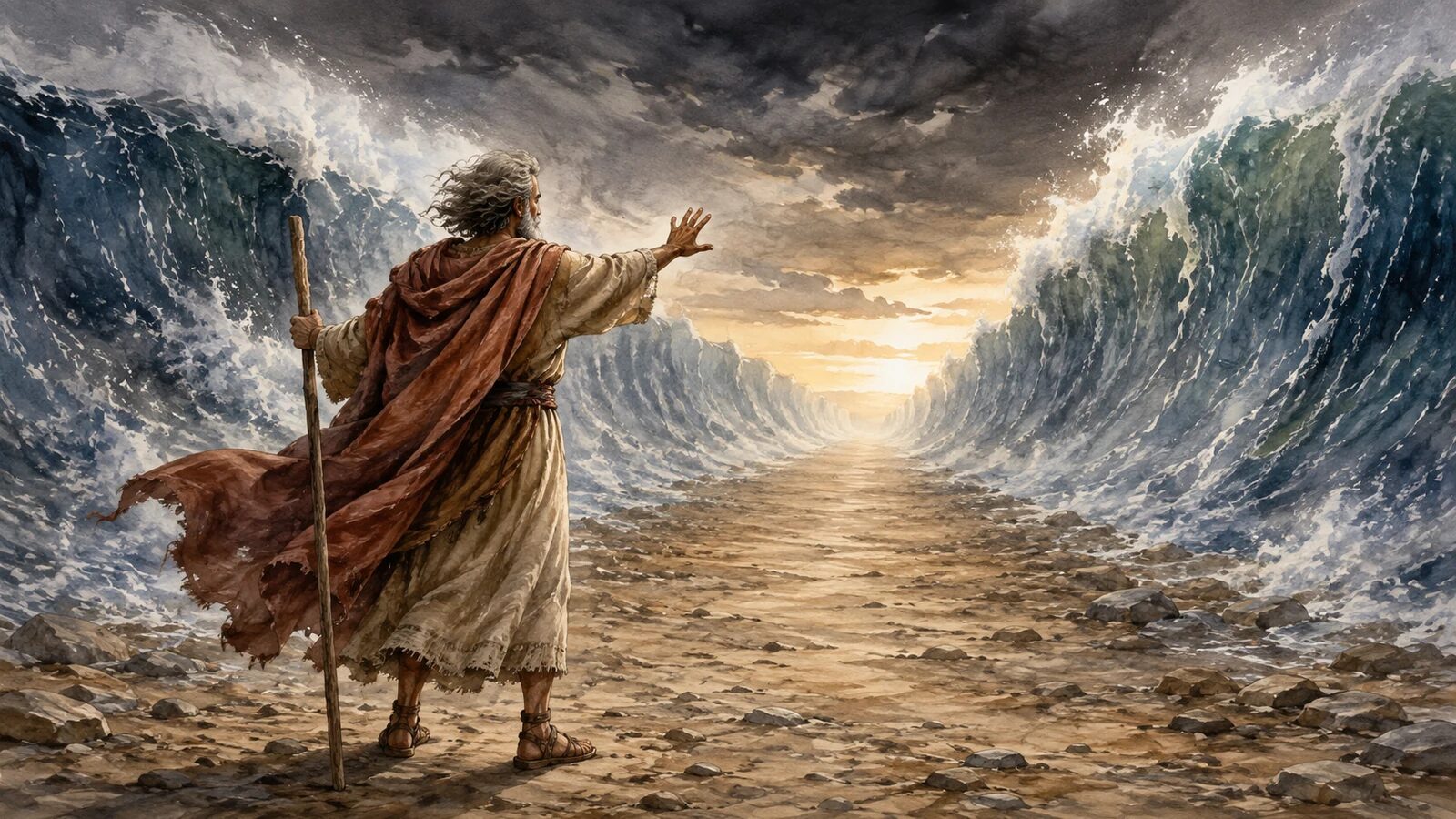
Moses’ command to stand still does not mean the people will remain physically motionless. God immediately tells them to go forward. They can advance only because the LORD opens the way. Israel crosses on dry ground, and the waters close over the army that intends to drag them back into bondage.
The same path brings rescue to God’s people and judgment to the enemy that refuses to release them. No human army could create that escape. The LORD completes Israel’s deliverance from Pharaoh by power that belongs to Him alone.
The Red Sea does not complete the Book of Exodus. God leads His redeemed people toward Sinai and gives them His covenant law. He then directs them to build the tabernacle so His presence may dwell among them. This larger movement explains the purpose of the rescue.
Even the command to “stand still” must be heard in that movement. Israel cannot fight its way free, so the people must stop panicking as though survival rests on their own strength. Yet trust does not leave them frozen at the shoreline. When God opens the path and commands them to move, faith walks forward on ground that did not exist until the LORD provided it.
God brings Israel out of slavery so the nation may belong to Him. The people must hear His word and worship Him as they live in His presence. Redemption is not permission to return to bondage or invent worship according to human preference.
This is why Exodus cannot be reduced to a symbol or a general story of personal freedom. It records real events that later Scripture repeatedly treats as history. The account certainly includes liberation and courage, but neither idea carries its full weight. Exodus is first about the LORD keeping His covenant. He judges evil and redeems Israel through blood and power, bringing His people out so they may worship Him.
The book calls us to fear God more than Pharaoh and to trust His promise even when affliction and waiting are real. It teaches us to take sin and judgment seriously while directing us to the refuge God has provided. Pharaoh heard the word of the LORD repeatedly and resisted it. The right response is humble faith that receives Christ. From that faith, worship and obedience grow.
That response keeps us from admiring deliverance while resisting the Deliverer. Israel’s escape is not merely an inspiring account of people overcoming hardship. The LORD claims the people He rescues. In the same way, the gospel does not offer freedom from judgment while leaving us free to ignore Christ. Grace brings sinners into a new relationship in which they belong to the One who saved them.
My Final Thoughts
After following the Exodus from Joseph’s forgotten service to Israel’s passage through the sea, I keep coming back to the faithfulness of the LORD. Pharaoh turned fear into slavery and murder, but he could not erase God’s covenant or prevent God from making His name known. God provided a refuge at Passover, then opened the way through the Red Sea by His own power. Jesus is our true Passover Lamb, and His blood is the only sufficient basis for forgiveness. Those who trust Him are not redeemed so they can return to bondage. We belong to the Lord now, and He calls us to hear His Word as we worship in His presence.