
Why does God keep meeting people on mountains throughout Scripture? The rock and soil have no power of their own, yet God repeatedly chooses these places when He makes His holiness known and calls people to hear His Word. I want to follow the theme from Horeb to the holy city and see why it finally directs our attention to Jesus Christ.
As we follow the theme, one mountain prepares us to understand the next. God first calls Moses at Horeb. He later brings redeemed Israel back to that region, where He gives His law and teaches the need for mediation. Moriah shows the LORD providing a sacrifice, while Zion carries the promise of His King. Elijah eventually returns to Horeb in weakness, and much later he and Moses appear with Jesus at the Transfiguration. Revelation completes the movement with John’s view of the holy city. These places are not disconnected scenery. Together they show the holy God making Himself known and providing the way for His people to come near.
Holy Ground at Horeb
The mountain theme begins here with Moses at Horeb, a name Scripture often uses for the same mountain region called Sinai elsewhere. Moses is not looking for a spiritual experience. He is tending his father-in-law’s sheep after years of exile from Egypt. He had once tried to defend an Israelite by killing an Egyptian, and Pharaoh then sought his life. Now the public importance he once knew seems far behind him. God steps into this ordinary day and calls the failed exile by name. The place where Moses stands becomes holy because God is there, and the shepherd receives a mission he could not have planned.
Now Moses was tending the flock of Jethro his father-in-law, the priest of Midian. And he led the flock to the back of the desert, and came to Horeb, the mountain of God.
Exodus 3:1, NKJV
Horeb is called the mountain of God, but this does not mean hidden power lives in the rock. God chose the place for revelation and covenant dealings. In Scripture, holiness includes being set apart to God, and whatever belongs to the holy LORD must be treated according to His Word. The ground is ordinary before His appearance. His presence and command establish its sacred use.
This keeps us from treating biblical places like spiritual batteries. I think these places deserve our attention because real events happened there, but God is not contained by elevation or beautiful scenery. An ancient site cannot put Him under human control. The Creator sets the terms of approach. He met Moses in the wilderness and later brought Israel back to Sinai. At Horeb He corrected Elijah, and on another mountain He revealed Christ’s glory to the disciples. Today He speaks to His people through His written Word as the Holy Spirit works in them.
The burning bush is not merely a strange sight used to get Moses’ attention. Exodus first says that the Angel of the LORD appeared in the flame, then says that God called from the bush. This distinctive Messenger speaks as God and bears the divine identity. I believe this is a Christophany, which means a visible appearance of the eternal Son before He took on human flesh. He is not an ordinary created angel. The Father, Son, and Holy Spirit are the one God, while the Son is personally distinct from the Father.
The fire adds to the scene. Fire in Scripture can display God’s holiness, purity, glory, or judgment, yet this bush burns without being consumed. We should not force each detail into a hidden code. Still, the sign unmistakably confronts Moses with a divine presence that is active without being exhausted. God is the living, self-existent Creator. He depends on nothing He made.
When Moses turns aside to look, God calls him by name. The holy God is not vague energy. He knows Moses personally and gives a command that requires an answer.
Then He said, “Do not draw near this place. Take your sandals off your feet, for the place where you stand is holy ground.”
Exodus 3:5, NKJV
Removing his sandals shows reverence and humility. Moses does not decide how the meeting will proceed; God does. Sincere interest in God does not give anyone the right to approach Him casually or invent a way to worship Him. Holy ground calls for reverence.
Yet holiness is not cold distance. God immediately identifies Himself as the God of Abraham, Isaac, and Jacob. He has seen His people’s oppression and heard their cry. He knows their sorrows and has come down to deliver them. His holiness does not erase His mercy. His mercy is itself holy, and it flows from His covenant faithfulness.
Moses knows that the Israelites may ask which God sent him. Egypt was full of named deities, while Israel’s fathers knew the LORD through His covenant promises. Moses cannot return with vague religious language or confidence in himself. He needs to know who is sending him, so he asks about God’s name.
And God said to Moses, “I AM WHO I AM.” And He said, “Thus you shall say to the children of Israel, ‘I AM has sent me to you.’”
Exodus 3:14, NKJV
The Hebrew expression is ehyeh asher ehyeh, commonly rendered “I AM WHO I AM.” It is not given as a puzzle for speculation. The LORD is the One who is. Unlike the false gods of the nations, He does not depend on worshipers for His existence. No shrine contains Him, and human weakness never limits His power. He is the living God who made promises to Abraham and confirmed them to Isaac and Jacob. That same God is able to act within history for His people.
This answer also meets Moses’ fear. Moses asks, “Who am I?” God does not build the mission on Moses’ self-confidence. He promises His presence and reveals His name. The success of the mission rests on who God is, not on Moses’ natural ability.
God also gives Moses a sign that points forward. After He brings Israel out of Egypt, the people will serve Him on this very mountain. Moses cannot verify the sign before obeying. Its fulfillment on the far side of deliverance will confirm that the God who called him also accomplished the rescue.
So He said, “I will certainly be with you. And this shall be a sign to you that I have sent you: When you have brought the people out of Egypt, you shall serve God on this mountain.”
Exodus 3:12, NKJV
The Hebrew verb translated “serve” is avad. It can mean to work or serve, and in this setting it includes worshipful service. God is not merely recruiting workers. He is redeeming people who will belong to Him and live under His Word. The Exodus is not freedom into self-rule. Redemption has a destination because the LORD brings His people out of bondage in order to bring them to Himself.
I think this is an important order we should not overlook. Israel is not rescued because the people first keep the Sinai covenant. God delivers them by His power and then teaches the redeemed nation how to live before Him. Sinners likewise are not saved by works. Religious rituals and law-keeping cannot earn life, and later obedience never becomes part of the purchase price. We are saved by grace through faith in Jesus Christ. Obedience follows as the fruit of new life.
Redemption, Law, and Mediation at Sinai
When Israel reaches the wilderness of Sinai in the third month after leaving Egypt, God is doing exactly what He promised. The Passover lambs have been slain. Israel has walked out of bondage and safely through the sea before any commandment is spoken from the mountain. Now the LORD has brought the people to Himself. Sinai is the appointed place where the redeemed nation will hear the terms of God’s covenant with Israel.
We need to keep that order clear: redemption comes before law. Israel does not earn release from Egypt by keeping commandments that have not yet been given. God saves the people first and then gives His covenant law to them. This does not mean every Mosaic command is addressed directly to the church. Each command must be read with its original audience and covenant in view, and we must also ask how Scripture says it is fulfilled. The law still reveals God’s holy standard and exposes sin while instructing Israel. If we reverse the order, we turn it into a ladder sinners try to climb to God. Read in context, it shows our need for a better Mediator and a final sacrifice.
“You have seen what I did to the Egyptians, and how I bore you on eagles’ wings and brought you to Myself. Now therefore, if you will indeed obey My voice and keep My covenant, then you shall be a special treasure to Me above all people; for all the earth is Mine. And you shall be to Me a kingdom of priests and a holy nation.”
Exodus 19:4-6, NKJV
The Hebrew word segullah in Exodus 19:5 means a special treasure or treasured possession. The LORD claims Israel as His own while also declaring that all the earth belongs to Him. Israel’s election to covenant privilege was never permission for pride. The nation was set apart as holy and called to bear witness to the living God.
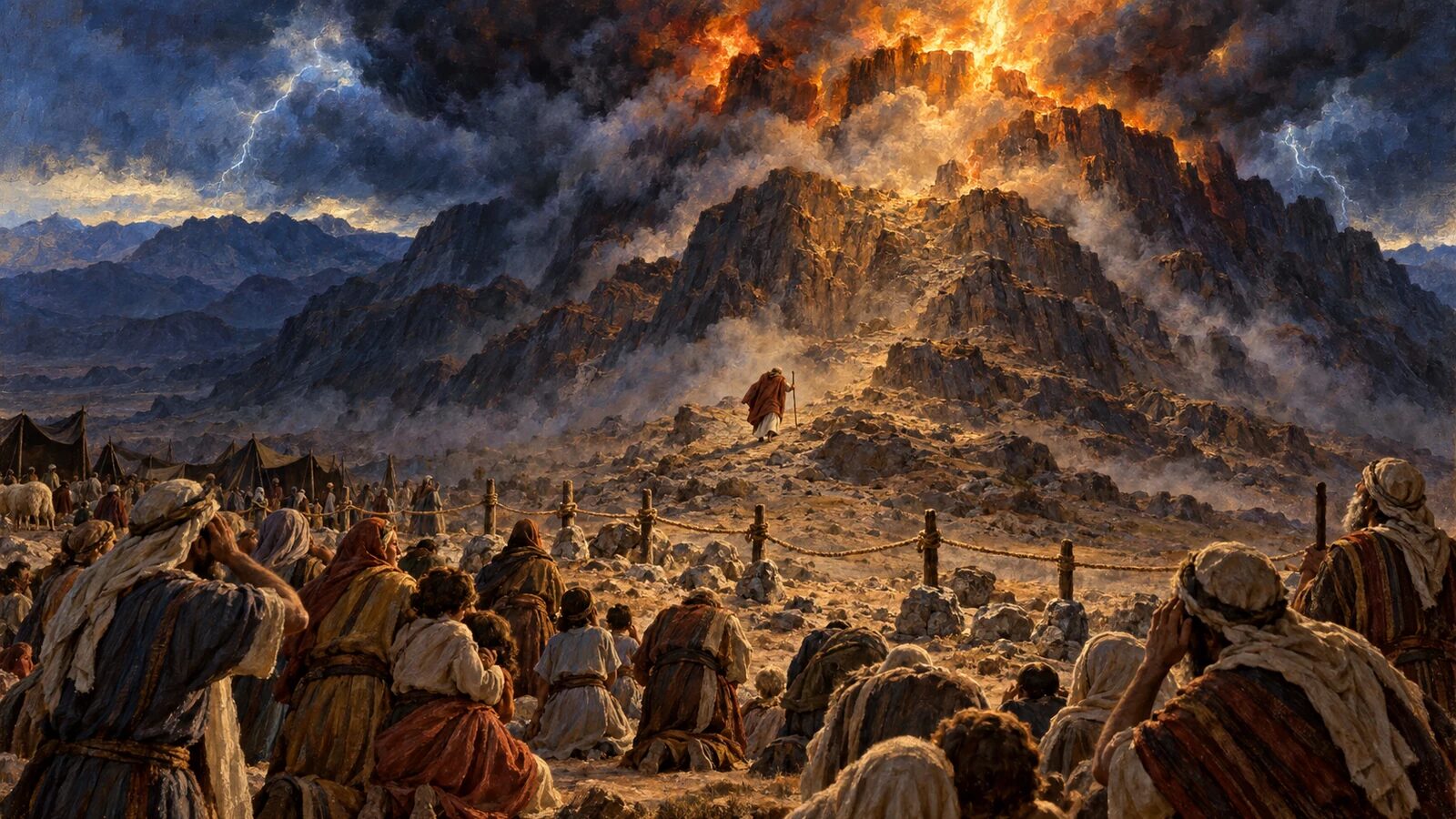
Before the LORD descends, He commands the people to consecrate themselves and sets a boundary around the mountain. On the third day a loud trumpet sounds as thunder and lightning break across the cloud. The LORD descends in fire, and the mountain smokes and quakes while the people tremble. These are not stage effects meant to manufacture emotion. The Creator is drawing near in holiness, so sinful people must not treat His presence lightly.
Now Mount Sinai was completely in smoke, because the LORD descended upon it in fire. Its smoke ascended like the smoke of a furnace, and the whole mountain quaked greatly.
Exodus 19:18, NKJV
The boundary is mercy as well as warning. It does not mean God is unwilling to meet His people. He is teaching Israel that holy access must come by His appointed way. When the people hear the commandments, they tremble and stand far off, while Moses draws near.
So the people stood afar off, but Moses drew near the thick darkness where God was.
Exodus 20:21, NKJV
Here we begin to see the need for mediation. Sinful people cannot stroll into God’s presence on their own terms. Moses stands between God and the people in a real but limited way. The priesthood and sacrifices later continue this lesson. The altar and tabernacle show that God is holy and sinners need cleansing. Access comes only through the provision He appoints.
Those sacrifices did not save by their own power. Animal blood cannot finally remove human sin. The sacrifices showed how serious sin is and taught that atonement requires blood. Atonement is God’s provision for dealing with sin so that guilty people may be reconciled to Him. The substitute died in the sinner’s place, displaying God’s mercy while pointing forward to Christ. Wicked men subjected His innocent body to real torture and shed His blood, while He willingly bore that punishment for our sins. They killed Him on the cross. He was buried and rose bodily from the grave.
Exodus 24 records the formal establishment of the covenant. Moses builds an altar and twelve pillars for the twelve tribes. Young men offer sacrifices, and Moses puts part of the blood on the altar. After reading the Book of the Covenant, he receives the people’s promise to obey and sprinkles covenant blood on them. Moses, Aaron, Nadab, Abihu, and seventy elders then ascend and see a revealed appearance of the God of Israel during a remarkable covenant meal. They did not see or fully grasp God’s invisible being. God graciously showed them a true revelation of Himself in a form human beings could receive.
Word and blood belong together. Israel is not invited into fellowship with God by pretending sin does not exist. Covenant access is marked by what God says and by the blood He appoints. This prepares us for the tabernacle instructions that follow. God gives Moses the pattern on the mountain because He intends to dwell among His redeemed people in a way that guards His holiness and provides access.
The tabernacle is not a human plan for reaching upward. It is God’s gracious provision for dwelling with His people. The altar shows that blood is required, while the priesthood governs the people’s access. Repeated sacrifices keep the cost of sin in view, and the veil marks a boundary that no one may ignore. Even the ark and mercy seat receive their meaning from God’s command. Hebrews 9-10 later explains that these patterns find their answer in Christ’s once-for-all sacrifice and priestly work.
There is a difference between God’s gracious nearness and casual familiarity. At Sinai He truly comes down to the people He has rescued, yet the smoke, boundary, mediator, and blood keep reminding them who He is. The covenant meal of Exodus 24 is real fellowship, but it happens only after God has spoken and covenant blood has been applied. The tabernacle continues that same pattern in Israel’s camp. God chooses to dwell among them, while every part of the approach teaches that sin cannot simply be overlooked.
This helps us understand why the mountain cannot be separated from the rest of Exodus. The LORD who speaks from Sinai is the One who heard Israel in Egypt and passed over homes marked by blood. He carried the nation through the sea and supplied them in the wilderness. His commands do not appear as an impersonal code dropped from the sky. They come from the covenant God who has already acted to make Israel His people. The law therefore reveals both the holiness of the Redeemer and the kind of life fitting for a nation that belongs to Him.
Provision at Moriah and the King on Zion
The mountain theme reaches back before Sinai to Genesis 22, where God tests Abraham concerning Isaac in the land of Moriah. God is not enticing Abraham to evil. He is proving faith through a command whose resolution Abraham cannot yet see. The account is especially solemn because Isaac is the son through whom God promised descendants. Isaac is not necessarily the small child often pictured in art. He is strong enough to carry the wood and old enough to ask where the lamb is. Abraham obeys while trusting that God will keep His promise. At the decisive moment, the Angel of the LORD stops him. As in Exodus 3, I understand this divine Messenger to be the pre-incarnate Son.
And Abraham called the name of the place, The-LORD-Will-Provide; as it is said to this day, “In the Mount of the LORD it shall be provided.”
Genesis 22:14, NKJV
God provides a ram in Isaac’s place. Abraham’s obedience does not earn salvation. Instead, the account shows faith obeying God while God supplies what is needed. The place becomes associated with the LORD’s provision.
In 2 Chronicles 3:1, Mount Moriah in Jerusalem becomes the place where Solomon begins to build the house of the LORD, at the threshing floor David had prepared. This connects Moriah with temple worship and its sacrifices. Once again, God’s appointed approach is displayed. I would be careful about going farther than Scripture does. The Bible does not identify the exact spot of Isaac’s altar with the later temple altar or the precise location of Calvary. The revealed connection is strong enough: God supplies the sacrifice and makes a way for His people to draw near.
All of this points beyond itself. Isaac is spared through a substitute, and the later temple sacrifices continue the lesson of atonement. Christ fulfills what those shadows could only anticipate. He is not a symbolic improvement on human effort. Jesus is the Lamb of God and the sinless Son who shed His blood for sinners before rising bodily from the grave.
Zion gathers another part of the mountain theme. The name can be confusing because Scripture does not always use it for exactly the same area. It first refers to the Jebusite stronghold David captured, which became known as the City of David. As Jerusalem became the center of royal rule and worship, Zion could refer more broadly to the holy hill or the city. At times it could even refer to the covenant people connected with it. Geography still serves God’s promise rather than holding power of its own. Psalm 2 pictures the nations raging while God establishes His King on Zion.
“Yet I have set My King On My holy hill of Zion.”
Psalm 2:6, NKJV
Zion is not a vague symbol for feeling spiritual. It is tied to God’s promises and the King He establishes. Psalms 48, 87, and 125 develop the themes of God’s city, His protection, and the people who belong to Him. The prophets also look ahead to the mountain of the LORD’s house being established as the nations come to receive instruction. Isaiah 2:1-4 says that the Word of the LORD will go out from Jerusalem and that the nations will learn His ways.
I do not think we should flatten that future hope into inspirational language. Jesus will return bodily and reign as God promised. Zion’s hope is centered on Christ because the King established there is the Son. Human politics cannot heal the nations, and neither scenery nor ceremony can bring the promised peace. The nations must come under the righteous rule of the Lord.
This also keeps us from collapsing Israel and the church into one indistinct idea. Hebrews can speak of the heavenly Zion to which believers have come without canceling the Old Testament promises tied to Jerusalem, Israel, and the reign of the Messiah. The images belong together because the same King rules over all of God’s purpose, but each passage must be allowed to speak in its own covenant setting. Psalm 2 expects the Son to rule the nations. Isaiah expects instruction to go out from Jerusalem. The New Testament does not make those promises less real when it reveals their center in Christ.
Elijah, the Greater Prophet, and the Beloved Son
Centuries after Moses, Elijah travels to Horeb, the mountain of God. His journey follows the dramatic victory at Mount Carmel. The LORD answered by fire, exposing Baal’s weakness until the people confessed that the LORD is God. Jezebel responded by threatening Elijah’s life, and the prophet fled. After leaving his servant behind, he sat under a broom tree and asked to die. Fear and exhaustion are shaping the way he sees his ministry, but God does not begin with a rebuke. Before Elijah travels to Horeb, God lets him rest and gives him food and water to strengthen him for the journey.
So he arose, and ate and drank; and he went in the strength of that food forty days and forty nights as far as Horeb, the mountain of God.
1 Kings 19:8, NKJV
Elijah’s forty-day journey echoes Moses, but this prophet’s need is different. He is not being called from shepherding into Egypt. God is restoring and correcting him after he has concluded that he alone remains faithful. At the mountain, a strong wind tears into the rocks. An earthquake and fire follow, yet the text says that the LORD was not in the wind, the earthquake, or the fire. Then comes a still small voice, or a quiet, restrained sound, and Elijah covers his face.
I do not think this passage gives us permission to place private impressions above Scripture. Elijah’s ministry has depended on the Word of the LORD from the beginning. At Horeb, God corrects and directs His weary servant. The LORD is not limited to dramatic public signs. He can shake a mountain, and He can speak with quiet restraint. He exposes Elijah’s loneliness and tells him that seven thousand have not bowed to Baal.
Here the mountain theme becomes very personal. The same holy God who descended in fire at Sinai feeds a tired prophet before his journey to Horeb. He does not become less holy when He deals kindly with Elijah. His kindness includes the correction Elijah needs, and God sustains him while giving it. A fuller treatment of this event belongs in the study on Elijah’s life.
Matthew 5 then tells us that Jesus went up on a mountain. He sat down as teachers commonly did and began teaching His disciples while the crowds listened. The setting naturally reminds readers of Moses, but Matthew does not name the mountain or tell us to construct an exact Sinai reenactment. What he emphasizes is Jesus’ unmistakable authority. Jesus does not merely repeat the opinions of earlier scribes. He brings God’s demands to the level of the heart and speaks with an authority that calls for true obedience before the Father.
The Sermon on the Mount does not lower the law into easy moral advice. Jesus shows that God sees murderous anger as well as the lustful heart behind adultery. He then turns to religious acts and exposes the desire for human praise. Giving, prayer, and fasting must be done under the Father’s eye because He sees the motive. The same inward truth reaches our words and our willingness to forgive. It even reaches the way we love an enemy.
The One greater than Moses is speaking. Deuteronomy 18 promised a Prophet like Moses, and the New Testament reveals Christ as that final and greater Prophet. Moses received God’s Word as a servant. Jesus is the eternal Word who became flesh and mediates as the Son.
Then we come to the Transfiguration, where the New Testament brings these lines together. This event follows Peter’s confession that Jesus is the Christ and Jesus’ plain announcement that He must suffer, be killed, and rise again. After calling His disciples to take up the cross, Jesus takes Peter, James, and John onto a high mountain. There He is transfigured before them. His face shines, His clothes become white as light, and Moses and Elijah appear with Him.
Moses and Elijah are not random guests. Moses is closely tied to the law and Sinai, while Elijah represents the prophets and also met God at Horeb. Luke adds that they spoke with Jesus about His coming departure. The Greek word Luke uses is exodos, and Jesus was about to accomplish this departure at Jerusalem through His death and resurrection. That choice of word connects the earlier Exodus pattern with the work Christ came to finish.
Yet Moses and Elijah are not equal centers of the scene. When Peter proposes three tabernacles, the Father speaks from the cloud and directs all attention to Jesus.
While he was still speaking, behold, a bright cloud overshadowed them; and suddenly a voice came out of the cloud, saying, “This is My beloved Son, in whom I am well pleased. Hear Him!”
Matthew 17:5, NKJV
When the disciples lift their eyes, they see Jesus only. This is where the mountain theme must lead. Moses and Elijah hold an important place in God’s revelation. Sinai and Horeb are significant, and so are Moriah and Zion. None may compete with the beloved Son. The Father commands us to hear Him.
The disciples’ fear also belongs to the scene. They fall on their faces when they hear the Father’s voice, but Jesus comes and touches them. He tells them to rise and not be afraid. The One whose glory overwhelms them is also the One who comes near. This does not lessen His majesty. It shows why He alone can mediate between the holy God and human beings. He is fully God and fully man, and His coming suffering is not a detour from the glory on the mountain. The cross and resurrection are the work He came to accomplish.
From Sinai to the Holy City
Hebrews addresses believers under pressure who must not turn away from Christ. In Hebrews 12, Paul contrasts the mountain Israel could touch but was forbidden to approach with the Mount Zion to which New Covenant believers have come. We should read the contrast carefully. He is not saying that the God of the Old Testament was harsh while the God of the New Testament is gentle. The same holy God speaks in both settings. The difference lies in the covenant under which the people approach Him and in Christ’s completed work as Mediator.
But you have come to Mount Zion and to the city of the living God, the heavenly Jerusalem, to an innumerable company of angels,
Hebrews 12:22, NKJV
Believers come to God through Jesus, the Mediator of the new covenant. This access is greater than Sinai, but it is not casual. Hebrews continues by warning readers not to refuse Him who speaks. Grace opens the way through Christ; it does not give us permission to treat God lightly.
The contrast also protects the gospel. We are not made right with God by trying to climb Sinai through commandment-keeping. We draw near through Christ because He is the Mediator sinners need. Jesus obeyed perfectly and shed His blood for us. He died for our sins and rose bodily from the grave.
The Bible’s mountain theme looks forward as well as backward. Revelation 21 follows the final rebellion, the Great White Throne judgment, and John’s vision of a new heaven and a new earth. An angel then carries John in the Spirit to a great and high mountain. From there he sees the bride, the Lamb’s wife, pictured as the holy city descending out of heaven from God. The direction catches my attention. Humanity does not climb high enough to reach the Lord or build a civilization that becomes heaven. God brings the city down.
And he carried me away in the Spirit to a great and high mountain, and showed me the great city, the holy Jerusalem, descending out of heaven from God,
Revelation 21:10, NKJV
Revelation’s hope is holy because nothing that defiles will enter the city. Its gates and foundations display the beauty of God’s finished work. The river and tree of life show life flowing from Him, and the absence of a temple points to God and the Lamb dwelling openly with a purified people. This is the final answer to the tabernacle pattern. God dwells with His people, and no veil remains between them.
The city also gathers earlier biblical hopes without erasing their history. Its gates bear the names of Israel’s twelve tribes, while its foundations bear the names of the Lamb’s twelve apostles. The glory of God gives it light, and the Lamb is its lamp. The nations walk in that light, and the kings of the earth bring their glory into it. What began with chosen places of revelation reaches a creation openly filled with God’s presence. There is no sacred corner that people must visit to get closer to Him, because the Lord God Almighty and the Lamb are there.
The same Bible that promises this fellowship also warns about final judgment. Unbelievers are bodily raised and judged at the Great White Throne. The Lake of Fire and Gehenna describe the final, irreversible destruction of the human body and soul, which Scripture calls the second death. This rejects universalism because not everyone is finally saved. It also rejects endless conscious torment for human beings while retaining the full severity and finality of judgment from the holy God.
That warning makes the gospel invitation urgent. God genuinely offers salvation to every person because Christ died for the whole world. People can resist and finally reject Him, but no one is excluded from the invitation to repent and believe. Anyone who trusts the Lord Jesus is born again and receives eternal life. The Holy Spirit indwells and seals that believer. God keeps His child, and the security He gives calls us to walk in holiness rather than making sin harmless.
The final city is not earned by climbing a mountain or keeping Sinai’s covenant. It cannot be reached through a ceremony or a manufactured emotional experience. Entrance is given through the Lamb. The mountain settings are real, and the events that happened on them are essential to the biblical story, but the ground is never the Savior. Christ is.
That distinction protects the whole theme from several errors. Mountains are not spiritually powerful in themselves. God makes a place holy when He sets it apart through His presence and Word. Sinai does not teach salvation by law, because God redeemed Israel before giving the law. The sacrifices offered under that law had no saving power of their own; they pointed ahead to Christ’s sacrifice once for all.
Zion also cannot be reduced to an inward feeling. It is tied to God’s promises and to the King who will rule. The biblical hope reaches from Jerusalem to the heavenly city without losing its center in Christ. At the Transfiguration, Moses and Elijah do not stand as equal voices beside Him. The Father’s command settles the matter: hear the Son.
From holy ground to the descending city, God remains the One who takes the initiative. He calls Moses and delivers Israel before giving His Word at Sinai. When sin bars the way, God provides sacrifice and appoints a mediator. He establishes the promised King, and at the end He brings the city down. People do not discover a spiritual route that places God within reach. He reveals Himself and supplies the only way sinners may draw near.
If you want to trace connected parts of this theme further, the studies on the Shekinah glory and the pillar of fire and cloud follow God’s revealed presence and His guidance of Israel after the Exodus.
My Final Thoughts
After following these mountains through Scripture, I keep coming back to the fact that God always sets the terms of approach. Horeb and Sinai teach reverence and the need for a mediator, while Moriah and Zion show the sacrifice God provides and the King He promises. At the Transfiguration, the Father directs us away from every lesser center and tells us to hear His beloved Son. Jesus shed His blood and died so that sinners can draw near. He rose bodily and will bring His people into the holy city where God and the Lamb dwell with them. Our hope is not in sacred ground or religious effort, but in the Savior to whom every mountain points.