
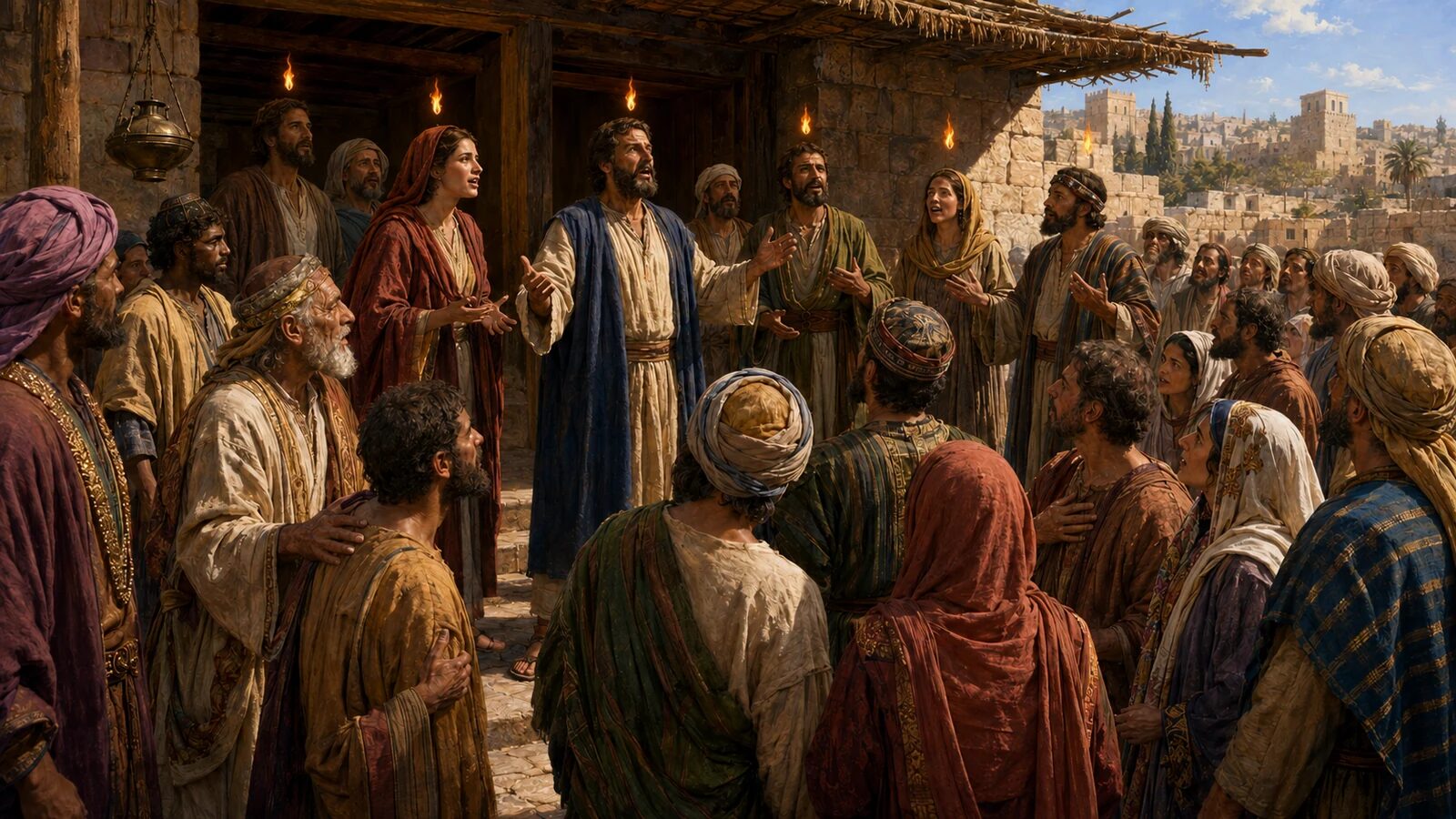
Acts continues Luke’s account of Jesus by showing the risen Lord directing His church from heaven. The people He sent encountered threats they could not control and serious failures within their own congregations. I don’t read those difficulties as evidence that Christ had left them to manage His work alone. He worked through His Spirit as they proclaimed Him, even when obedience cost them dearly.
The Risen Jesus Continues His Work
Luke addressed both his Gospel and Acts to Theophilus. His Gospel records Jesus’ ministry, death, and bodily resurrection. Acts returns to His final instructions and ascension before following the spread of the gospel. Luke names rulers and places as he records journeys, sermons, and testimony in court. The apostles were speaking about events they had witnessed, and Luke places their testimony in public history.
The former account I made, O Theophilus, of all that Jesus began both to do and teach, until the day in which He was taken up.
Luke describes Jesus’ earthly ministry as what He “began” to do and teach. Acts then follows His continuing work through the Holy Spirit and the witnesses He had prepared. Theophilus had reason to be confident in what he had been taught because the apostles served the Lord they had seen alive after His death.
The promise given at His ascension also directed their attention toward the future. As they watched Him go, two men in white clothing told them:
This same Jesus, who was taken up from you into heaven, will so come in like manner as you saw Him go into heaven.
“This same Jesus” is the Lord who will return personally and bodily. The disciples had seen Him ascend, and they were told to expect His return in the same manner. Their work in the meantime depended on His authority and care. They proclaimed the risen Christ who would return as Judge, rather than trying to preserve the memory of a leader whose life had ended.
Acts follows that witness from Jerusalem to Rome. Some of the people who heard it responded with faith, while others threatened or imprisoned the messengers. Believers were driven from their homes, and disagreements arose within the church. Christ continued to direct their witness without promising that His servants would escape suffering.
Witness from Jerusalem to the Nations
Before ascending, Jesus had told the apostles where their witness would begin and how far it would reach:
But you shall receive power when the Holy Spirit has come upon you; and you shall be witnesses to Me in Jerusalem, and in all Judea and Samaria, and to the end of the earth.
Jerusalem received the first witness because the risen Messiah had come to Israel in fulfillment of its Scriptures. As the message spread through Judea and Samaria, it crossed the old hostility between Jews and Samaritans. God then publicly confirmed that Gentiles were received through faith in the same Lord. The gospel fulfilling Israel’s promises was intended for the nations, so no people could claim it as their private possession.
The Greek plural martyres means witnesses or testifiers. The apostles had been appointed to tell what they had seen and heard concerning Jesus, especially His bodily resurrection. They spoke of His ministry and death, His ascension, and His promised return. Our own testimony rests on the truth they delivered; we are not being asked to invent a message that will seem more appealing to our neighbors.
Jesus promised power through the Holy Spirit, who is God, not an impersonal force. He convicts people of sin, guides His servants, and strengthens them to obey. I reject cessationism, the view that certain spiritual gifts have ceased, because I do not believe Acts teaches us to expect the Spirit to stop working that way. I also reject hyper-charismatic excess, where spectacle and untested claims are allowed to displace sound teaching.
If someone claims the Spirit has given a message that contradicts the Word He inspired, the claim needs to be rejected, however impressive the experience sounds. Depending on the Spirit requires discernment and obedience to Scripture. Throughout Acts, He directed people’s attention to Christ and gave believers courage to speak about Him.
Pentecost and the Life of the Church
The believers obeyed Jesus’ command to wait and spent that time together in prayer. When Pentecost arrived, Jerusalem was filled with Jewish worshipers from many regions who had come for the biblical feast. The languages they spoke help explain the miracle Luke describes:
And they were all filled with the Holy Spirit and began to speak with other tongues, as the Spirit gave them utterance.
The visitors heard the wonderful works of God in their own languages. Luke is describing speech the hearers could recognize, not meaningless noise. The language barrier reminds me of Babel, where people were scattered after their speech was confused. At Pentecost, the Spirit enabled testimony about God’s works to cross that barrier. The disciples had not produced the event by working themselves into a religious frenzy; Jesus was keeping His promise.
Peter explained what had happened from Scripture and preached Jesus crucified and bodily risen. He held those responsible for His death accountable even as he explained that God had foretold it. The Father had exalted Jesus, and Peter declared Him to be Lord and Christ. The miracle gave the crowd an occasion to hear that message, rather than an experience to pursue for its own sake.
When the hearers were cut to the heart, Peter called them to repent and be baptized. They were to identify publicly with the Jesus they had rejected. Baptism was an obedient response to Christ, not a substitute for trusting Him.
Luke then describes how those who received the message lived together:
And they continued steadfastly in the apostles’ doctrine and fellowship, in the breaking of bread, and in prayers.
The apostles’ teaching governed their fellowship, so their life together rested on more than enthusiasm or enjoying one another’s company. In the breaking of bread, they remembered the Lord’s body and blood through communion. Prayer expressed their dependence on Him. Their generosity also reached people who lacked what they needed, and reverence for God shaped how they treated one another.
These practices have not become obsolete. If a fellow believer lacks food while the rest of us have enough, enjoying a warm conversation after church is not the full extent of our responsibility. The fellowship Luke describes calls us to help, as well as to learn the Word and pray together.
Opposition Carries the Word Outward
In Acts 3, a man lame from birth was healed, and Peter directed the crowd’s attention away from himself and toward Jesus. He used the sign to proclaim the risen Lord. The authorities arrested Peter and John and commanded them to stop speaking in Jesus’ name. The apostles answered:
For we cannot but speak the things which we have seen and heard.
Obeying that command would have required them to disobey the Lord who appointed them as witnesses. After the threats, the believers asked God for boldness to keep speaking. I can want trouble to end and still ask God for courage to obey while it continues. Their prayer challenges me when protecting my comfort begins to seem more important than telling the truth about Christ.
The church also had to confront sin among its own people. In Acts 5, Ananias and Sapphira sold property and agreed to present part of the price as though it were the whole amount. They had been free to keep the land, and even after selling it they could have kept the money. Peter said they had lied to the Holy Spirit. Both died under God’s judgment, and fear came upon the church. God was judging deliberate deception, not a failure to meet a compulsory donation.
In Acts 6, Greek-speaking Jewish believers complained that their widows were being neglected in the daily distribution. The apostles arranged for qualified men to take responsibility without abandoning prayer and the ministry of the Word. The congregation chose seven men of good reputation, full of the Spirit and wisdom, and the apostles prayed and laid hands on them.
Taking preaching seriously did not give the apostles permission to leave widows without care. They dealt with the complaint and made arrangements for the need to be met. I would have little reason to boast about a church’s spiritual life if people were going hungry while we refused to address the problem. Organized care for them belongs within the work God has given His people.
Stephen, one of the seven, later gave the testimony recorded in Acts 7. He traced Israel’s history of resisting God’s messengers and accused his hearers of repeating that rebellion by rejecting the Righteous One. He was explaining the fulfillment of Israel’s Scriptures, not preaching a religion detached from Israel’s God. His hearers stoned him, and the persecution that followed scattered believers from Jerusalem.
Those displaced believers continued preaching as they went through Judea and Samaria. They had not chosen an orderly expansion plan; persecution had driven them away. Their suffering was real, and Stephen’s faithfulness had cost him his life. Yet the people trying to silence the message had not stopped the witness Jesus announced in Acts 1:8. God worked through His servants’ obedience without making the cruelty they endured good in itself.
Gentiles Included and Grace Defended
Philip was another of the seven men chosen to serve, and Acts 8 follows his preaching in Samaria. He also met an Ethiopian official reading Isaiah and, beginning with that Scripture, preached Jesus to him. The man believed and was baptized. Through these particular encounters, the witness was reaching people beyond the original congregation in Jerusalem.
In Acts 9, the risen Lord confronted Saul, the man we usually know as Paul, while he was persecuting the church. Saul was not looking for Jesus, and his religious education had not kept him from being profoundly wrong. Christ identified Himself with the people Saul was attacking. He showed the persecutor undeserved mercy, humbled him, and sent him out to bear witness.
Acts 10 and 11 describe how Peter came to preach in the household of Cornelius, a devout Gentile who still needed to hear about Christ. Before entering that home, Peter had to relinquish the assumption that he should keep away from Gentiles. God was not asking him to approve pagan worship. He was preparing Peter to bring these people the message about Christ.
When Peter preached, he explained that everyone who believed in Jesus would receive forgiveness. The Holy Spirit came upon the hearers before their water baptism. Peter then commanded that they be baptized, because God had already given them the Spirit. Jewish believers had no right to exclude people God had cleansed through faith in Jesus. The same Lord received them, and their ethnicity could not be used to deny them fellowship.
I read Peter’s earlier instruction in Acts 2:38 in light of that event. He called people to repent and be baptized, but he did not make water the means of regeneration, or the new birth. Cornelius’s household had received the Spirit through faith before entering the water. Baptism followed as the proper public confession of belonging to Christ.
The reception of Gentiles brought a serious dispute into the open in Acts 15. Some insisted that Gentiles must be circumcised and keep the law of Moses to be saved. Paul and Barnabas opposed that demand, and the apostles and elders met in Jerusalem to address it. Peter reminded them that God had purified Gentile hearts by faith and that Jewish believers were saved through the same grace.
The meeting heard testimony from Barnabas and Paul, and James appealed to the prophets in support of God’s reception of the nations. Scripture governed the conclusion; a forceful personality or pressure from outside could not redefine salvation. The council rejected the demand to make law-keeping a condition of being saved.
Their letter still gave instructions about holiness and shared fellowship. Gentile believers were to abstain from food offered to idols, blood, meat from strangled animals, and sexual immorality. Those instructions were not a price they had to pay before God would receive them. Taking obedience seriously does not require us to turn it into the means of obtaining salvation.
No amount of baptism, law-keeping, or good works could accomplish what Christ did for sinners. Jesus is the eternal Son, fully God and fully man, born of a virgin and entirely sinless. Wicked men physically tortured and punished His innocent body. He willingly endured that real punishment for our sins, shedding His blood and dying. His saving work was completed through His blood and death before His bodily resurrection. The Father did not punish, curse, abandon, strike, bruise, or pour wrath on Jesus.
He was buried and rose bodily, having died for the whole world. God’s offer is genuine for every person, though people can resist His grace and reject Him. Everyone who repents and believes is forgiven and justified, meaning declared righteous before God. That person is born again, indwelt by the Spirit, and sealed for redemption. Every genuine believer is eternally secure in Christ. A superficial Christian profession does not establish new birth, and assurance gives us no permission to continue in lawlessness. When a person has been born again, we should see evidence of that new life in his conduct. His obedience grows from salvation; it does not earn it.
Reading Acts Faithfully
Acts records real events, but recording an event does not command us to reproduce all its circumstances. Pentecost, the apostles’ confirming signs, and the first public reception of new groups had foundational places as God’s plan unfolded. We need to understand why an event happened before assuming that every believer must have an identical experience.
I cannot use these accounts as techniques to manufacture a miracle or compel God to repeat an event. Neither should I explain away the Spirit’s work and live as though God no longer acts. We can preach Christ, test spiritual claims by Scripture, and pray boldly while trusting God to work according to His will.
The course of the book helps us follow that work. Chapters 1 through 7 center on Jerusalem, while chapters 8 through 12 carry the witness across old boundaries. From chapters 13 through 20, Luke largely follows Paul’s missionary journeys as he preaches among Jews and Gentiles. The closing chapters follow his arrest and trials on the way to Rome. Luke repeatedly reports the spread of the Word and the increase in disciples through those events.
Paul eventually reached Rome as a prisoner, after repeated hearings and a shipwreck. He could not travel freely, but people came to the rented house where he was confined, and he taught them. His legal defenses had also given him opportunities to testify before rulers.
God’s providence, His care and direction through circumstances, did not spare Paul the confinement or the waiting. The Lord sustained his witness while those restrictions remained. I need to be careful about calling a period useless simply because I cannot do what I had planned. Paul still had to speak faithfully to the people he could reach, rather than wait until his circumstances became more convenient.
Acts ends with Paul preaching the kingdom of God and teaching about the Lord Jesus Christ openly, with no one forbidding him. Luke’s volume closes while the witness continues. Until the same Jesus returns, the church still needs the truth He entrusted to the apostles and the courage to proclaim it. We also need to keep praying and caring for one another as people who depend on that living Lord.
My Final Thoughts
I want our congregations to learn from the whole of Acts. We should pray for God’s power without neglecting the people who need our care, and we should defend sound doctrine without adding our own conditions to His saving grace. The risen Jesus has given His church a message to proclaim and promised to return. We can trust Him with the work while taking our responsibility to obey Him seriously.