
Sackcloth and ashes appear again and again in the Bible, but the people using them are not always doing the same thing. One passage may show grief, while another shows repentance or an urgent plea for God’s help. What did those signs mean, and what should Christians learn from them now?
What Sackcloth and Ashes Meant
Sackcloth was a rough material often associated with coarse hair or ordinary utility fabric. It was uncomfortable, unlike the clothing people wore to display honor or status. Putting it on meant taking the low place. Ashes were what remained after a fire. Sitting in them or putting them on the head expressed how low and helpless a person had become. The gesture also acknowledged human mortality.
Together, sackcloth and ashes expressed the condition of someone who had been brought low. The person laid aside pride and admitted a need for mercy. Grief could produce that posture, as could repentance or an urgent plea for help. Their meaning came from genuine lowliness rather than from the objects themselves.
Ashes also fit the larger biblical truth that man is dust and will return to dust. Our strength eventually fails, and outward beauty does not last. Even carefully made plans can be brought down. Sitting in ashes visibly admitted that appearance could not save anyone. Power and reputation could not deliver a helpless sinner either.
The first thing we need to understand is that sackcloth and ashes were never magic. They could not cleanse sin or force God to answer. Neither could they turn an insincere heart into a sincere one. These outward signs were meant to correspond with an inward reality. They could be fitting and powerful when they told the truth about a humble heart. God rebuked them when they became a covering for pride or religious performance.
The Hebrew verb shuv means to turn or return. That helps keep repentance from being reduced to emotion. Biblical repentance includes turning from sin and returning to God. Another Hebrew verb, nacham, can speak of sorrow or being deeply moved. In other settings, it carries the thought of relenting. When Scripture says that God relented from an announced disaster after people humbled themselves, it does not mean He became unstable. God responded consistently with His revealed mercy toward people who humbled themselves and turned.
When Grief Brings Someone Low
One use of sackcloth that must not be confused with repentance is grief. Joseph’s brothers sold him into slavery and deceived their father by dipping Joseph’s special tunic in animal blood. Jacob concluded that a wild beast had killed his son. He tore his clothes, put sackcloth around his waist, and mourned for many days. The passage does not present Jacob as confessing sin at that moment. It shows a father crushed by what he believes is the death of his son.
Then Jacob tore his clothes, put sackcloth on his waist, and mourned for his son many days.
This distinction has direct pastoral consequences because not all sorrow is guilt. Sometimes suffering brings someone low even though he did not cause the tragedy. Christians should be careful not to treat every grieving person as though a particular sin must explain his pain. Job’s friends made that mistake, and the Lord rebuked them.
David and his men tore their clothes when Saul and Jonathan died. After catastrophic loss, Job tore his robe and shaved his head. Then he fell to the ground and worshiped.
Then Job arose, tore his robe, and shaved his head; and he fell to the ground and worshiped.
Scripture does not treat tears as unbelief. The Lord Jesus Himself wept at the tomb of Lazarus. Faith does not require anyone to pretend that loss is painless. Biblical grief bows before God while speaking honestly about pain. In these settings, sackcloth admitted outwardly that life could not simply continue as though nothing had happened.
I find it comforting that Scripture does not flatten every kind of sorrow into the same category. Grief may bring us to our knees without being a confession that we caused the loss. A grieving believer may worship through tears, ask for grace, and tell God honestly how much the loss hurts.
That does not mean grief and repentance never meet. Loss may uncover anger that needs to be confessed. It can also show that our trust had settled in something other than God. Yet we should not begin by assuming guilt. We can sit with a grieving person and share some of the weight while helping him bring it before the Lord. Honest mourning has a place in a life of faith because death and suffering are enemies, not harmless parts of the world as God first made it.
Repentance Means Turning to God
Sackcloth and ashes also appear when sin has been exposed and judgment is deserved. Daniel 9 gives one of the clearest examples. Babylon had fallen, and Daniel was reading Jeremiah’s prophecy that Jerusalem’s desolations would last seventy years. He understood that the exile was not an accident or merely a Babylonian political victory. Israel’s rebellion had brought the nation under the covenant judgment Moses had warned about. Daniel therefore turned to the Lord with earnest prayer. He fasted and wore sackcloth and ashes as he sought God’s mercy.
Then I set my face toward the Lord God to make request by prayer and supplications, with fasting, sackcloth, and ashes.
Daniel’s prayer is full of plain confession. Although the book presents him as personally faithful, he repeatedly says “we” and identifies himself with his people’s guilt. He does not rename sin or blame his circumstances. He agrees that the LORD was righteous in bringing the judgment He had announced. Confession means saying the same thing God says about sin instead of defending it.
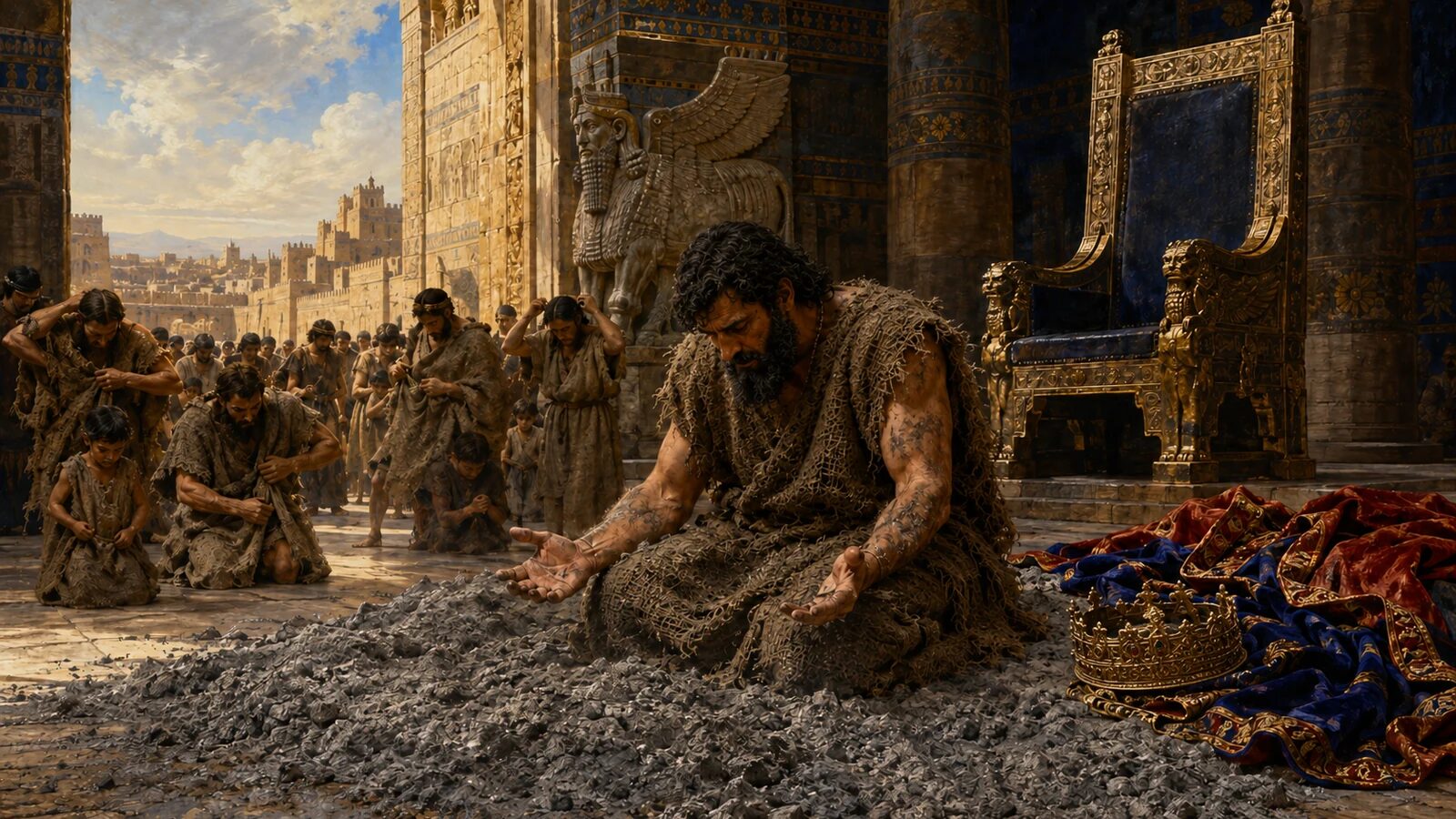
Nineveh gives another strong example. When Jonah announced judgment, the people believed God. They proclaimed a fast and put on sackcloth from the greatest person to the least. Even the king left his throne, covered himself with sackcloth, and sat in ashes. Pride clings to the throne, but humility is willing to step down from it.
So the people of Nineveh believed God, proclaimed a fast, and put on sackcloth, from the greatest to the least of them.
Jonah’s warning was direct: in forty days Nineveh would be overthrown. The king called the people to cry mightily to God and turn from their violence and evil. Jonah 3:10 tells us what God saw. He saw their works and that they had turned from their evil way. Their sackcloth and ashes expressed repentance rather than an empty display. Repentance is more than feeling bad. It is a changed mind and direction before God that shows itself by turning away from evil.
Job 42:6 also uses dust and ashes in the language of repentance. Job was not admitting the false charges made by his friends. The book is clear that his suffering was not punishment for hidden wickedness. Yet when God spoke, Job was humbled. He repented of speaking beyond his place and bowed before the Lord’s wisdom.
These passages help us separate repentance from regret. A person may be sorry that he was caught or embarrassed by the consequences of what he did, yet return to the same sin as soon as the pressure passes. Repentance agrees with God and turns toward Him. Emotion may accompany that turn, but emotion alone is not the turn.
Daniel also shows that confession does not need to wait until every other person admits his part. He stood before God and spoke truthfully about the sins of his people even though he had remained faithful in ways many others had not. His prayer did not make him responsible for deeds he had never committed. It showed that he cared about God’s honor and the condition of the people to whom he belonged.
Nineveh shows the other side of the same truth. The king’s words would have meant little if the violence continued unchanged. God saw that the people turned from their evil way. When repentance is genuine, its fruit eventually becomes visible in what a person stops doing and in the new direction he begins to take.
Crisis, Pleading, and Counterfeit Humility
Sometimes sackcloth and ashes appear when danger threatens an entire people. In Esther, Haman persuaded the Persian king to authorize the destruction of the Jews throughout the empire on an appointed day. The decree was sent across the provinces under royal authority. Mordecai tore his clothes, put on sackcloth and ashes, and went into the city with a loud and bitter cry. His grief was public because the danger itself was public.
When Mordecai learned all that had happened, he tore his clothes and put on sackcloth and ashes, and went out into the midst of the city. He cried out with a loud and bitter cry.
Mordecai was not staging emotion for applause. He was sounding an alarm. In that world, public mourning communicated urgency and told the truth about the weight of the moment. Time was short, and God’s people were in danger.
Hezekiah gives another example. Assyria had already captured Judah’s fortified cities, and the Assyrian spokesman stood near Jerusalem mocking Hezekiah’s trust and speaking against the LORD. When the king heard the report, he tore his clothes, covered himself with sackcloth, and went into the house of the LORD. He also sent leaders to the prophet Isaiah. He did not answer the threat with swagger. He sought God and His Word while admitting that Judah could not save itself.
And so it was, when King Hezekiah heard it, that he tore his clothes, covered himself with sackcloth, and went into the house of the LORD.
There is a place for corporate humility. 2 Chronicles 7:14 called God’s people to humble themselves, pray, seek His face, and turn away from wickedness. That promise was given to Israel within a covenant setting. Christians should not pull it out of that setting and turn it into a guarantee of particular political results. Even so, it plainly reveals that God calls His people to seek Him humbly and turn from evil.
Public need can rightly lead to public prayer. A church facing danger or recognizing serious sin does not have to pretend that everything is normal. Leaders may call people to fast and seek the Lord together. The value is not in creating an impressive event. Corporate humility is truthful when the people actually depend on God, listen to His Word, and turn from the evil He exposes.
Because sackcloth and ashes were recognized signs, they could also be faked. Isaiah 58 gives one of the Bible’s sharpest rebukes of empty religious display. The people complained that God had not noticed their fasting, but the LORD exposed what their religious day concealed. They pursued their own pleasure and exploited their workers. Their quarrels even ended in violence. They bowed their heads and spread sackcloth and ashes beneath themselves while refusing to change.
Is it a fast that I have chosen, A day for a man to afflict his soul? Is it to bow down his head like a bulrush, And to spread out sackcloth and ashes?
The problem was not the sackcloth, but the difference between the humility they displayed and the way they treated people. An outward sign that claims humility while the heart clings to sin is a lie acted out with religious objects. God wants truth in the inward parts.
Joel 2 gives the positive call. God told His people to return to Him with all their heart. Fasting could accompany genuine weeping and mourning, but He said, “Rend your heart, and not your garments.” Tearing fabric is easy. The real issue is a broken heart that returns to God.
So rend your heart, and not your garments; Return to the LORD your God, For He is gracious and merciful.
That call rests on God’s character. Repentance is not despair. It is a return to the gracious and merciful God, who is slow to anger and abundant in kindness. People do not come because they can repair their own lives. They come because God receives those who humble themselves and turn.
How Jesus Used Sackcloth and Ashes
Jesus treated sackcloth and ashes as a known picture of repentance. Chorazin and Bethsaida were Galilean towns near the center of His public ministry, so their people had received remarkable light through His teaching and mighty works. Tyre and Sidon were Gentile cities remembered by the prophets for pride and judgment. Jesus said those pagan cities would have repented long ago in sackcloth and ashes if they had seen what Chorazin and Bethsaida saw. He was not commanding a costume. He was exposing stubborn hearts that refused greater light.
Woe to you, Chorazin! Woe to you, Bethsaida! For if the mighty works which were done in you had been done in Tyre and Sidon, they would have repented long ago in sackcloth and ashes.
Greater light brings greater responsibility. When people receive a clearer witness to Jesus Christ and still refuse Him, that refusal is not small. Judgment is real, and each person is accountable for what he does with the light God gives.
Jesus also warned against using the signs of fasting to gain attention. People can make sorrow look holy while seeking human praise. If being seen is the goal, Jesus says that being seen is their reward. The Father sees what is done in secret and knows what the heart is seeking.
Moreover, when you fast, do not be like the hypocrites, with a sad countenance.
This warning reaches beyond fasting. Tears may be displayed for effect, and even a public confession can be shaped to impress people. A deliberately simple appearance can serve the same purpose. The issue is not merely whether others can see the response. When sin is public, repentance and reconciliation may also need to be visible. The real question is whether the heart is seeking God or an audience.
That question is especially important for anyone who leads others. A dramatic display is not proof of spiritual health, and polished words are not the same as repentance. We should look for honest agreement with the truth and a real turn from sin. Restitution may follow where someone was harmed, while continued obedience reveals the direction over time. God sees the heart more clearly than we do, but genuine repentance does not remain forever without fruit.
What Christians Should Do Today
The New Testament never commands Christians to wear sackcloth or sit in ashes. It does command the inward realities those signs were meant to express. Believers must humble themselves under God’s mighty hand and confess their sins. A true confession turns away from evil. When the sin has harmed another person, humility also seeks reconciliation. Prayer and fasting still have a place in Christian life. When the burden is grief rather than guilt, we carry it with the hope Christ gives.
When a believer sins, hiding is not the answer. He must confess what he has done and agree with God’s judgment of the act. That requires him to stop defending his conduct or trying to make it seem smaller. He calls the sin what God calls it and brings it into the light before the Lord.
If we confess our sins, He is faithful and just to forgive us our sins and to cleanse us from all unrighteousness.
1 John was written to believers so they might walk in fellowship with God and one another. Confession does not earn forgiveness as a work, because salvation is by grace through faith in Jesus Christ alone. For a believer, confession restores interrupted fellowship; it is not a way to keep himself saved. God is faithful and just because Christ shed His blood, died for our sins, and rose bodily.
Paul makes another needed distinction in 2 Corinthians 7. He had sent the church a severe corrective letter that caused grief. The Corinthians responded with earnestness and a changed direction rather than merely resenting the correction. Paul therefore separates godly sorrow from worldly sorrow. Not every form of regret is repentance.
For godly sorrow produces repentance leading to salvation, not to be regretted; but the sorrow of the world produces death.
Some people are sorry only for the consequences of what they did. Others feel embarrassed because their conduct has been exposed, but soon return to the same sin. Godly sorrow produces repentance by leading toward a real change of direction. It is not self-hatred or an effort to punish oneself.
Self-punishment can look humble while quietly refusing grace. A person may believe he needs to remain miserable long enough to prove that he is sincere. Scripture directs him somewhere better. He should confess the sin, receive the forgiveness God gives in Christ, and then walk in the obedience that repentance requires. Lingering consequences may still have to be faced, but suffering those consequences does not purchase cleansing.
When we have harmed someone, humility may require more than private words to God. Jesus said that a person should seek reconciliation when a brother has something against him. Taking the low place begins by telling the truth and asking forgiveness. Restitution may be right when it is possible. After that, we do the next right thing without demanding that our reputation or the other person’s trust be restored immediately.
Sackcloth could express need, but it could never cleanse sin. A rough garment made no atonement, ashes could not clean a soul, and fasting could not purchase forgiveness. Every outward sign pointed beyond itself to our need for God’s mercy.
That mercy is fulfilled in Jesus Christ. He did not come merely to admire humble people. He came to save sinners. Jesus physically bore the punishment for our sins in His innocent body. Wicked men truly tortured Him, shed His blood, and killed Him. The Father did not punish or curse His Son. He did not abandon Jesus or pour wrath on Him. Jesus died for the whole world and rose bodily from the dead. His blood cleanses; sackcloth does not.
This keeps repentance from becoming despair. We do not humble ourselves before a reluctant God who enjoys crushing the lowly. We come to the God who gave His Son. We confess because mercy is available, and we turn because the Lord is worthy. At the same time, the cross keeps us from treating grace as cheap. It shows the terrible punishment Christ willingly endured in His innocent body to save sinners.
The offer is genuine for everyone, though people can resist and reject Christ. Whoever truly repents and believes is born again, indwelt and sealed by the Holy Spirit, and eternally secure. In repentance, we humble ourselves before God in response to the holy grace He has given through Christ.
If you are guilty, do not hide behind the strength of your emotion. Name the sin plainly and stop defending it. Ask God’s forgiveness, then make things right with other people wherever you can. If you are grieving instead, do not let someone tell you that tears alone prove unbelief. Bring your sorrow honestly to God and ask Him for grace when you feel too weak even to know what to pray.
My Final Thoughts
After comparing these passages, I do not believe Christians are being called to recover a particular garment or ritual. Sackcloth and ashes could honestly express grief, repentance, or desperate need, but God always looked at the heart. If you are grieving, bring that sorrow before Him without accepting false guilt. If you have sinned, stop defending it, turn toward God, and seek reconciliation where you caused harm. Do not make humility into a performance; come to Christ, because no outward sign can cleanse the soul, but His blood truly does.