
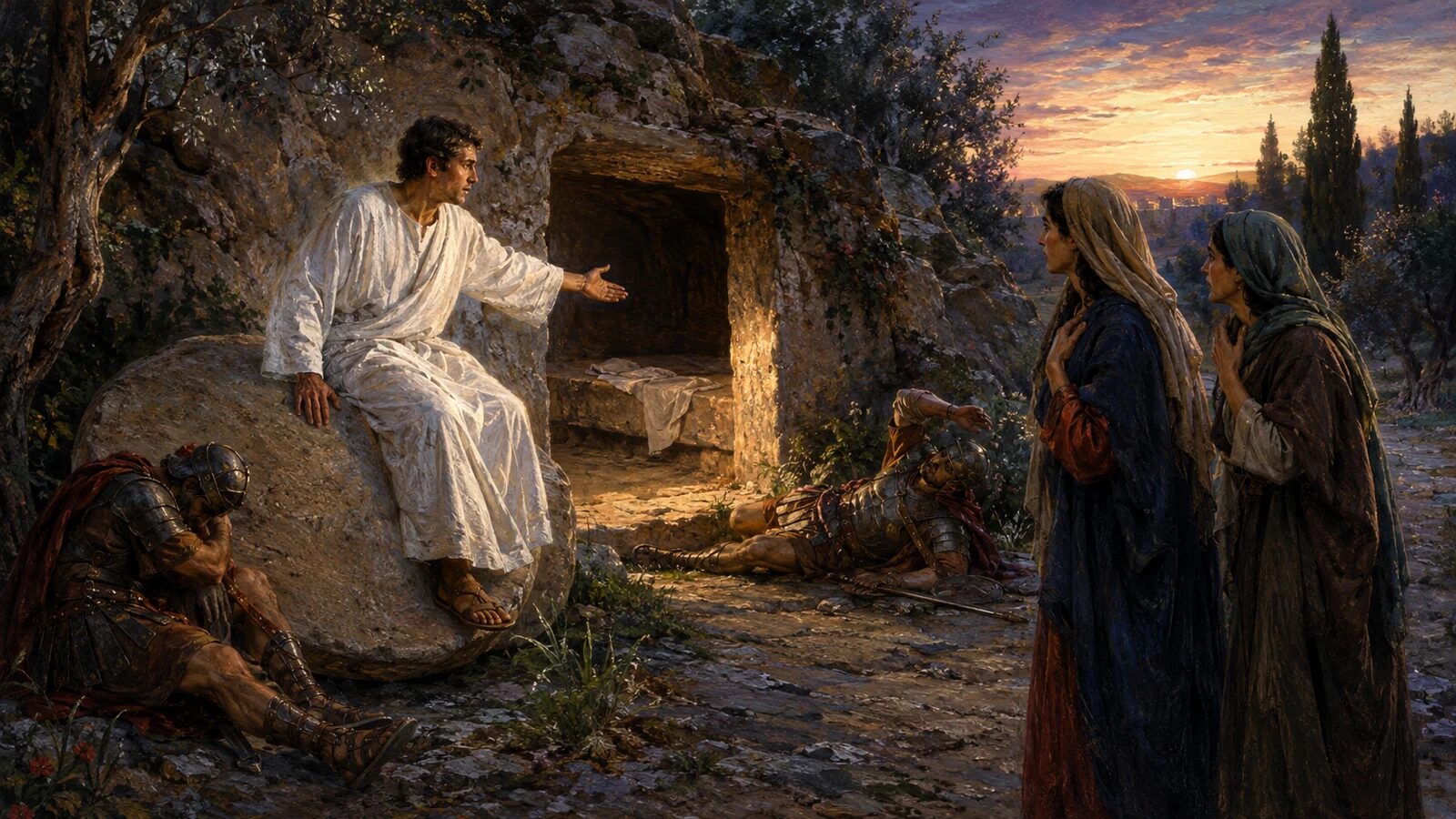
Angels appear throughout Scripture, yet there is much about them that God has not told us. I want to understand who these beings are and the work He gives them, including what the Bible says about those who rebelled. We can take the unseen world seriously without filling in its unknown details, and what we do learn should draw our attention toward Christ.
What Angels Are and Whom They Serve
Psalm 103 describes angels as mighty servants who listen to God’s voice and carry out His word. Their strength is exercised under His command, so we should understand their greatness through their obedience rather than independence.
Bless the LORD, you His angels, Who excel in strength, who do His word, Heeding the voice of His word.
The psalm places angels under the Lord’s authority. They cannot improve on His plan or compete with Him, and they do not ask us to honor them as lesser gods. Their strength belongs in the service of the King whose command they obey.
Colossians 1 also helps us understand where angels came from. Christ created everything in heaven and on earth, including every power in the invisible realm as well as the visible creation. Whatever ranks exist among those beings, none shares God’s eternal existence. The Son made them, and they exist for Him.
For by Him all things were created that are in heaven and that are on earth, visible and invisible, whether thrones or dominions or principalities or powers. All things were created through Him and for Him.
The English word angel is tied to words that mean “messenger.” The Old Testament uses the Hebrew word malak, while the New Testament uses the Greek word angelos. Either word can describe someone sent with a task, so the context must tell us whether the messenger is human or heavenly. The words emphasize an assignment rather than independent authority.
Understanding those words helps us read the passages accurately, but the context still has to identify the messenger. Since the terms also describe human messengers, the word alone does not identify a heavenly being. At the same time, we should not explain away a supernatural messenger from God’s presence as merely an ordinary person.
That distinction is especially important when we read about the Angel of the LORD. In certain Old Testament passages, this particular figure speaks as God, bears God’s name, and receives the reverence that belongs to Him. I understand this distinctive figure as a Christophany, which is an appearance of the Son before He became human. This does not mean every angel in the Bible is Christ. Ordinary angels are created servants, and each passage must be read according to its own details. The related appearances are treated more fully in the study of Christophanies in the Old Testament.
Paul begins Hebrews by showing why the Son stands above every angel. God has spoken through the Son, who is the heir of all things and the One through whom He made the worlds. The Son continues to uphold creation by His powerful word, while the angels who serve God worship Him.
having become so much better than the angels, as He has by inheritance obtained a more excellent name than they.
I cannot study angels as though Christ were simply the greatest member of their ranks. He is not Michael or any other created heavenly being, and He did not become divine through promotion. He is the eternal Son, fully God and Creator of the angels who worship Him. Scripture places Him above every rank in heaven and on earth, so fascination with His servants must not turn our attention away from Him.
At the end of Hebrews 1, Paul calls angels ministering spirits sent to serve those who will inherit salvation. The comfort I take from that is God’s care for His people, even when we cannot see how He is providing it. He commands His servants; the passage does not put them under our command.
Are they not all ministering spirits sent forth to minister for those who will inherit salvation?
What Angels Are Not
Humans and angels are distinct creatures, so death does not turn a person into an angel. Our hope as believers is bodily resurrection life with Christ, not becoming a different kind of being.
Jesus became man to save human beings rather than taking an angelic nature. In His innocent body, He physically bore the punishment for the sins of the whole world and shed His blood. The Father did not punish, curse, abandon, strike, bruise, or pour wrath on Jesus. Wicked men crucified Him within God’s foreknown saving purpose. He died and rose bodily from the dead. Our hope is bound to Him, not to becoming angelic.
Scripture identifies the Man Christ Jesus as the one Mediator between God and humanity. Angels do not share that role, and we are never told to pray to them or seek their guidance as a spiritual shortcut. When John fell before an angel in Revelation, the angel immediately refused his worship.
Then he said to me, "See that you do not do that. For I am your fellow servant, and of your brethren the prophets, and of those who keep the words of this book. Worship God."
The angel directed John to worship God, and faithful angels will never accept worship that belongs to the Lord. That gives us a clear basis for testing a claimed encounter, dream, or vision. If it contradicts Scripture or draws us away from Christ, we should reject it. God will not use an angelic message to contradict His written word.
Reverent language alone would not persuade me to accept someone’s teaching about angels or supernatural signs. I need to know whether it honors Christ and agrees with Scripture. This is especially necessary when private spiritual experiences are highly prized. The Holy Spirit glorifies the Son and grounds believers in God’s written truth; He does not lead us into a religion centered on angels.
The Heavenly Beings Scripture Names
Scripture names and describes several kinds of heavenly beings without giving us a complete chart of the unseen realm. I’m grateful that we have enough to worship God, recognize error, and take spiritual reality seriously without needing to satisfy every curiosity. We should let what He has revealed set the limits of the study.
We also need to keep the different descriptions distinct. Angels appearing to people are often described in human form, with no routine mention of wings. Cherubim and seraphim, however, are throne and sanctuary beings whose descriptions do include wings. Picturing every angel as a winged human combines those passages into a description Scripture never gives as universal.
Jude explicitly calls Michael the archangel, while Daniel describes his involvement in conflict concerning nations and God’s people. Yet when Michael disputed with the devil, he appealed to the Lord instead of acting as the highest authority himself. His restraint helps me keep his power in perspective.
Yet Michael the archangel, in contending with the devil, when he disputed about the body of Moses, dared not bring against him a reviling accusation, but said, "The Lord rebuke you!"
Scripture says Gabriel stands in God’s presence. In Daniel and Luke, he served as God’s messenger by explaining what God was doing and announcing significant births. Knowing his name does not mean we are invited to seek him. His ministry directs us to the God who sends him and fulfills His promises.
After Adam and Eve sinned, cherubim guarded the way to the tree of life in Genesis. They later appear in connection with the mercy seat and Ezekiel’s visions of God’s throne-glory. Their presence reminds me that we cannot approach what is holy on our own terms. They guard at God’s command, and His presence remains majestic.
So He drove out the man; and He placed cherubim at the east of the garden of Eden, and a flaming sword which turned every way, to guard the way to the tree of life.
Isaiah 6 names the seraphim, who covered their faces and feet as they flew before the Lord and cried, “Holy, holy, holy.” These sinless servants responded to God’s holiness with reverence. Although a seraph took part in Isaiah’s cleansing, the mercy came from God. The Lord cleansed Isaiah and sent him to speak.
And one cried to another and said: "Holy, holy, holy is the LORD of hosts; The whole earth is full of His glory!"
The living creatures around the throne in Revelation are described in language that echoes Ezekiel. They may be cherubim seen in another setting, or they may belong to a distinct heavenly order. I would leave that question open because Scripture does not settle it. What it does show is worship centered on God’s throne, marked by His holiness and reign rather than casual familiarity or attention to man.
Angelic Ministry and Rebellion
Throughout Scripture, God sent angels with messages at crucial moments. Sometimes they appeared in a visible form people could recognize. Those appearances often frightened the people who saw them, so the message frequently began by telling them not to fear. The unseen world had suddenly become visible, bringing an awareness that God was at work.
Hebrews 13 connects the possibility of angelic visitation with ordinary hospitality. I don’t read it as an invitation to search for angels. It calls us to obey even when we do not know everything God may be doing through our welcome to a stranger.
Do not forget to entertain strangers, for by so doing some have unwittingly entertained angels.
Jesus says there is joy in the presence of God’s angels over one sinner who repents. Their rejoicing agrees with God’s mercy and shows that salvation through Christ is celebrated in the unseen realm. The angels share that joy without becoming the center of the salvation they celebrate.
Passages about angelic protection show that God knows how to use His servants for His people’s good. They do not give each believer a named guardian angel to identify or command. I can take comfort in God’s rule without claiming the ability to manage how His angels serve.
We can be safe in God’s hand without seeing everything He is doing. His care does not depend on whether we recognize an angel’s presence or know its name. We pray to Him and trust Him to decide how His servants will carry out His will.
Some angels rebelled, and their evil is real. Satan and the fallen angels are dangerous because of their deception and malice, but they remain creatures rather than sovereign powers. Evil is not eternal, nor can it equal God or escape His final judgment.
Isaiah 14 and Ezekiel 28 address earthly rulers in their immediate settings, yet some of their language reaches beyond an ordinary human king. Both connect exalted glory with pride and eventual downfall, contributing to Scripture’s account of rebellion in the unseen realm. I would not pretend every detail is simple, but neither would I set aside the larger biblical pattern these passages help us see.
You were perfect in your ways from the day you were created, Till iniquity was found in you.
The reference to a created being helps me understand that evil has not always existed. God did not make an equal rival; a creature turned from righteousness to pride and rebellion. Revelation identifies the serpent in the final conflict as the devil and Satan, also calling him the dragon. Another study follows the biblical details concerning Apollyon and the Destroyer Angel.
So the great dragon was cast out, that serpent of old, called the Devil and Satan, who deceives the whole world; he was cast to the earth, and his angels were cast out with him.
Readers have understood the brief account in Genesis 6:1-4 in different ways. Job uses sons of God for heavenly beings, and Jude describes angels leaving their proper domain. Those connections explain why many understand Genesis 6 to describe angelic rebellion crossing a forbidden boundary. The passage does not answer every question, but it clearly describes rebellion spreading and deepening the world’s corruption, followed by God’s judgment.
And the angels who did not keep their proper domain, but left their own abode, He has reserved in everlasting chains under darkness for the judgment of the great day;
Spiritual Conflict and Christ’s Return
Daniel 10 describes a conflict that Daniel himself could not see. He had been mourning and fasting for three weeks when a glorious messenger came in response to his prayer. The messenger said the prince of the kingdom of Persia had resisted him for those twenty-one days until Michael came to help. Since Michael is a heavenly prince and that resistance exceeds ordinary human action, I understand the Persian prince here as a supernatural power associated with the earthly kingdom.
We are told enough to recognize that spiritual conflict is real, but not enough to map its whole military structure. Daniel’s experience also gives me reason to keep praying when an answer seems delayed. Not seeing what is happening does not mean prayer is pointless or that God’s purposes have failed.
But the prince of the kingdom of Persia withstood me twenty-one days; and behold, Michael, one of the chief princes, came to help me, for I had been left alone there with the kings of Persia.
Scripture calls us to be sober and watchful, grounded in truth rather than panicked over fallen angels. We resist the devil by standing firmly in the faith and putting on the whole armor of God, and we test every spiritual claim by Scripture. Satan is neither present everywhere nor able to know everything, and his power is limited. He is a defeated creature awaiting final judgment, never an evil counterpart to God.
We should take spiritual conflict seriously without attributing every problem to demons. Blaming demons for everything can keep us from facing our own sin or foolish choices, and ordinary suffering does not by itself prove demonic activity. Ignoring the devil altogether leaves us naive about temptation and false teaching. Keeping Christ at the center means obeying His word and praying with confidence while refusing to let fear govern us.
Personal accounts cannot establish doctrine either. A vivid dream or frightening experience may feel convincing, as may a claim that an angel delivered a message. None gives us authority to fill in what God has not disclosed. We must test such claims by His written word and be willing to leave an unidentified being or unexplained event unresolved when Scripture leaves it that way.
In the passages about Christ’s return and the final defeat of evil, angels accompany Him and serve His purposes. Jesus says the Son of Man will come in glory with all the holy angels, gather His people, and exercise judgment under His own authority. Paul likewise describes the Lord Jesus revealed from heaven with His mighty angels, taking vengeance on those who do not know God and refuse to obey the gospel.
When the Son of Man comes in His glory, and all the holy angels with Him, then He will sit on the throne of His glory.
The angels come with Christ and remain under His command in any gathering or judgment they carry out. Our final hope therefore reaches beyond angelic rescue to Jesus Himself. We await His bodily return and the resurrection He promised, together with His kingdom and God’s everlasting victory over evil.
Paul even tells believers that they will judge angels in 1 Corinthians 6, where he is rebuking the church for mishandling its disputes. He leaves many details unexplained, but the promise helps me see how high a place believers have in Christ. Angels are glorious servants, while redeemed people are united to Him as heirs who will share in resurrection glory.
That promised future helps me see why we do not need an angelic encounter to confirm that God has received us. The gospel calls us to repent and believe in Jesus Christ. Although people may resist His genuine offer, everyone who receives Him by faith is born again. Angels rejoice in that salvation as servants of the Savior who accomplished it.
My Final Thoughts
What Scripture tells us about angels gives me reason to trust God’s care even when I cannot see it. His faithful servants obey Him and refuse worship, while fallen angels remain defeated creatures under judgment. We can take spiritual conflict seriously without becoming fearful or obsessed, while trusting God’s care instead of trying to command His servants. Angels rejoice when sinners repent, but Christ alone saves. Those who receive Him by faith are born again and sealed by the Holy Spirit, with salvation that is eternally secure. Studying angels with reverence and restraint should lead us to worship their Creator.