
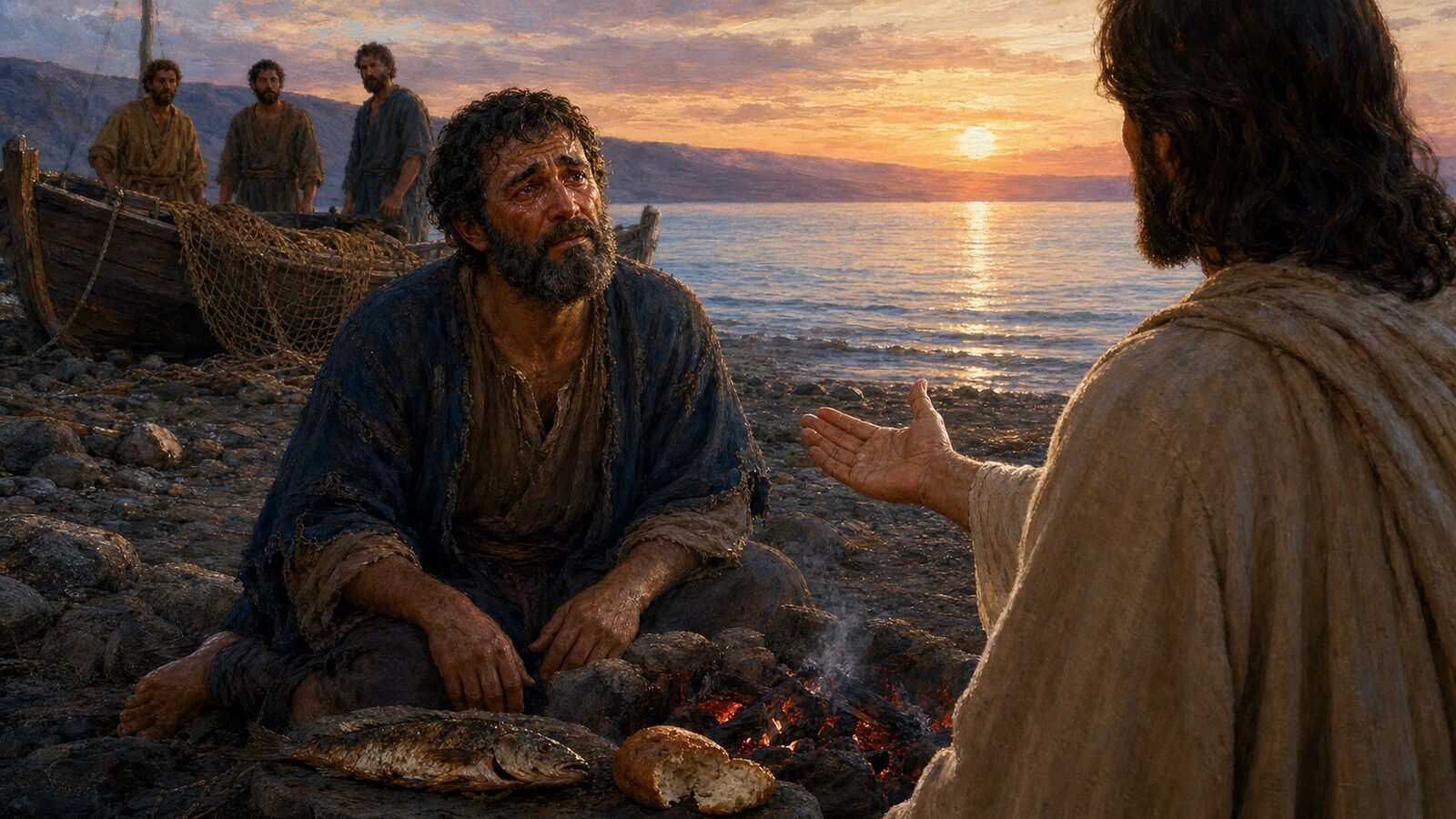
Before Jesus was arrested, Peter insisted that he was ready to go to prison and die with Him. When that loyalty was tested, he denied knowing Him three times. I find hope in the way Jesus dealt with Peter, because He took that failure seriously and still entrusted the repentant man with work to do. Peter would become a courageous apostle, but he had to learn how unreliable his own promises could be.
Called and Changed by Christ
Simon, the son of Jonah, was a fisherman from Bethsaida in Galilee who later worked around Capernaum with his brother Andrew and with James and John. Andrew had heard John the Baptist identify Jesus as the Lamb of God and brought his brother to meet Him. Jesus addressed Simon by name and told him what he would be called:
And he brought him to Jesus. Now when Jesus looked at him, He said, “You are Simon the son of Jonah. You shall be called Cephas” (which is translated, A Stone).
Cephas is an Aramaic name referring to a stone or rock, and Petros is its Greek counterpart. I understand the name as pointing ahead to the steady servant Jesus intended to make of Simon. It certainly wasn’t a description of unwavering courage he already possessed. The Gospels repeatedly show him speaking confidently and then discovering how much he still needed to learn.
Peter was also a married man with a home in Capernaum. Jesus visited that home and healed his mother-in-law. Luke records the healing in chapter 4, before the miraculous catch in chapter 5, and Matthew describes it this way:
Now when Jesus had come into Peter’s house, He saw his wife’s mother lying sick with a fever. So He touched her hand, and the fever left her. And she arose and served them.
By the time Peter left his nets in Luke 5, he had already met Jesus and seen His power in his own home. John’s account of Andrew introducing him and Luke’s account of the catch describe different stages in that relationship. We don’t need to treat them as conflicting versions of a single event.
After the catch, Peter fell at Jesus’ knees and said, “Depart from me, for I am a sinful man, O Lord!” (Luke 5:8). Jesus answered, “Do not be afraid. From now on you will catch men” (Luke 5:10). Peter’s sin was real, but it didn’t put him beyond the mercy of the Lord who was calling him. Jesus would forgive him and teach him to obey as he followed, rather than waiting for him to become a flawless disciple first. Leaving the nets was a response to that call, not a judgment that fishing was somehow an ungodly occupation.
When Jesus walked on the water, Peter asked to come to Him and began walking toward Him. Then he saw the wind and became afraid.
But when he saw that the wind was boisterous, he was afraid; and beginning to sink he cried out, saying, “Lord, save me!” And immediately Jesus stretched out His hand and caught him, and said to him, “O you of little faith, why did you doubt?”
Jesus didn’t wait for Peter to recover his composure before helping him. He caught him immediately, then reprimanded him for doubting. Peter had taken a remarkable step of faith, but that didn’t mean he was incapable of becoming frightened. He still needed the Lord’s help and correction.
Peter, the Rock, and Christ the Builder
In Matthew 16, Jesus asked the disciples who they believed He was. Peter answered with a confession at the heart of Christian faith:
Simon Peter answered and said, “You are the Christ, the Son of the living God.” Jesus answered and said to him, “Blessed are you, Simon Bar-Jonah, for flesh and blood has not revealed this to you, but My Father who is in heaven. And I also say to you that you are Peter, and on this rock I will build My church, and the gates of Hades shall not prevail against it.”
Jesus credited the Father with revealing the truth Peter confessed. Peter had received that truth, and the authority Jesus gave him would serve it. The related Greek words Petros and petra make the wordplay between Peter and rock real. Peter had a foundational role as an apostolic witness to the Christ he confessed. We shouldn’t explain that role out of the passage, but neither should we overlook who owns and builds the church. Jesus said, “I will build My church.”
We need to read Peter’s role alongside the rest of the New Testament. Paul writes, “For no other foundation can anyone lay than that which is laid, which is Jesus Christ” (1 Corinthians 3:11). Peter’s own letter later describes Christ as the living stone and believers as stones being built together:
Coming to Him as to a living stone, rejected indeed by men, but chosen by God and precious, you also, as living stones, are being built up a spiritual house.
Jesus’ promise in Matthew 16 also addresses the gates of Hades, referring to the power of death and the realm of the dead. He was going to face death Himself and rise bodily from the grave, so His promise rests on His own victory. Peter would announce that victory as a witness to the risen Lord. Christ remains the ultimate foundation of the church He builds.
Jesus also gave him real authority in the keys of the kingdom. I understand that authority through Peter’s work as an apostolic witness, not as establishing a papal office passed down to successors. We will see him carrying out that work in Acts, where the gospel reaches Jews, Samaritans, and Gentiles.
Peter still had much to learn about the Christ he had just confessed. In Matthew 16:21-23, Jesus began explaining that He would suffer, be killed, and rise on the third day. Peter took Him aside and rebuked Him. Jesus answered, “Get behind Me, Satan!” Peter was opposing the very suffering through which the Savior would accomplish His work. His confession was true, but his understanding of the Messiah’s mission needed correction.
At the transfiguration in Matthew 17, Peter saw Jesus in glory with Moses and Elijah and suggested building three tabernacles. The Father directed their attention to the Son: “This is My beloved Son, in whom I am well pleased. Hear Him!” (Matthew 17:5). Moses and Elijah were His servants and witnesses, not His equals. Peter needed to listen to the One he had confessed, including what He said about His coming death. The study on the Shekinah glory examines that revelation of Christ’s majesty.
Denial, Intercession, and Restoration
As the cross approached, Jesus warned that Satan had asked to sift Peter like wheat. He also told Peter that He had already prayed for him:
But I have prayed for you, that your faith should not fail; and when you have returned to Me, strengthen your brethren.
Christ’s intercession—His prayer on Peter’s behalf—gave Peter a security his own courage couldn’t provide. Jesus knew what was coming and said, “When you have returned.” He was already speaking about Peter’s restoration and his responsibility to strengthen the other disciples. Peter would have to face what he had done and return to the Lord; the promise didn’t give him permission to treat disloyalty casually.
Peter was certain he would stand by Jesus even if it meant prison or death. Later, under questioning, he denied knowing Him three times. When he realized what he had done, he went out and wept bitterly. He had meant his earlier pledge, but sincerity hadn’t shown him how vulnerable he was to fear. Peter needed the mercy of the Lord who had prayed for him, and he needed to stop trusting his own assurances.
After His bodily resurrection, Jesus met Peter by the sea and asked him three times whether he loved Him. The three questions recall Peter’s three denials, while the commands that followed entrusted him with service again.
He said to him the third time, “Simon, son of Jonah, do you love Me?” Peter was grieved because He said to him the third time, “Do you love Me?” And he said to Him, “Lord, You know all things; You know that I love You.” Jesus said to him, “Feed My sheep.”
John uses two Greek verbs for love in this conversation. Jesus initially used agapao in His questions, and Peter answered with phileo. On the third question, Jesus used Peter’s word. John uses agapao for the Father’s love for the Son in John 3:35 and phileo for that same relationship in John 5:20. Since either verb can describe the Father’s love, we can’t simply label one divine love and the other inferior affection. Here, John tells us Peter was grieved because Jesus asked him a third time.
Peter answered by appealing to what Jesus knew about him, with no claim that he loved Him more than the other disciples did. Jesus told him to care for “My sheep.” Peter was being entrusted with people who belonged to Christ, and feeding and tending them would require more than another declaration of loyalty. He would have to care for them faithfully as a servant of the Lord who owned the flock.
Jesus also spoke about Peter’s old age, when another would carry him where he did not want to go. John explains that this indicated the death by which Peter would glorify God. Following Jesus would eventually cost Peter his life, so restoration was no guarantee of a comfortable future. He would need to keep following the Lord as that future unfolded. The command Jesus gave him was “Follow Me.”
Apostolic Courage That Still Needed Correction
At Pentecost, the Holy Spirit filled the disciples and enabled them to declare God’s works in languages understood by the gathered pilgrims. Peter explained the event from Scripture and publicly preached the Jesus he had denied. About three thousand received the word and were baptized. He could speak with this boldness because he knew the risen Lord and was ministering in the Spirit’s power. Becoming a more forceful version of his former self would never have equipped him for that work.
Peter declared that Jesus had been delivered according to God’s determined purpose and foreknowledge, crucified by lawless men, and raised because death could not hold Him. God’s saving purpose didn’t excuse the wickedness of those who killed Jesus. Peter held them responsible while announcing that God had raised the One they had crucified. The bodily resurrection was central to the message he preached.
In Acts 3, Peter healed a man who had been unable to walk from birth. The man stood and walked in the name of Jesus, and the crowd’s amazement gave Peter an opportunity to speak. Peter and John were arrested while teaching the people. Before the rulers, Peter identified Jesus as the rejected stone who had become the chief cornerstone and declared that salvation could be found in no other name (Acts 4:1-12). An arrest hadn’t persuaded him to conceal whom he served.
His responsibility also included confronting sin among believers. In Acts 5:1-11, Ananias and Sapphira misrepresented the money from a property sale. Peter exposed their deception, explaining that they had lied to God. He wasn’t free to overlook dishonesty simply because it came with a donation.
As the gospel reached beyond Jerusalem, Peter and John went to Samaria, where people had already received the word through Philip’s preaching. Peter wasn’t the first person to preach to them. He and John came as apostles to minister among these new believers, and God brought Samaritans into the fellowship alongside Jews.
God later sent Peter to Cornelius, a Gentile. At his house, Peter explained what the Lord had taught him about receiving people from other nations:
Then Peter opened his mouth and said: “In truth I perceive that God shows no partiality. But in every nation whoever fears Him and works righteousness is accepted by Him.”
These words don’t mean moral effort purchases salvation. In the same sermon, Peter promises forgiveness through Jesus’ name to everyone who believes in Him (Acts 10:43). While he was still speaking, the Holy Spirit came upon the Gentile hearers. Peter then commanded them to be baptized. They needed the gospel, and God received them through faith without requiring them to become Jewish converts first.
I understand Peter’s use of the keys through these occasions when Jews, Samaritans, and Gentiles were brought into the same fellowship. He proclaimed the crucified and risen Lord and called people to repentance and faith. His apostolic authority served the gospel Christ had commanded him to preach; he couldn’t create a different way of salvation or make the church his own possession.
That ministry still exposed him to danger. Herod imprisoned Peter after having James killed, but the Lord sent an angel to bring Peter out of custody (Acts 12:1-11). I cannot turn Peter’s deliverance into a promise that every faithful believer will escape death. James had already been killed, and Jesus had told Peter that he too would eventually die for following Him.
Peter had learned that God received Gentiles through faith in Christ, but he didn’t always act consistently with what he knew. Galatians 2 records that he had been eating with Gentile believers in Antioch, then withdrew in fear when certain men came from James. Other believers followed his example. Paul confronted him because that conduct contradicted the gospel they both preached.
But when Peter had come to Antioch, I withstood him to his face, because he was to be blamed.
Paul wasn’t denying Peter’s apostleship. He was holding him accountable to the truth that justification—being declared righteous before God—comes through faith in Christ rather than works of the Law. Peter’s withdrawal treated Gentile believers as though they did not enjoy the same standing. I think a pastor needs to be just as willing to receive correction. If even an apostle could be reprimanded for conduct that contradicted the gospel, holding an office today doesn’t give a man the right to silence someone who confronts his sin from Scripture.
A Shepherd Under the Chief Shepherd
Peter wrote his first letter to believers scattered through the provinces of Asia Minor. They were suffering as outsiders because they belonged to Christ, and he directed them to the living hope secured by Jesus’ resurrection. When he instructed their leaders, he called himself a fellow elder:
Shepherd the flock of God which is among you, serving as overseers, not by compulsion but willingly, not for dishonest gain but eagerly; nor as being lords over those entrusted to you, but being examples to the flock; and when the Chief Shepherd appears, you will receive the crown of glory that does not fade away.
Peter was passing on the responsibility Jesus had given him in John 21. The flock belongs to God, and its leaders answer to the Chief Shepherd for how they treat His people. They should teach the truth and provide an example others can follow. A leader who enriches himself at the congregation’s expense or intimidates people into serving his ambitions is abusing the work Christ entrusted to him.
Peter had once rebuked Jesus for saying He must suffer. Years later, he told believers not to be surprised by fiery trials and pointed them to the God of all grace to establish and strengthen them. He had learned that following Christ could bring hardship. He could encourage these believers to endure because their risen Savior would keep them, even when he couldn’t promise a quick end to their suffering.
That hope rests on what Jesus accomplished for sinners. He is the eternal Son, fully God and fully man, and entirely sinless. Wicked men tortured and crucified Him, and He willingly endured that bodily punishment for the sins of the whole world while shedding His innocent blood. The Father did not punish, curse, abandon, strike, bruise, or pour wrath on Jesus. In God’s foreknown saving purpose, Christ completed His saving work through His blood and death. He was buried and rose bodily from the grave.
God genuinely offers that salvation to everyone. Those who repent and believe are born again, indwelt and sealed by the Holy Spirit, and eternally secure in Christ. If I call myself a Christian while defending a life of deliberate disobedience, that label is no proof that I have been born again. Christ’s keeping power gives a believer reason to confess sin and receive correction, rather than permission to refuse repentance.
I also need to remember Peter’s overconfidence when I am certain I would never give in under pressure. If I am neglecting prayer while reassuring myself that I would stand firm in a crisis, I am repeating Peter’s mistake of trusting his own resolve. His sincerity didn’t make him immune to fear. The study on testing and temptation looks more closely at the pressures that expose us and our responsibility to resist sin.
My Final Thoughts
Peter gives me reason to admit failure without making excuses for it or assuming the Lord has finished with me. Christ had given him real apostolic authority, but Peter still had to repent when he sinned and accept correction when he was wrong. He never became the owner of the church or a substitute for its Savior. He remained a servant of the Christ he had confessed, the Son of the living God. I need to follow that same Lord and be willing to receive His correction, including when I have been very sure of myself.