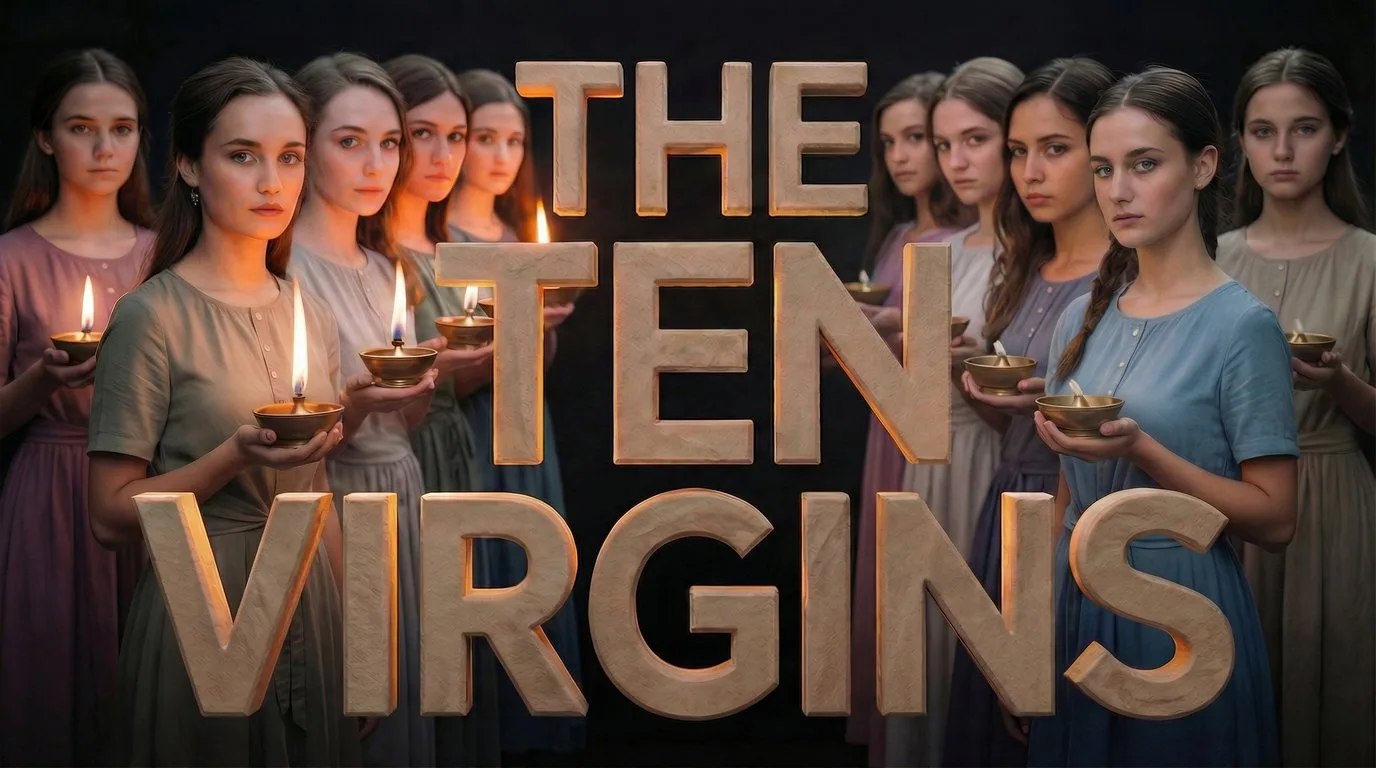
Jesus gives the parable of the ten virgins in Matthew 25:1-13 to warn people who are close to the things of God not to confuse closeness with readiness. It is not written to satisfy curiosity about timelines. It is written to press a simple question: when Christ comes, will your faith be real, or only a public association that looked right for a while?
The setting and scene
Matthew 25 does not drop out of the sky. It continues what Jesus has been teaching in Matthew 24 about His return, deception, delay, and the need to stay ready. Matthew 25 opens with a small connecting word: then. Jesus is tying this parable to what He just said about not knowing the day or hour, and about servants who live differently depending on whether they really think the master could show up at any time.
That connection keeps us from using the parable like a puzzle for end-times hobbyists. Jesus is not handing out a chart. He is calling for readiness that holds steady when time stretches longer than expected.
Watch therefore, for you do not know what hour your Lord is coming. But know this, that if the master of the house had known what hour the thief would come, he would have watched and not allowed his house to be broken into. Therefore you also be ready, for the Son of Man is coming at an hour you do not expect. (Matthew 24:42-44)
The picture Jesus uses is a wedding procession. Ten virgins, meaning unmarried young women, are part of the bridal party. They are not outsiders crashing the event. They are expected to be there, and they have a role in honoring the bridegroom as he arrives. That is where the warning bites. The danger is not only open unbelief outside the wedding. The danger Jesus highlights is religious nearness that still fails when the real moment arrives.
Wedding background
In first-century Jewish wedding practice, there was typically a betrothal period, and later the bridegroom would come to take the bride and bring her into the celebration. This often involved a nighttime procession. Friends and attendants would go out with lamps or torches, not just so they could see, but as part of the honor given to the bridegroom and the public joy of the event.
The timing could be uncertain. Delays were normal enough that everybody in the story expects waiting. That uncertainty is not a side detail. It is the pressure point of the parable. Jesus is teaching about a coming that is certain but not scheduled by human expectation.
So these ten virgins represent people connected to the waiting community. They look like they belong in the procession. They share the same basic direction. They go out to meet the bridegroom. On a first read, it is easy to assume that means they are all truly ready, because they are all in the same group. Jesus immediately shows that is not safe to assume.
Two kinds of readiness
Jesus divides them into five wise and five foolish. The surprising thing is how much they have in common. They all have lamps. They all go out. They all expect the bridegroom. They all get drowsy and sleep. If sleep were the main issue, all ten would fail. But Jesus does not treat them the same.
Here is something you could easily miss: the parable does not condemn the wise for sleeping. The dividing line is not that the wise never get tired. The dividing line is that the wise had oil when the moment came and the foolish did not. Jesus is aiming the warning deeper than outward activity and outward association.
Two people can sit in the same church, say the same things, and even get equally sleepy in a long season, and still not be in the same spiritual condition before God.
Lamps and oil
The center of the parable is the contrast between a lamp that can be carried and a lamp that can actually burn. A lamp without oil is still a lamp. It has the right shape. It can be held up in the hand. It may even look fine until the darkness presses in and time runs long. Jesus is dealing with that exact problem: the difference between a visible profession and inward life.
What the lamp shows
The lamp is what others can see. It is public identification with the wedding party. It is a profession. In biblical terms, it is the outward side of belonging: words, habits, church connections, the basic shape of a religious life.
Scripture warns often about the gap between the outward and the inward. Jesus warned that people could call Him Lord and still not belong to Him.
"Not everyone who says to Me, "Lord, Lord,' shall enter the kingdom of heaven, but he who does the will of My Father in heaven. Many will say to Me in that day, "Lord, Lord, have we not prophesied in Your name, cast out demons in Your name, and done many wonders in Your name?' And then I will declare to them, "I never knew you; depart from Me, you who practice lawlessness!' (Matthew 7:21-23)
Paul warned about having a form of godliness while denying its power.
having a form of godliness but denying its power. And from such people turn away! (2 Timothy 3:5)
Those warnings are not there to make true believers live in constant panic. They are there to keep people from resting their souls on externals that cannot save.
What the oil points to
The oil is the inward supply that makes the lamp burn when it counts. Over the years, some have tried to assign the oil to one specific Christian practice, like prayer, good works, Bible knowledge, or church service. Those things matter, but the parable is not describing a single discipline. It is describing an inner spiritual reality that cannot be faked at the last minute.
In the Bible, oil is often connected to being set apart for God and to the empowering work of God’s Spirit. In Zechariah’s lampstand vision, the supply is not human strength, but God’s Spirit.
So he answered and said to me: "This is the word of the LORD to Zerubbabel: "Not by might nor by power, but by My Spirit,' Says the LORD of hosts. (Zechariah 4:6)
In the New Testament, the Holy Spirit is given to believers to indwell them, seal them, and produce fruit in them over time.
In Him you also trusted, after you heard the word of truth, the gospel of your salvation; in whom also, having believed, you were sealed with the Holy Spirit of promise, who is the guarantee of our inheritance until the redemption of the purchased possession, to the praise of His glory. (Ephesians 1:13-14)
So without turning the parable into a one-word code, the oil most naturally points to the reality of Spirit-given life: real faith from the heart, not merely religious association.
The Greek verb translated meet in Matthew 25:1 is worth noticing. It is used for going out to welcome an arriving person and escort him in. It is the same kind of idea you see when people go out to receive a visiting king or honored guest. So the foolish are not pictured as people who hated the bridegroom. They wanted to be part of the welcome. But wanting to be part of the welcome is not the same thing as being ready to enter the feast.
The wise took oil in their vessels. The foolish did not. They are not described as having less oil. They are exposed as having none when it counts. They have lamps, but no reserve. They have a public connection, but not the inward supply that endures through delay and into the late hour.
Delay and exposure
Jesus says the bridegroom was delayed, and they all became drowsy and slept. The delay is the test in the parable. Many people can look ready in a short season. The harder test is ordinary time. Years can dull urgency. Routine can replace watchfulness. A person can coast on habit, on the strength of friends, on family tradition, or on the momentum of past religious experiences.
Jesus already warned about this kind of thinking in Matthew 24. A servant can tell himself the master is delaying and then use that delay as permission.
But if that evil servant says in his heart, "My master is delaying his coming,' and begins to beat his fellow servants, and to eat and drink with the drunkards, the master of that servant will come on a day when he is not looking for him and at an hour that he is not aware of, and will cut him in two and appoint him his portion with the hypocrites. There shall be weeping and gnashing of teeth. (Matthew 24:48-51)
Delay is not cancellation. Delay is not God forgetting. God is patient, and His patience is meant to lead people to repentance.
The Lord is not slack concerning His promise, as some count slackness, but is longsuffering toward us, not willing that any should perish but that all should come to repentance. (2 Peter 3:9)
But that same patience exposes what is real, because time has a way of pulling the mask off.
Then comes the sudden announcement at midnight. Midnight is the least convenient time. It underlines that the coming of Christ will not fit human schedules. The cry wakes everybody up. All ten get up. All ten start dealing with their lamps. The foolish are not portrayed as indifferent in that moment. They are portrayed as unprepared.
The foolish say their lamps are going out. That tells you their lamps had been lit. They had enough flame to participate for a while. They may have looked the same as the wise for much of the wait. But under the strain of delay and the sudden demand of the midnight moment, the lack becomes obvious. A person can burn for a season on borrowed momentum. When the pressure comes, only what is real stays.
The foolish ask the wise to share oil. The wise refuse, and at first that sounds harsh. But Jesus is not teaching selfishness. He is teaching that some things cannot be transferred. Another person’s faith cannot become your faith at the last second. Another person’s new birth cannot cover you. Parents cannot hand salvation to their children like a family heirloom. A spouse cannot believe in your place. A church cannot replace personal faith in Christ with attendance and involvement.
The wise tell them to go buy for themselves. That marketplace language does not mean salvation is earned. Scripture is clear that salvation is God’s gift, received by faith, not achieved by works.
For by grace you have been saved through faith, and that not of yourselves; it is the gift of God, not of works, lest anyone should boast. (Ephesians 2:8-9)
But the parable uses that language to stress responsibility and urgency. There is a real receiving. There is a real coming to Christ. Isaiah even uses buying language to call people to receive God’s mercy without money and without price.
"Ho! Everyone who thirsts, Come to the waters; And you who have no money, Come, buy and eat. Yes, come, buy wine and milk Without money and without price. (Isaiah 55:1)
The issue is not price. The issue is timing. The foolish wait until the crisis to seek what should have been settled earlier.
The door and warning
While the foolish go away, the bridegroom comes, and those who are ready go in with him, and the door is shut. That is one of the most sobering lines in the whole passage. It teaches that history moves toward a real turning point. The window for preparation does not stay open forever.
The closed door
The closed door is not because God enjoys excluding people. It is because God is moving His plan to completion. Scripture has this pattern. In Noah’s day, the door of the ark was shut and judgment came.
So those that entered, male and female of all flesh, went in as God had commanded him; and the LORD shut him in. (Genesis 7:16)
Jesus taught elsewhere about people seeking too late.
"Strive to enter through the narrow gate, for many, I say to you, will seek to enter and will not be able. When once the Master of the house has risen up and shut the door, and you begin to stand outside and knock at the door, saying, "Lord, Lord, open for us,' and He will answer and say to you, "I do not know you, where you are from,' (Luke 13:24-25)
Those passages are warnings, but they are also mercy, because God gives the warning before the moment arrives.
When the foolish return, they address the bridegroom with respectful words. They ask to be let in. The bridegroom answers that he does not know them. The point is not that he lacks information. It is relational knowledge: belonging. They were near the wedding, but they were not truly ready for the bridegroom.
And while they went to buy, the bridegroom came, and those who were ready went in with him to the wedding; and the door was shut. "Afterward the other virgins came also, saying, "Lord, Lord, open to us!' But he answered and said, "Assuredly, I say to you, I do not know you.' (Matthew 25:10-12)
Jesus gave the same warning earlier about people who claim religious activity, but the Lord does not know them.
"Not everyone who says to Me, "Lord, Lord,' shall enter the kingdom of heaven, but he who does the will of My Father in heaven. Many will say to Me in that day, "Lord, Lord, have we not prophesied in Your name, cast out demons in Your name, and done many wonders in Your name?' And then I will declare to them, "I never knew you; depart from Me, you who practice lawlessness!' (Matthew 7:21-23)
This is where the parable presses the personal question. Do you know Christ in a saving way, and are you known by Him? Knowing Him is not merely knowing facts about Him. Jesus defined eternal life as knowing the Father and the Son. That is not trivia. It is life in union with Christ, received by faith.
And this is eternal life, that they may know You, the only true God, and Jesus Christ whom You have sent. (John 17:3)
Watchfulness defined
Jesus ends with a direct command to watch, because we do not know the day or hour. Watchfulness here is not frantic date-setting. It is not scanning headlines like that will make you holy. It is steady readiness, a life that stays lined up with the reality that Christ will return.
In Matthew 24 and 25, Jesus ties watchfulness to faithfulness. The faithful servant keeps doing what the master assigned while he is gone. The wise virgins carry oil through the delay. So watchfulness looks like ongoing trust in Christ, repentance that stays current, and obedience that is sincere. Not perfection, but reality.
It also helps to read this parable next to what follows in Matthew 25. The parable of the talents emphasizes faithful stewardship during the master’s absence. The judgment scene shows that real allegiance to Christ shows up in real life, in love that acts. Those passages do not teach salvation by works. They teach that genuine faith bears fruit.
Assurance and examination
Some people read the parable and fear it teaches that a true believer can lose salvation at the last moment. But the parable does not describe five who had real oil and then lost it. It describes five who never had it. They had lamps, but no supply to sustain the flame.
Elsewhere, Scripture teaches that those who are truly born again are kept by God’s power through faith, and Jesus said His sheep will never perish and cannot be snatched from His hand.
who are kept by the power of God through faith for salvation ready to be revealed in the last time. (1 Peter 1:5)
And I give them eternal life, and they shall never perish; neither shall anyone snatch them out of My hand. (John 10:28)
At the same time, Scripture also teaches that endurance shows the faith is real. Some leave because they were never truly of Christ’s people in the first place.
They went out from us, but they were not of us; for if they had been of us, they would have continued with us; but they went out that they might be made manifest, that none of them were of us. (1 John 2:19)
So this parable is aimed at false assurance, not at tender believers who stumble and get back up. The wise are not portrayed as superhuman. They get sleepy too. They are simply prepared because their readiness is not a surface thing.
If you are depending on borrowed light, this parable calls you to stop playing games with your soul. Borrowed light can come from growing up around Christianity, from being part of a good church, from having Christian friends, from liking the morals and the atmosphere. Those are blessings, but they cannot replace the new birth and personal faith in Christ.
If you truly have come to Christ, this parable calls you to stay ready through the long delay. Keep short accounts with God. Confess sin quickly. Do not treat delay like permission to drift. Keep feeding on the Word, keep praying, keep gathering with God’s people, keep serving, keep obeying. Not to earn salvation, but because you belong to the Bridegroom and you are waiting for Him.
My Final Thoughts
The parable of the ten virgins in Matthew 25:1-13 is both a warning and a kindness. It warns that outward association with God’s people is not the same as inward spiritual life. It also gives you time to face that honestly before the midnight cry comes.
Do not settle for carrying a lamp that looks right in public while your heart stays empty of real faith. Come to Jesus Christ for salvation. Trust Him, not yourself. If you already know Him, keep watching in the plain, steady way He describes, ready for His return, faithful through the delay, with a faith that is real when the door finally shuts.



 Get the book that teaches you how to evangelize and disarm doctrines from every single major cult and religion.