
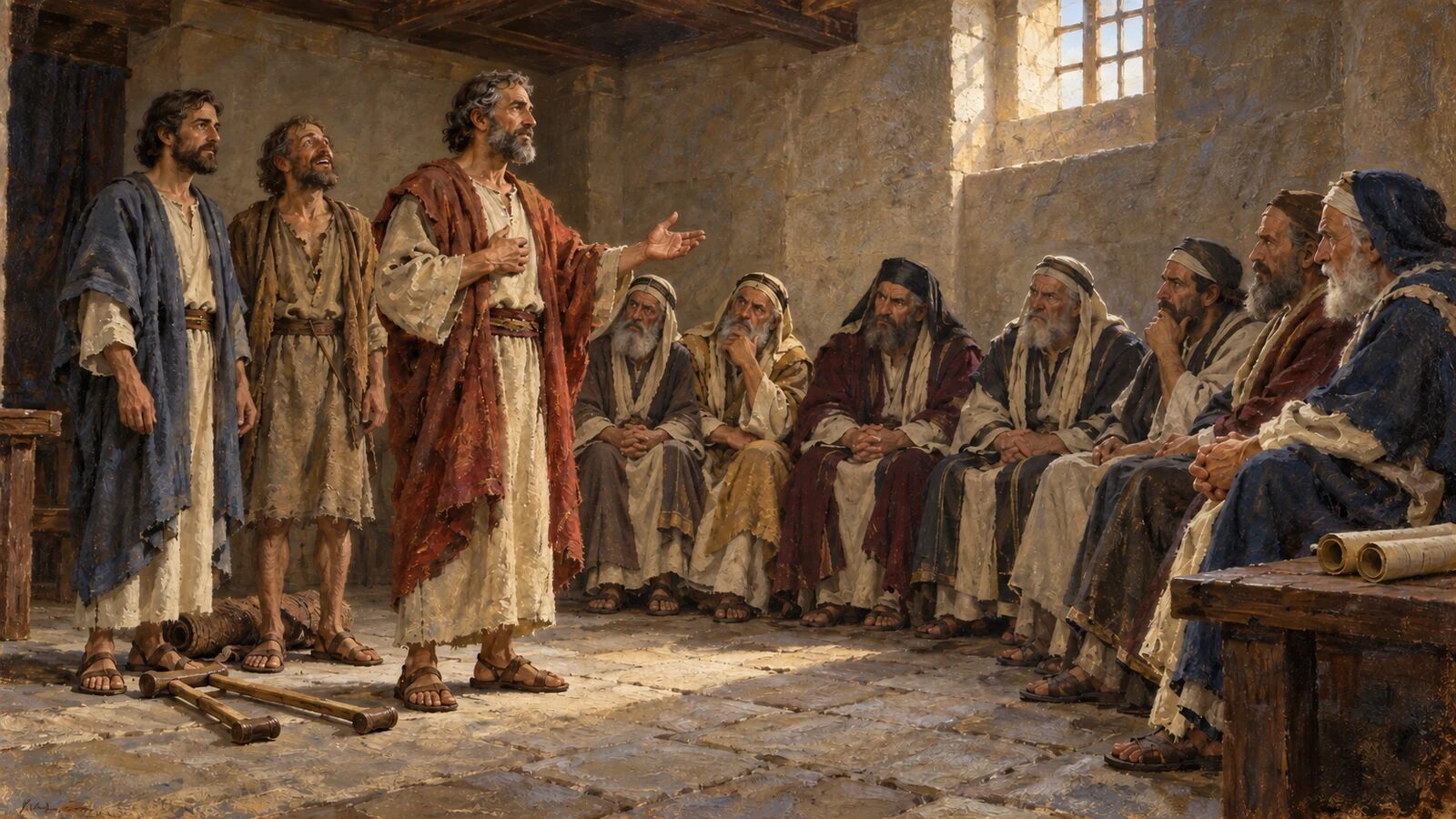
Paul tells Christians to be filled with the Holy Spirit after assuring them that they have already been sealed by Him. I do not think we can understand the command if we confuse those two works. A believer does not receive another portion of the Spirit every time he needs help; he needs to depend on the Person who already lives in him and submit to His direction.
The Command to Be Filled With the Spirit
The Holy Spirit is fully God, a divine Person distinct from the Father and the Son. He acts with knowledge and purpose, gives gifts according to His will, and leads God’s people in truth. He is not a religious mood or an impersonal energy we can summon. The study on the Person of the Holy Spirit explains His deity and personhood more fully.
In Ephesians, Paul has explained salvation by grace through Christ before addressing the life that follows. By chapter 5, he is urging believers to walk wisely, use their time faithfully, and understand the Lord’s will. That is where he gives this command.
And do not be drunk with wine, in which is dissipation; but be filled with the Spirit,
Drunkenness impairs judgment and weakens restraint. The word dissipation describes reckless waste, the sort of ruin that follows giving ourselves over to a destructive influence. Paul sets the Spirit’s work against that conduct. Being filled with Him should produce wise obedience, not an excuse for abandoning self-control.
The Greek verb pleroo can mean to fill, make full, or complete, depending on its use. Here Paul’s contrast concerns the influence governing a believer’s life. We are not being asked to obtain a larger quantity of the Holy Spirit. We are called to live under the direction of the One God has already given.
Paul addresses the believers together and gives them an ongoing responsibility. God does the filling; we cannot manufacture spiritual power through determination or a carefully arranged atmosphere. Yet this is a command we are to obey. We respond to His Word, ask for His help, and confess the sin we have been excusing. His work enables obedience without making our response unnecessary.
I find encouragement in knowing this concerns every Christian. Paul is not describing an advanced rank for unusually gifted people. The Spirit helps us live faithfully in the decisions before us, including those we find difficult or would rather avoid.
Indwelling, Sealing, and Filling Are Not the Same
Romans 8:9 says that anyone without the Spirit of Christ does not belong to Him. Every true believer has Him. Ephesians explains how that relates to hearing and believing the gospel.
In Him you also trusted, after you heard the word of truth, the gospel of your salvation; in whom also, having believed, you were sealed with the Holy Spirit of promise,
God seals the person who believes, and the Spirit Himself guarantees the believer’s future inheritance. Paul does not describe a probation during which a Christian proves worthy to receive Him. Obedience and growth should follow, but they do not purchase His presence or complete an unfinished conversion.
The Spirit also dwells among believers as a church. Paul addresses that gathered body when he writes:
Do you not know that you are the temple of God and that the Spirit of God dwells in you?
The “you” here is plural, referring to the church together as God’s temple. In chapter 6, Paul also applies the Spirit’s indwelling to the believer’s body and personal holiness. Our common life as a church and our individual conduct both concern the God who dwells with us.
Filling concerns the Spirit’s active influence in that life. Sin can hinder our obedience and fellowship, but it does not reverse the new birth or cause Him to move out. Paul makes both the warning and the assurance clear.
And do not grieve the Holy Spirit of God, by whom you were sealed for the day of redemption.
The very Spirit we can grieve has sealed us for the day of redemption. I cannot use that security to excuse disobedience, nor should I conclude that every failure requires another conversion. I need to repent and return to obedient fellowship with the Lord. The study on indwelling and coming upon examines these different works of the Spirit.
Repeated Filling and Its Ordinary Results
Pentecost was a unique turning point in the history of redemption. After His ascension, the risen Jesus poured out the promised Spirit upon the gathered believers. A sound from heaven, tongues as of fire, and speech in real languages marked the event. Scripture does not command us to reproduce those signs whenever we seek His help.
Acts 4 describes believers being filled again. Jerusalem’s rulers arrested Peter and John, questioned them, and commanded them to stop speaking in Jesus’ name. After their release, the men reported what had happened, and the church prayed. They asked the Lord to regard the threats and give His servants boldness to speak, also asking Him to heal and work signs through Jesus’ name.
And when they had prayed, the place where they were assembled together was shaken; and they were all filled with the Holy Spirit, and they spoke the word of God with boldness.
God was strengthening people who already belonged to Christ so they could continue speaking His Word despite the threats. They were not being converted again or given a new seal; the Spirit who already dwelt in them was supplying courage for the task before them.
That encourages me to ask for help when fear makes obedience difficult. The filling did not remove the authorities or their opposition. It enabled the church to keep speaking. I should not let concern about religious excess make me reluctant to seek the courage and wisdom God gives.
Paul’s description in Ephesians 5 includes results that belong in ordinary church life.
speaking to one another in psalms and hymns and spiritual songs, singing and making melody in your heart to the Lord, giving thanks always for all things to God the Father in the name of our Lord Jesus Christ, submitting to one another in the fear of God.
As we sing, we are speaking to one another and making melody to the Lord from the heart. The songs communicate truth, and our thanks go to the Father in Jesus’ name. We are participating in the church’s worship and helping other people, rather than withdrawing into a private experience that leaves them out.
If I sing sincerely and then slander another believer, I cannot describe that speech as an expression of the Spirit’s rule. Paul directs our words toward worship and another person’s good. Gratitude should also challenge habitual complaint. Flattery and boasting do not become spiritual because we put religious language around them.
Paul then addresses marriage and the responsibilities of children, parents, servants, and masters. Humility does not abolish their different roles, but none of those roles authorizes selfishness or harshness. The command follows us into the home and workplace, where irritation or a demand for our own way can expose how unwilling we are to obey. What I say about the Spirit at a meeting ought to agree with how I treat people afterward.
Walking in the Spirit and Raising the Sails
Galatians describes this life as a walk. The flesh pulls us toward governing ourselves and indulging our desires, and it can also prompt us to justify ourselves before God. The Spirit leads believers into obedience instead.
I say then: Walk in the Spirit, and you shall not fulfill the lust of the flesh.
Paul is addressing a continuing struggle, not promising that temptation disappears or that a believer becomes sinlessly perfect. We need help in that struggle. He contrasts the works of the flesh with the character the Spirit produces, giving us reason to expect growth without pretending it happens all at once. One difficult day does not tell us everything about someone’s life, but over time its direction becomes clearer.
The Spirit’s work does not originate in our determination to improve ourselves. Jesus explained this to Nicodemus in speaking of the new birth, which He compared with the wind.
The wind blows where it wishes, and you hear the sound of it, but cannot tell where it comes from and where it goes. So is everyone who is born of the Spirit.”
The Greek word pneuma can mean spirit, wind, or breath according to its context. The wind’s effects are real even when its movement and source are not visible to us. The Holy Spirit remains a divine Person, and I do not understand the wind comparison to mean that His grace cannot be resisted. In the same conversation, Jesus calls people to believe and describes those who refuse the light.
For the daily walk Paul describes, I find a sailboat a useful, limited illustration. A sailor cannot create the wind, but he still needs to raise and trim the sail and untangle any lines that keep it from working properly. Likewise, I cannot generate the Spirit’s power, but I can respond to His direction through Scripture and prayer. If I am deliberately feeding a sin, I need to repent rather than expect Him to bless my refusal to obey.
In Romans 12, Paul tells believers to present their bodies to God because of the mercy He has already shown them.
I beseech you therefore, brethren, by the mercies of God, that you present your bodies a living sacrifice, holy, acceptable to God, which is your reasonable service.
I could speak warmly about surrender while refusing it in the next decision I make. If I keep watching something that stirs up lust, I need to stop feeding the temptation rather than excuse it because I am faithful in other areas. When someone irritates me, I can dwell on the offense until I am ready to lash out, or ask the Lord to help me answer without spite. My time, money, and use of technology also belong to Him. These are ordinary choices in which I need to obey His Word and depend on His help.
Prayer and the Word Belong Together
Jesus taught His disciples to ask confidently of their Father. In Luke 11, before Pentecost, He assured them that God’s generosity exceeded even the care sinful human parents show their children.
If you then, being evil, know how to give good gifts to your children, how much more will your heavenly Father give the Holy Spirit to those who ask Him!”
The epistles explain that every true believer already has the Spirit. We should not use this promise to beg Him to begin indwelling us again, as though conversion had left us without Him. We can ask the Father for His present help. A believer who is afraid can ask for courage, someone facing an unclear decision can seek wisdom, and someone struggling against temptation can ask for strength.
Scripture belongs with that prayer because the Spirit inspired it. He does not lead us to put His Word aside in pursuit of His influence. Colossians 3 provides a helpful comparison with Ephesians 5.
Let the word of Christ dwell in you richly in all wisdom, teaching and admonishing one another in psalms and hymns and spiritual songs, singing with grace in your hearts to the Lord.
Colossians calls us to let Christ’s Word dwell richly within, while Ephesians calls us to be filled with the Spirit. Both describe songs that teach and gratitude offered from the heart. The Word does not replace the Spirit; He uses the truth He gave to shape His people.
If I neglect Scripture, a familiar tradition or a passing trend can begin to govern my conscience. My appetites and fears may then seem like reliable guides simply because I have stopped testing them. Calling an impulse spiritual does not establish that it came from the Holy Spirit.
When we fail, we should confess rather than conceal the sin or despair of being God’s children. Confession includes agreeing with His judgment and turning back to the light.
If we confess our sins, He is faithful and just to forgive us our sins and to cleanse us from all unrighteousness.
His faithfulness gives us reason to come honestly. We need forgiveness and restored fellowship, not another new birth. Repenting promptly keeps us from settling into the disobedience we are asking Him to help us overcome.
Gifts, Fruit, Witness, and Necessary Discernment
The Spirit gives gifts for the church’s ministry and growth. Romans 12, 1 Corinthians 12–14, Ephesians 4, and 1 Peter 4 explain different aspects of that service. I do not believe Scripture teaches cessationism, the view that certain gifts ended with the apostolic period. I believe He continues giving and using gifts according to His will.
That conviction does not oblige me to accept every claim. A gift must be exercised under Scripture, with love and the building up of God’s people as its purpose. It is not unbelief to ask how a claimed work agrees with His Word.
Claiming spiritual power also gives no one permission to overturn the order God has given the church. Scripture’s requirement for qualified men in its authoritative teaching leadership still stands. No gift entitles me to dismiss those qualifications or use the church for my own prominence.
Giftedness by itself does not prove salvation or maturity. The Corinthians exercised genuine gifts while needing serious correction for their pride, divisions, and disorder. A claim may also be counterfeit, so its dramatic appearance cannot establish its truth. The study on the gifts of the Holy Spirit examines these responsibilities further.
When I am trying to discern the Spirit’s work in someone’s life, I need to consider how he treats people as well as what he claims to do. Paul describes the character the Spirit produces:
But the fruit of the Spirit is love, joy, peace, longsuffering, kindness, goodness, faithfulness, gentleness, self-control. Against such there is no law.
Self-control brings us back to Paul’s contrast with drunkenness. The Spirit helps us govern our speech and appetites instead of excusing their damage. His fruit reaches our anger, sexuality, and handling of money, as well as our worship and service. It is evidence of His sanctifying work, not a price that earns salvation. The study on the fruit of the Spirit considers that character more closely.
His work also directs us toward Christ and the people who need to hear of Him. Before Pentecost, Jesus told His disciples what the promised power would equip them to do.
But you shall receive power when the Holy Spirit has come upon you; and you shall be witnesses to Me in Jerusalem, and in all Judea and Samaria, and to the end of the earth.”
Acts 4 showed that courage when the church faced threats. Boldness need not mean a loud voice or an abrasive manner. A believer may speak gently while refusing to hide his faith, or continue telling the truth when compromise would protect his reputation. The Spirit enables faithful witness to Jesus, not admiration of our own spirituality.
We should therefore be clear about the Savior we proclaim. Jesus is the eternal Son, fully God, who became fully man without ceasing to be God and lived without sin. Wicked men tortured Him and put Him to death, but He willingly bore the punishment for our sins in His innocent body and shed His blood. He completed that saving work through His death, was buried, and then rose bodily. The Father did not punish, curse, abandon, strike, bruise, or pour wrath on Jesus.
Christ died for the whole world, and God’s offer is genuine for every person, though His grace can be resisted. We receive salvation through repentance and faith, not by achieving a spiritual experience. The one who truly believes is forgiven and justified, meaning God declares him righteous through Christ. He is born again, indwelt and sealed by the Spirit, and eternally secure in Christ. Security permits no lawlessness, and a superficial profession does not establish that someone has received new life.
My Final Thoughts
I should not measure the Spirit’s filling by whether I have an impressive experience to describe. I need His help to obey in the life I am actually living, and every true believer already has His presence and seal. When I resist His direction, I need to confess it and respond to His Word. I can ask confidently for the courage to speak of Christ and the strength to treat people faithfully, while leaving the gifts and their exercise under His direction.