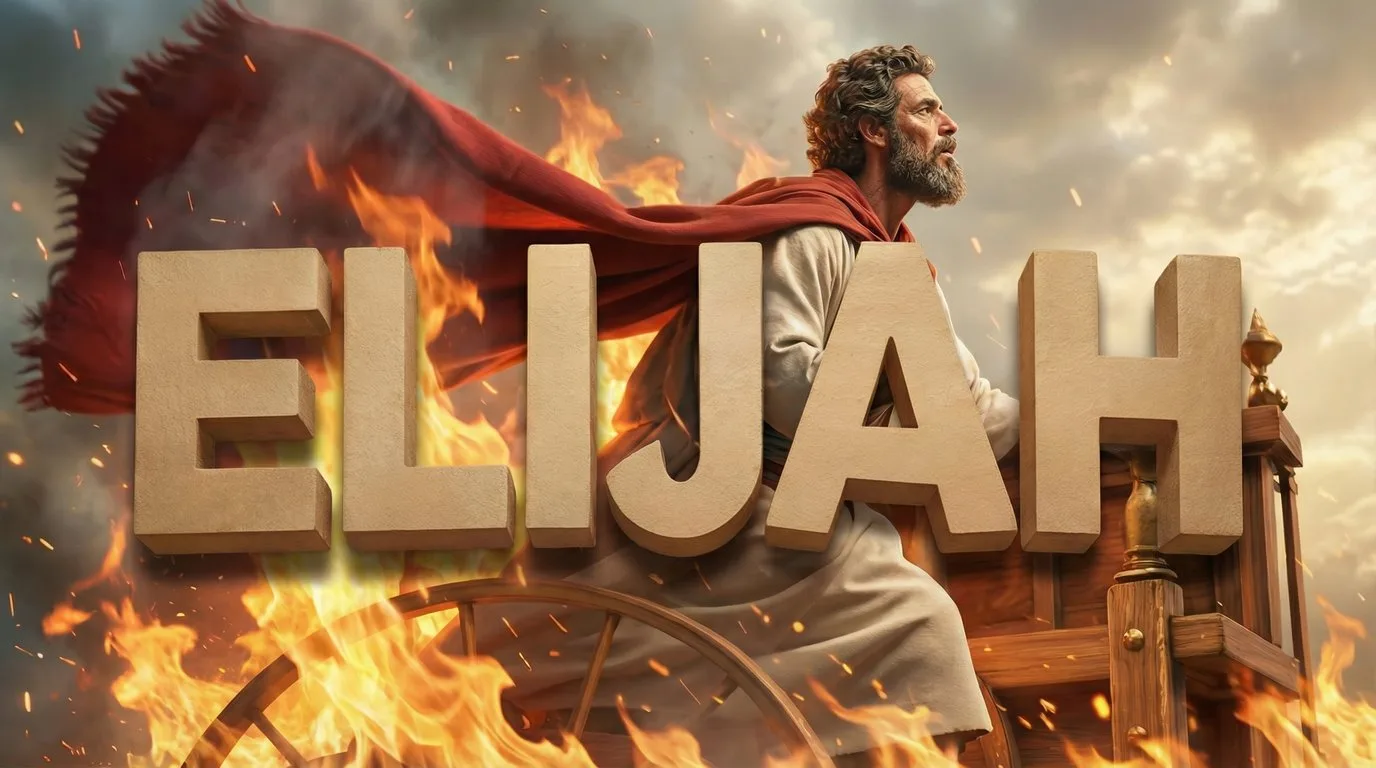
Elijah steps onto the page like a man sent straight from God, and the Bible does not pause to build his resume. In one verse he confronts a king, challenges a nation’s idols, and announces a judgment that will touch every field and every table in Israel. If you want to understand Elijah, start where Scripture starts: with a man standing in front of Ahab, but living like he is standing in front of the living God in 1 Kings 17:1.
Elijah shows up
First Kings drops Elijah into the middle of a dark time. Ahab is on the throne in the northern kingdom, and his reign is marked by open promotion of Baal worship. This is not just private sin. It is organized false worship, financed and normalized. That sets the stage for why Elijah’s first recorded words are so direct. He is not trying to win a debate. He is delivering God’s message to a nation that has turned from the Lord.
Standing before the Lord
Elijah identifies himself as a Tishbite from Gilead, rugged country east of the Jordan. Scripture gives almost no background, which is part of the point. The weight is not on Elijah’s training. The weight is on the God who sends him, and on the message he carries.
And Elijah the Tishbite, of the inhabitants of Gilead, said to Ahab, "As the LORD God of Israel lives, before whom I stand, there shall not be dew nor rain these years, except at my word." (1 Kings 17:1)
In that verse Elijah calls the Lord the living God and says he stands before Him. That kind of language was used for a servant who attends a king, ready for orders. Elijah may be physically in Ahab’s court, but he is answering to a higher King. That is why he can speak plainly without trying to impress anybody. Boldness like that is not personality-driven bravado. It grows out of living like God is real and present.
A small wording detail is easy to miss: Elijah does not present the drought as a guess, or as a threat he hopes will work. It is announced as certain, and it is tied to the authority of God’s word through His prophet. Elijah is not claiming personal magic. He is functioning as God’s spokesman.
The drought and Baal
Elijah’s first public act is not calling down fire. It is declaring a drought. That may feel less dramatic, but it goes right after Baal’s claimed job description. Baal was promoted as the storm and fertility god, the one who supposedly brought rain and crop success. When Elijah says there will be no dew or rain, the Lord is picking the battleground. The thing Israel was trusting Baal to provide is the very thing the Lord withholds.
The drought also fits what God had already warned Israel about. Moses told them that idolatry would bring covenant discipline, including withheld rain and failing crops. Elijah is not inventing new theology. He is announcing that the Lord is enforcing what He already said.
Take heed to yourselves, lest your heart be deceived, and you turn aside and serve other gods and worship them, lest the LORD's anger be aroused against you, and He shut up the heavens so that there be no rain, and the land yield no produce, and you perish quickly from the good land which the LORD is giving you. (Deuteronomy 11:16-17)
That makes the drought both judgment and mercy. Judgment, because sin has consequences. Mercy, because God is exposing the lie before it destroys the nation completely. Idols promise life, security, and control. Then God shows how empty they really are.
A name that preaches
Elijah’s name says a lot. In Hebrew it means My God is Yahweh. It is a confession every time you read it. Israel’s problem was not that they had no religion. It was that they tried to mix the Lord with rivals. Elijah’s very name keeps pressing the question: Who is God, really?
And there is another observation worth holding onto: 1 Kings introduces Elijah with almost no personal history, but with total clarity about the Lord. Scripture is teaching you where to put the weight. God does not need impressive credentials to confront idolatry. He needs a servant who will speak His word.
God trains Elijah
After Elijah speaks to Ahab, the Lord tells him to leave and hide. That is not what we would expect if we were writing the script. We tend to assume the faithful servant should stay in the spotlight and keep pressing publicly. But God often does deep work in His servants away from the crowd. Elijah’s public courage is going to be supported by private dependence.
Cherith and ravens
God sends Elijah to the brook Cherith, east of the Jordan. He will drink from the brook, and God says He has commanded ravens to feed him.
Then the word of the LORD came to him, saying, "Get away from here and turn eastward, and hide by the Brook Cherith, which flows into the Jordan. And it will be that you shall drink from the brook, and I have commanded the ravens to feed you there." So he went and did according to the word of the LORD, for he went and stayed by the Brook Cherith, which flows into the Jordan. The ravens brought him bread and meat in the morning, and bread and meat in the evening; and he drank from the brook. (1 Kings 17:2-6)
The raven detail is meant to stick in your mind. Ravens were unclean birds under the Law. God is not confused about that. He is showing that He is not limited to the channels we consider proper or likely. He can sustain His servant however He chooses.
And notice the shape of the provision. Elijah does not receive a storehouse full of supplies. He receives what he needs morning and evening. God is feeding faith one day at a time.
Then the brook dries up. Elijah is obeying God and still loses his water source. That teaches something many believers learn the hard way: being in God’s will does not mean circumstances stay comfortable. Sometimes God ends one provision to move you to the next step. A dried brook can be guidance, not rejection.
Zarephath in Sidon
God sends Elijah to Zarephath, outside Israel, in the region of Sidon. That location is not accidental. Jezebel, Ahab’s wife and Baal’s loudest promoter, was from Sidon. So the Lord sends His prophet into enemy territory and provides for him there. Baal cannot even defend his own neighborhood from the Lord’s hand.
Then the word of the LORD came to him, saying, "Arise, go to Zarephath, which belongs to Sidon, and dwell there. See, I have commanded a widow there to provide for you." (1 Kings 17:8-9)
Elijah meets a widow gathering sticks. She is down to a last meal. God’s instruction through Elijah calls her to act on God’s promise in a way that feels risky. The promise is not framed as luxury. It is daily, ordinary mercy: flour and oil that will not run out until the rain returns.
The wording helps here. When the text says the Lord commanded the ravens, it uses a common Hebrew verb for giving orders. It is the same idea when God sends Elijah and directs the widow. The point is simple: nature, prophets, and everyday people are all under God’s authority. If God can give an order to a raven, He can also keep a handful of flour and a little oil going day after day.
There is also a pattern 1 Kings 17 repeats on purpose: God speaks, someone acts on God’s word, and God proves faithful. That is not a formula to control God. It is the normal shape of faith. Faith is not just agreeing with facts. It is taking God at His word when obedience costs something.
The Lord gives life
Then the widow’s son dies, and Elijah prays. God restores the child’s life. That does more than comfort a grieving mother. It shows the Lord is not only the God of weather and bread. He is the God of life itself.
And he stretched himself out on the child three times, and cried out to the LORD and said, "O LORD my God, I pray, let this child's soul come back to him." Then the LORD heard the voice of Elijah; and the soul of the child came back to him, and he revived. (1 Kings 17:21-22)
The widow’s response is that she now knows the word of the Lord in Elijah’s mouth is truth. That is how miracles function in Scripture. They are not party tricks. They confirm that God’s message is real and that God Himself is present and active.
If you read Elijah only as a man of power, you will miss what God is doing in him. By the time Elijah returns to confront Ahab again, he is not just a bold preacher. He is a man who has watched God provide in hidden places, through unlikely means, one day at a time.
The Lord proves Himself
When Elijah returns to the public stage, the issue is not mainly Elijah versus Ahab. It is the Lord versus Baal, and it is Israel’s divided loyalty being brought into the open. The showdown on Mount Carmel in 1 Kings 18 is famous, but the heart of it is not spectacle. It is a call to decision.
How long will you limp
Elijah challenges the people about their double-minded worship. They want the Lord for tradition and Baal for productivity, or the Lord for conscience and Baal for convenience. Elijah will not let that mixture hide under polite religious talk.
And Elijah came to all the people, and said, "How long will you falter between two opinions? If the LORD is God, follow Him; but if Baal, follow him." But the people answered him not a word. (1 Kings 18:21)
The key word translated falter or limp carries the idea of limping or hopping back and forth. It is a picture of unstable worship, like someone who cannot plant both feet in one place. Israel is trying to live on two branches at once, and it cannot be done. In Scripture, divided worship is not a harmless middle ground. It is disobedience dressed up as balance.
The people answer him not a word. Silence is part of compromise. When you have tried to keep everybody happy, you eventually lose the ability to speak clearly about what is true. You can argue preferences all day, but you go quiet when it is time to confess the Lord.
Fire and the altar
The contest is set: two altars, two offerings, no human fire. The prophets of Baal call out, dance, and cut themselves. Nothing happens. Their intensity does not create reality. Elijah’s sharp comments are not the main event. The main event is that there is no answer because Baal is not there.
Elijah repairs the altar of the Lord with twelve stones. That is not random. The kingdom is politically split, but God’s covenant claim on His people is not split. Elijah is reminding Israel who they are and who they belong to.
And it came to pass, at the time of the offering of the evening sacrifice, that Elijah the prophet came near and said, "LORD God of Abraham, Isaac, and Israel, let it be known this day that You are God in Israel and I am Your servant, and that I have done all these things at Your word. Hear me, O LORD, hear me, that this people may know that You are the LORD God, and that You have turned their hearts back to You again." (1 Kings 18:36-37)
Elijah’s prayer is short and God-centered. He is not trying to build a platform for himself. He wants the people to know the Lord is God and to understand this confrontation is happening at God’s word. When the fire falls, it leaves no room for tricks or shared credit. The people’s response is exactly right: they confess the Lord as God.
Then Elijah orders the execution of the prophets of Baal. You have to read that in its Old Testament setting. Israel was a nation under God’s covenant law, and false prophets were not treated as harmless private teachers. They were actively leading the nation into rebellion. Today the church is not a civil government, and believers do not carry out those penalties. But the principle still stands: idolatry is deadly, and God takes truth seriously.
Victory and collapse
After Carmel, Elijah prays again and the rain returns. The Lord controls fire and rain. Baal controls neither. James later points out that Elijah prayed earnestly, and that his prayer life mattered. Elijah was not a mythical superhero. He was a man who depended on God.
Elijah was a man with a nature like ours, and he prayed earnestly that it would not rain; and it did not rain on the land for three years and six months. And he prayed again, and the heaven gave rain, and the earth produced its fruit. (James 5:17-18)
Then comes a turn that catches many readers off guard. Jezebel threatens Elijah, and Elijah runs. The man who stood in front of a hostile crowd now folds under fear and exhaustion. First Kings 19 shows him under a broom tree asking God to take his life.
God’s care for Elijah is tender and practical. An angel gives him food and water and lets him sleep. God deals with him as a whole person. Sometimes what a worn-out servant needs first is not a lecture. He needs rest and strength to think straight again.
Elijah then goes to Horeb, the mountain tied to Moses and the giving of the Law. There God meets him, not with the kind of dramatic display Elijah might expect, but with a gentle voice. The lesson is not that God never works in power. Carmel was power. The lesson is that God is not only in the dramatic. He also works quietly, steadily, and personally in the hearts of His servants.
Then God corrects Elijah’s perspective. Elijah thinks he is alone, but God says He has preserved a remnant that has not bowed to Baal. Discouragement lies by shrinking your view down to what you can see and feel. God tells Elijah there are faithful people Elijah does not even know about.
Yet I have reserved seven thousand in Israel, all whose knees have not bowed to Baal, and every mouth that has not kissed him." (1 Kings 19:18)
And God gives Elijah work to do, including calling Elisha. Elijah is not only a confrontational prophet. He is also used to raise up the next man. God’s work is bigger than one generation.
Elijah’s life ends in a remarkable way in 2 Kings 2, taken up by a whirlwind. Elisha picks up Elijah’s mantle and continues the ministry. The mantle is not magic. It is a visible sign that the same God who worked through Elijah will now work through Elisha. The power never belonged to the prophet. It belongs to the Lord.
The New Testament keeps Elijah in his proper place. He appears at the transfiguration with Moses, speaking with Jesus, which shows Elijah is not the center. Jesus is. John the Baptist comes in the spirit and power of Elijah, not as a reincarnation, but as a prophet with a similar calling to confront sin and prepare the way for the Lord. Elijah’s greatest role is not that he was unusual. It is that he was faithful to point people back to the true God, and in the fullest sense that turning happens through Jesus Christ.
My Final Thoughts
Elijah’s first recorded sentence in 1 Kings 17:1 puts the whole man on the table: he lives before the living God, and he speaks God’s word in a nation that wants religion without obedience. God then trains him in hidden places, provides for him in unlikely ways, proves Himself publicly, and cares for him when he breaks down. Elijah is not presented as flawless. He is presented as a real servant upheld by a real God.
Keep it plain. Stand before the Lord even when you are standing before people. Obey the next clear thing God has said, even if it feels small or hidden. And when the brook dries up, do not assume God is done. It may simply be time to follow Him to the next place He will show His faithfulness.




 Get the book that teaches you how to evangelize and disarm doctrines from every single major cult and religion.