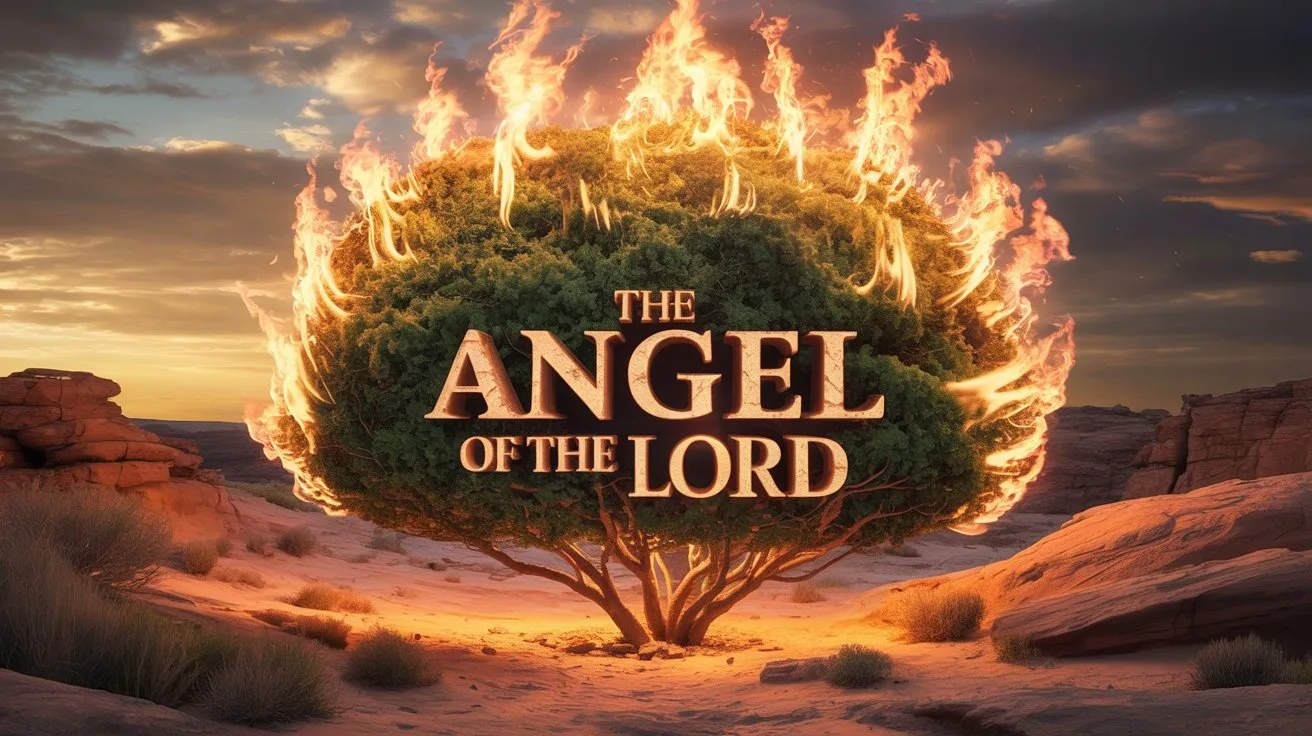

The Angel of the LORD appears repeatedly throughout Scripture, speaking and acting with divine authority. A close examination of His words, actions, and how people respond to Him shows that He is not presented as a merely created messenger. Instead, He speaks as God, bears God’s name, receives worship that would be sinful if offered to a creature, and exercises authority that belongs to God alone. This study explores the multifaceted role of the Angel of the LORD, highlighting His divine authority, His covenant promises, and His significance in the unfolding story of redemption that culminates in Jesus Christ.
He Speaks as God and Receives Worship
The Angel’s words carry God’s own authority
In several key passages, the Angel of the LORD does not simply deliver a message about God. He speaks in the first person as God, commissioning, promising, and commanding with divine authority. This is one of the clearest patterns that separates Him from ordinary angelic messengers, who consistently refuse worship and carefully distinguish themselves from the LORD.
Now the Angel of the LORD came and sat under the terebinth tree which was in Ophrah, which belonged to Joash the Abiezrite, while his son Gideon threshed wheat in the winepress, in order to hide it from the Midianites. And the Angel of the LORD appeared to him, and said to him, “The LORD is with you, you mighty man of valor!” Gideon said to Him, “O my lord, if the LORD is with us, why then has all this happened to us? And where are all His miracles which our fathers told us about, saying, ‘Did not the LORD bring us up from Egypt?’ But now the LORD has forsaken us and delivered us into the hands of the Midianites.” Then the LORD turned to him and said, “Go in this might of yours, and you shall save Israel from the hand of the Midianites. Have I not sent you?” (Judges 6:11-14)
Notice the flow of the passage. The Angel of the LORD appears, yet the narrative can speak of “the LORD” turning to Gideon and commissioning him. Gideon’s fears and questions are real, but the answer he receives is not merely encouragement. It is a divine sending: “Have I not sent you?” Gideon’s later altar, named “The LORD Is Peace,” makes sense because he understands he has encountered the LORD in a personal manifestation, not a distant intermediary.
Holy ground and rightful reverence
The burning bush is another pivotal moment. The text explicitly says the Angel of the LORD appears, yet the One speaking identifies Himself as the God of the patriarchs. Moses responds with the kind of reverence Scripture associates with encountering God’s presence.
And the Angel of the LORD appeared to him in a flame of fire from the midst of a bush. So he looked, and behold, the bush was burning with fire, but the bush was not consumed. Then Moses said, “I will now turn aside and see this great sight, why the bush does not burn.” So when the LORD saw that he turned aside to look, God called to him from the midst of the bush and said, “Moses, Moses!” And he said, “Here I am.” Then He said, “Do not draw near this place. Take your sandals off your feet, for the place where you stand is holy ground.” Moreover He said, “I am the God of your father, the God of Abraham, the God of Isaac, and the God of Jacob.” And Moses hid his face, for he was afraid to look upon God. (Exodus 3:2-6)
The Angel is not treated as a lesser being who merely accompanies God. The holiness of the location is derived from His presence, and Moses understands he is standing before God. This is a consistent indicator throughout Scripture: true holiness and the command to reverence belong to God’s presence, not to a creature who simply reports God’s words.
The Commander of the LORD’s army receives worship
Joshua’s encounter near Jericho adds another layer. Joshua meets a Man with a drawn sword who identifies Himself as “Commander of the army of the LORD.” Joshua falls down in worship, and the Commander does not rebuke him. This is important because Scripture repeatedly shows faithful angels refusing worship. The fact that worship is accepted here strongly supports the conclusion that this is a divine appearance.
And it came to pass, when Joshua was by Jericho, that he lifted his eyes and looked, and behold, a Man stood opposite him with His sword drawn in His hand. And Joshua went to Him and said to Him, “Are You for us or for our adversaries?” So He said, “No, but as Commander of the army of the LORD I have now come.” And Joshua fell on his face to the earth and worshiped, and said to Him, “What does my Lord say to His servant?” Then the Commander of the LORD’s army said to Joshua, “Take your sandal off your foot, for the place where you stand is holy.” And Joshua did so. (Joshua 5:13-15)
The parallels with Exodus are striking: holy ground, removed sandals, and worship that is not corrected. The simplest reading is that the One Joshua encounters is the LORD in a personal manifestation, distinct in appearance and yet bearing the authority and holiness of God Himself.
He Declares Divine Names and Promises
He knows, calls, and comforts with God’s personal knowledge
In Genesis 16, Hagar meets the Angel of the LORD in the wilderness. The encounter is deeply personal. He calls her by name and speaks with insight into her circumstances. More than that, He makes promises that only God can guarantee, including the multiplication of her descendants. Hagar’s response is one of awe because she realizes she has encountered the God who sees.
Then the Angel of the LORD said to her, “I will multiply your descendants exceedingly, so that they shall not be counted for multitude.” And the Angel of the LORD said to her: “Behold, you are with child, and you shall bear a son. You shall call his name Ishmael, because the LORD has heard your affliction.” Then she called the name of the LORD who spoke to her, “You-Are-the-God-Who-Sees”; for she said, “Have I also here seen Him who sees me?” (Genesis 16:10-13)
Hagar does not merely say, “God spoke through an angel.” The text emphasizes that “the LORD” spoke to her, and she responds accordingly. This matters for our study because it demonstrates that the Angel of the LORD is presented as God personally engaging with the afflicted, not only conveying information but also giving covenant-like assurances that require divine power and faithfulness.
“By Myself I have sworn” and covenant certainty
Genesis 22 is another decisive passage. Abraham is stopped from offering Isaac, and then the Angel of the LORD speaks in a way that leaves little room for viewing Him as a mere created messenger. He swears by Himself, which is a uniquely divine act. God can swear by no one greater, and here the Angel speaks with that same prerogative.
Then the Angel of the LORD called to Abraham a second time out of heaven, and said: “By Myself I have sworn, says the LORD, because you have done this thing, and have not withheld your son, your only son, blessing I will bless you, and multiplying I will multiply your descendants as the stars of the heaven and as the sand which is on the seashore; and your descendants shall possess the gate of their enemies. In your seed all the nations of the earth shall be blessed, because you have obeyed My voice.” (Genesis 22:15-18)
These are not merely encouraging words. They are covenant declarations that connect directly to God’s redemptive plan. The blessing “in your seed” ultimately finds fulfillment in Christ, and the Angel of the LORD is the One speaking these promises with divine authority. This strengthens the overall biblical portrait: the Angel is actively involved in covenant history, speaking as the LORD and binding Himself to the promise.
When we take these accounts together, a consistent pattern emerges. The Angel of the LORD is not simply delivering God’s promises as a third party. He is presented as the divine Speaker, the covenant-making LORD, while still being distinguishable in the narrative as “the Angel.” That combination prepares us to understand why many believers recognize in these appearances the pre-incarnate Son, who reveals God and makes Him known.
He Carries Divine Authority to Forgive and Judge
His presence confronts sin and demands obedience
The story of Balaam in Numbers 22 includes a striking confrontation. The Angel of the LORD stands as an adversary in the road. Balaam’s eyes are opened, and he responds with fear and confession. This is more than a startling moment. It is a moral confrontation that exposes sin and demands submission, revealing the Angel’s authority to judge and correct.
Then the LORD opened Balaam’s eyes, and he saw the Angel of the LORD standing in the way with His drawn sword in His hand; and he bowed his head and fell flat on his face. And the Angel of the LORD said to him, “Why have you struck your donkey these three times? Behold, I have come out to stand against you, because your way is perverse before Me. The donkey saw Me and turned aside from Me these three times. If she had not turned aside from Me, surely I would also have killed you by now, and let her live.” And Balaam said to the Angel of the LORD, “I have sinned, for I did not know You stood in the way against me. Now therefore, if it displeases You, I will turn back.” (Numbers 22:31-34)
The Angel is not merely an observer. He stands in the way as an opponent to perverse conduct. He also speaks with authority over life and death, describing what He would have done had the donkey not turned aside. This is not the language of a messenger who is uncertain or detached. It is the language of One who acts with divine prerogative in executing judgment.
He removes iniquity and silences the accuser
Even more direct is Zechariah 3, where Joshua the high priest stands filthy before the Angel of the LORD and Satan stands ready to accuse. The Angel rebukes Satan and commands that Joshua’s filthy garments be removed. Then He declares that iniquity is removed. This is a priestly and kingly action: cleansing, restoring, and declaring forgiveness. Scripture consistently teaches that forgiveness of sin is God’s work, and here the Angel does what God does.
Then he showed me Joshua the high priest standing before the Angel of the LORD, and Satan standing at his right hand to oppose him. And the LORD said to Satan, “The LORD rebuke you, Satan! The LORD who has chosen Jerusalem rebuke you! Is this not a brand plucked from the fire?” Now Joshua was clothed with filthy garments, and was standing before the Angel. Then He answered and spoke to those who stood before Him, saying, “Take away the filthy garments from him.” And to him He said, “See, I have removed your iniquity from you, and I will clothe you with rich robes.” (Zechariah 3:1-4)
This is not merely symbolic comfort. The act of removing iniquity points to divine authority to cleanse, justify, and restore a sinner to service. The accuser is rebuked, the priest is cleansed, and God’s choice and mercy are emphasized. When viewed alongside other passages where the Angel of the LORD speaks as God and receives worship, Zechariah’s vision reinforces that this Angel is no mere created being. He carries the authority of God to judge sin and to grant cleansing grace.
For the larger theme of redemption, this matters greatly. Scripture is not presenting forgiveness as an abstract concept. It is shown as a personal work of God toward His people. The Angel of the LORD stands in that place of divine advocacy, rebuking the enemy and restoring the one who is unclean. This anticipates Christ’s ministry, not as a distant idea but as the same divine commitment to save, cleanse, and keep.
He Reveals Himself in Theophany and Covenant Roles
Visible manifestations that mark divine presence
Many appearances of the Angel of the LORD are accompanied by visible signs such as fire, miraculous deliverance, or the overwhelming awareness that one has encountered God. These are not presented as ordinary meetings with a heavenly messenger. They carry the weight of theophany, which is God making Himself known in a tangible, perceivable way.
So Manoah said to the Angel of the LORD, “What is Your name, that when Your words come to pass we may honor You?” And the Angel of the LORD said to him, “Why do you ask My name, seeing it is wonderful?” So Manoah took the young goat with the grain offering, and offered it upon the rock to the LORD. And He did a wondrous thing while Manoah and his wife looked on, it happened as the flame went up toward heaven from the altar, the Angel of the LORD ascended in the flame of the altar! When Manoah and his wife saw this, they fell on their faces to the ground. When the Angel of the LORD appeared no more to Manoah and his wife, then Manoah knew that He was the Angel of the LORD. And Manoah said to his wife, “We shall surely die, because we have seen God!” (Judges 13:17-22)
The conclusion Manoah reaches is not casual. He believes they have seen God. The text records that recognition rather than correcting it as a mistake. The Angel’s name is described as “wonderful,” and the Angel ascends in the flame of the offering, a sign of divine acceptance and heavenly origin. The response is worship and fear, the common human reaction when God reveals Himself.
Covenant mediation and revelation
In these appearances, the Angel of the LORD repeatedly functions as a covenant mediator. He calls, commissions, promises, corrects, protects, and reassures. He makes God’s will known in a direct and personal way. This aligns with the broader biblical truth that God has always taken initiative to reveal Himself and to keep His promises, not merely through distant decrees but through personal engagement with His people.
The New Testament identifies the Son’s role in this revelatory work in a way that helps connect the Old Testament patterns to the fullness of revelation in Christ. Hebrews describes Jesus in terms that fit what we see the Angel of the LORD doing in covenant history: representing God to people and leading God’s people faithfully.
Therefore, holy brethren, partakers of the heavenly calling, consider the Apostle and High Priest of our confession, Christ Jesus. (Hebrews 3:1)
Calling Jesus the “Apostle” emphasizes that He is the One sent from God in a unique, ultimate sense. Calling Him the “High Priest” emphasizes His mediating work for God’s people. When we observe the Angel of the LORD acting with divine authority, delivering covenant promises, and drawing people into worship and obedience, it fits the scriptural trajectory that the Son is the great Revealer of God. The Old Testament appearances prepare us for the truth that God would ultimately be known most fully in Jesus Christ, without suggesting that God was absent or silent before the incarnation.
These theophanic encounters, then, are not random supernatural stories. They are part of a consistent revelation of God’s character and God’s faithfulness. The Angel of the LORD shows that God is near, that He sees affliction, that He confronts sin, and that He keeps covenant promises even when His people are weak.
He Continues in the New Covenant
From promise and anticipation to incarnation and fulfillment
When we arrive at the New Testament, the focus shifts to the incarnation itself, the eternal Son taking on human flesh. The Gospels show that God’s redemptive plan has always been moving toward this moment. The phrase “angel of the Lord” appears in the birth narratives, and those angels certainly function as created messengers delivering God’s words. Yet the larger continuity remains: the same God who spoke and acted in Old Covenant history brings His plan to completion in Christ.
But while he thought about these things, behold, an angel of the Lord appeared to him in a dream, saying, “Joseph, son of David, do not be afraid to take to you Mary your wife, for that which is conceived in her is of the Holy Spirit. And she will bring forth a Son, and you shall call His name JESUS, for He will save His people from their sins.” (Matthew 1:21)
The birth narratives help us make an important distinction. In the New Testament, “an angel of the Lord” (lowercase in many English translations) often refers to created angels who faithfully deliver God’s message. That is a normal, biblical use of the word “angel,” meaning a messenger. At the same time, the Old Testament pattern we have been tracing shows that “the Angel of the LORD” is repeatedly portrayed in a unique way, speaking as the LORD, bearing divine authority, and receiving the honor due to God.
But while he thought about these things, behold, an angel of the Lord appeared to him in a dream, saying, “Joseph, son of David, do not be afraid to take to you Mary your wife, for that which is conceived in her is of the Holy Spirit. And she will bring forth a Son, and you shall call His name
At that point, the angel explains the Child’s name and mission, emphasizing that the coming of Christ is not merely an inspiring birth story. It is God’s saving work entering history in a direct and final way. This is why the New Testament so strongly centers our attention on Jesus Himself, since He is the fulfillment of everything the Old Testament anticipated.
Christ is God’s fullest self-revelation
The Old Testament appearances of the Angel of the LORD show God personally drawing near, speaking, commissioning, and keeping covenant. The New Testament brings that same divine nearness to its fullest expression in the incarnation. God is not simply sending a message. He is sending His Son in the flesh, and through Him we come to know God with clarity that surpasses all earlier stages of revelation.
And the Word became flesh and dwelt among us, and we beheld His glory, the glory as of the only begotten of the Father, full of grace and truth. No one has seen God at any time. The only begotten Son, who is in the bosom of the Father, He has declared Him. (John 1:14, 18)
This helps us keep the biblical tension in view. The Angel of the LORD is distinct in the narrative as “the Angel,” and yet He speaks and acts as the LORD. John’s Gospel explains why this pattern makes sense: the Son is the One who “has declared Him.” God remains one, and yet God makes Himself known personally, relationally, and savingly.
So, when many believers identify the Angel of the LORD as the pre-incarnate Son, they are not trying to force a later doctrine back into the text. They are recognizing a scriptural pattern that becomes brighter when viewed in the light of Christ’s coming. The New Testament does not flatten the Old Testament. Instead, it completes it by showing us who the ultimate Revealer and Redeemer is.
God, who at various times and in various ways spoke in time past to the fathers by the prophets, has in these last days spoken to us by His Son, whom He has appointed heir of all things, through whom also He made the worlds; who being the brightness of His glory and the express image of His person, and upholding all things by the word of His power, when He had by Himself purged our sins, sat down at the right hand of the Majesty on high. (Hebrews 1:1-3)
Why created angels refuse worship, and why that matters for this study
As we compare Old and New Testament passages, it is also important to remember that created angels consistently refuse worship. That refusal is not because angels are “humble” in a general sense, but because worship belongs to God alone. This becomes a useful point of comparison when reading Old Testament scenes where worship is offered in the presence of the Angel of the LORD and is not rebuked.
Now I, John, saw and heard these things. And when I heard and saw, I fell down to worship before the feet of the angel who showed me these things. Then he said to me, “See that you do not do that. For I am your fellow servant, and of your brethren the prophets, and of those who keep the words of this book. Worship God.” (Revelation 22:8-9)
This distinction protects us from confusion. In the New Testament, “an angel of the Lord” often refers to a faithful created messenger who delivers God’s message. That is entirely biblical and should be received as such. At the same time, the Old Testament presentation of “the Angel of the LORD” is unique in its repeated combination of divine speech, divine holiness, covenant authority, and the kind of reverence that Scripture reserves for God’s own presence.
In other words, our conclusion should be careful and text-driven. We do not need to deny the existence and ministry of created angels, since Scripture clearly affirms them. Neither do we need to reduce the Old Testament appearances of the Angel of the LORD to ordinary angelic activity, when the text itself repeatedly portrays something far greater.
Ultimately, this study is not meant to stir curiosity for curiosity’s sake. It is meant to magnify the faithfulness of God in revealing Himself and saving His people. The same LORD who met Hagar in her affliction, who called Moses from the bush, who stood before Balaam with a drawn sword, who cleansed the priest in Zechariah’s vision, and who received worship on holy ground is the LORD who has now made Himself known in the person of Jesus Christ. The story is consistent: God is holy, God is near, God confronts sin, and God provides the way of mercy.
My Final Thoughts
The Angel of the LORD passages are meant to leave us with more than information. They call us to reverence. Again and again, people realize they are not dealing with a distant deity or a vague religious idea. They are encountering the living God, who speaks, who sees, who warns, who promises, and who keeps His word even when His people feel weak or afraid.
If you have ever felt overlooked, remember Hagar in the wilderness and take comfort that the Lord is the God who sees. If you have ever felt unqualified, remember Gideon and know that the Lord who calls also equips. If you have ever been convicted of sin, remember Balaam and do not resist the Lord’s correction. If you have ever felt stained by failure, remember Joshua the high priest and take hope that the Lord is able to cleanse and restore. These accounts do not invite us to chase mystical experiences. They invite us to trust the God who has already made Himself known and to walk in humble obedience before Him.
Most of all, let these passages lead you to Jesus. The God who revealed Himself in powerful ways throughout the Old Testament has not changed, and He has not become less personal. In Christ, God has drawn near in the clearest and most saving way. So read these texts with worship in your heart, gratitude for God’s faithfulness, and a renewed desire to honor the Lord with your life. The right response to the Angel of the LORD is the same response Scripture always commends when God makes Himself known: holy reverence, trusting faith, and sincere obedience.
 Get the book that teaches you how to evangelize and disarm doctrines from every single major cult and religion.