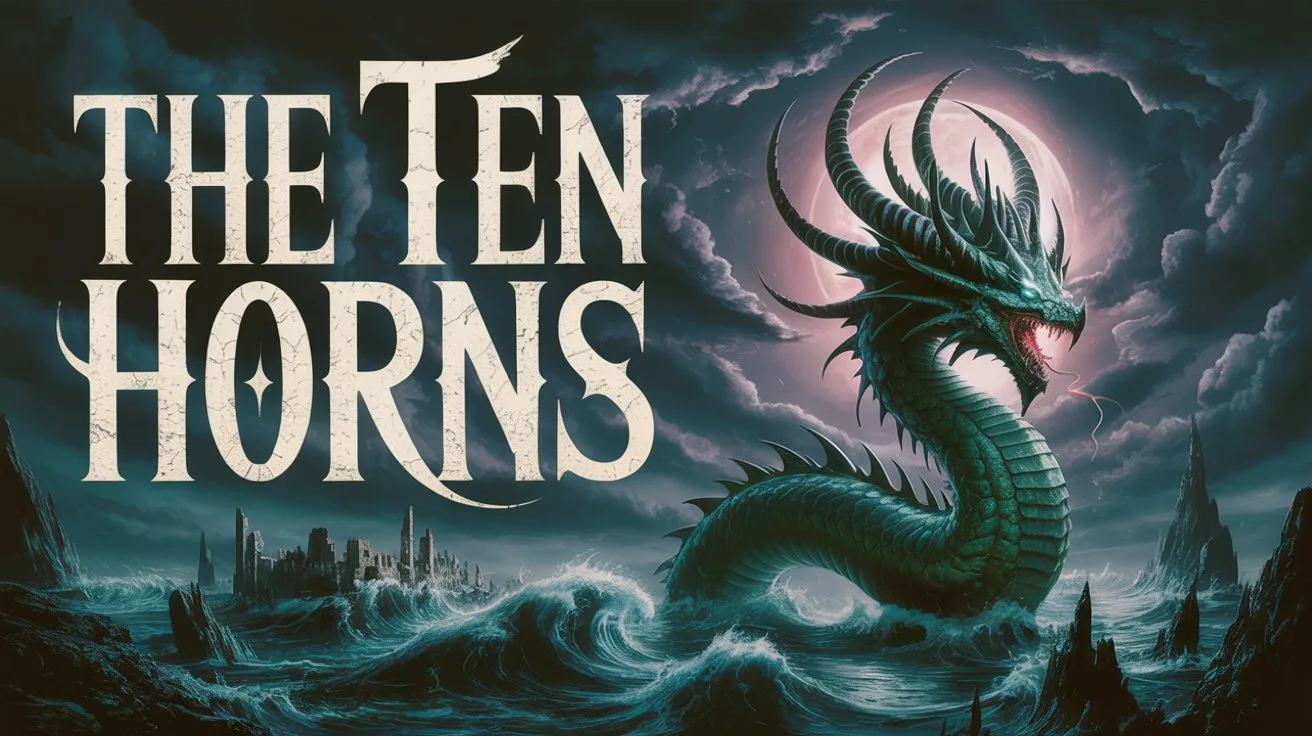
The “ten horns” appear repeatedly in prophetic Scripture, especially in Daniel and Revelation. Horns consistently symbolize kings, rulers, or centers of power. By tracing the passages that mention horns, we can let Scripture explain Scripture. This study walks carefully through Daniel 7–8, Revelation 13, and Revelation 17 to understand what the horns mean, why they are emphasized, and how they fit into God’s plan for the end of the age.
Horns in Biblical Symbolism
In the Bible, horns are a symbol of strength and rulership. Just as the horn of an animal is its weapon and power, so in prophetic visions, horns represent political rulers and their might.
“The ten horns are ten kings Who shall arise from this kingdom.” (Daniel 7:24)
“The ten horns which you saw are ten kings who have received no kingdom as yet, but they receive authority for one hour as kings with the beast.” (Revelation 17:12)
Therefore, the prophetic “horns” are not abstract forces but identifiable rulers or kingdoms in history and in the end times.
The Ten Horns in Daniel 7
“And the ten horns that were on its head, and the other horn which came up, before which three fell, namely, that horn which had eyes and a mouth which spoke pompous words, whose appearance was greater than his fellows…” (Daniel 7:20)
Daniel 7 describes four beasts representing four successive kingdoms. The fourth beast is “terrible and exceedingly strong,” unlike the others. It has ten horns, which Daniel is told represent ten kings that arise out of that kingdom. Among them, a “little horn” emerges, uprooting three, and speaking against God. This little horn makes war with the saints for a limited time (Daniel 7:25).
Key Observations from Daniel 7:
- The ten horns = ten kings arising from the fourth kingdom (Daniel 7:24).
- A little horn arises after them, displacing three (Daniel 7:8, 20).
- This little horn has human-like features (eyes, mouth), blasphemes God, and persecutes the saints (Daniel 7:25).
- The little horn’s dominion lasts “a time, times, and half a time” (3½ years), until judgment comes and the saints receive the kingdom (Daniel 7:26–27).
The Ten Horns in Daniel 8
Daniel 8 gives another vision, this time of a ram (Medo-Persia) with two horns and a goat (Greece) with a prominent horn (Alexander the Great). When the large horn is broken, four arise in its place. Out of one of them grows a little horn that magnifies itself and desecrates God’s sanctuary.
This shows again that horns = kings or rulers, and that “little horns” signify blasphemous leaders who exalt themselves above God.
The Ten Horns in Revelation 13
“And I saw a beast rising up out of the sea, having seven heads and ten horns, and on his horns ten crowns, and on his heads a blasphemous name.” (Revelation 13:1)
The beast from the sea mirrors Daniel’s fourth beast. It has ten horns with crowns (kingly authority). This beast is empowered by the dragon (Satan) and blasphemes God, waging war on the saints (Revelation 13:6–7). The horns show that this beast is not just one man, but a coalition of rulers under one satanic headship.
The Ten Horns in Revelation 17
“The ten horns which you saw are ten kings who have received no kingdom as yet, but they receive authority for one hour as kings with the beast. These are of one mind, and they will give their power and authority to the beast. These will make war with the Lamb, and the Lamb will overcome them…” (Revelation 17:12–14)
Here the horns are explicitly interpreted. They are future kings who have not yet received their kingdoms at John’s time, but will receive authority together, for a short time (“one hour”), aligned with the beast. They give their authority to him, forming a coalition against the Lamb. But Christ overcomes them.
The Mystery of “The Beast That Was, and Is Not, and Yet Is”
“The beast that you saw was, and is not, and will ascend out of the bottomless pit and go to perdition… The seven heads are seven mountains… There are also seven kings. Five have fallen, one is, and the other has not yet come. And when he comes, he must continue a short time. The beast that was, and is not, is himself also the eighth, and is of the seven, and is going to perdition.” (Revelation 17:8–11)
Revelation 17 explains that the beast has seven heads, representing seven kings/kingdoms. At the time of John:
- Five had fallen (past kingdoms/empires).
- One was (the present Roman Empire).
- One had not yet come (a future empire).
- The beast itself is called an “eighth,” but also “of the seven.”
This shows the continuity of beastly world power opposing God across history, culminating in a final expression. The ten horns, however, are distinct… they are ten kings who arise contemporaneously in the final stage, aligning with the beast to oppose Christ.
Summary Table of Horns in Scripture
| Reference | Description | Meaning |
|---|---|---|
| Daniel 7:24 | Ten horns on the fourth beast | Ten kings arising from the final kingdom |
| Daniel 7:8, 20 | Little horn arises, uproots three | A blasphemous ruler consolidating power |
| Daniel 8:20–22 | Two horns (Media/Persia); one large horn (Greece) | Horns = kings; again clarified by angel |
| Revelation 13:1 | Beast from the sea with ten horns, ten crowns | Coalition of kings aligned with the beast |
| Revelation 17:12–13 | Ten horns = ten kings without kingdom yet | Future rulers who unite under the beast |
| Revelation 17:16 | Ten horns hate the harlot | They destroy the harlot (false religious-political system) |
What Does It All Mean?
By letting Scripture interpret itself, we see that the ten horns always represent rulers or kingdoms tied to the final expression of worldly rebellion against God. Daniel and Revelation agree that:
- They are kings in the last days.
- They arise together as part of the final beast/kingdom.
- Three are displaced by the rise of a “little horn” ruler.
- They willingly give their power to the beast, aligning against Christ.
- They ultimately turn against the harlot (false world system) before being destroyed by Christ at His coming (Revelation 17:16–17; 19:19–20).
God reveals the horns not to satisfy curiosity but to strengthen endurance. The horns show the temporary coalition of power that rises in opposition to Christ, but also remind us that every horn is subject to God. Just as Daniel saw the Ancient of Days take His seat and judgment given to the saints (Daniel 7:9–14, 27), Revelation assures us that the Lamb will overcome (Revelation 17:14). The kingdoms of this world will fall; Christ’s kingdom alone is everlasting.
My Final Thoughts
The ten horns symbolize real rulers, real kingdoms, and real opposition to God, but not one of lasting dominion, it is one of inevitable defeat. Whether five fallen, one present, one to come, or ten rising for “one hour,” all beastly power is fleeting. Only the Lamb reigns forever. The saints are called to have discernment, patience, and hope. Do not fear the horns; but rather lift your eyes to the throne. The same visions that show the beast, also show the Son of Man receiving everlasting dominion. The horns are many; the Lamb is one. And the Lamb wins.


 Get the book that teaches you how to evangelize and disarm doctrines from every single major cult and religion.