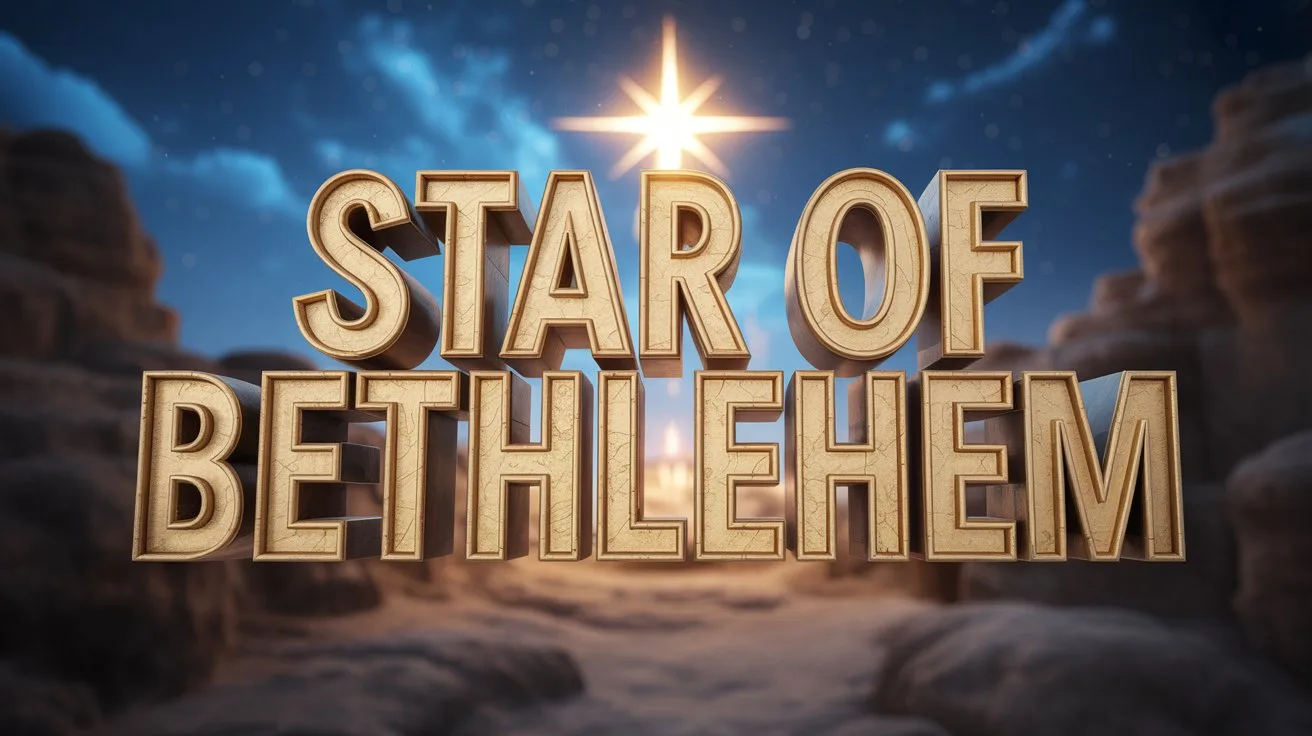
Matthew gives us a short, factual account of something God did to bring Gentile seekers to His Son. In Matthew 2:1-2 the Magi show up in Jerusalem asking about a newborn King, and they tie their trip to a star they call His star. If we read Matthew carefully, the star is not a cute detail or a puzzle piece for endless sky charts. It is a sign God used on purpose to lead people to Jesus, and the whole scene pushes us toward worship, not speculation.
The question they asked
Matthew starts with time and place. Jesus was born in Bethlehem of Judea, and it happened during the reign of Herod. Herod the Great ruled under Rome, and he was known for paranoia and cruelty. Matthew does not pause to give a character profile. He shows Herod’s heart by how he reacts to the idea of a rival king.
Now after Jesus was born in Bethlehem of Judea in the days of Herod the king, behold, wise men from the East came to Jerusalem, saying, "Where is He who has been born King of the Jews? For we have seen His star in the East and have come to worship Him." (Matthew 2:1-2)
The Magi came from the East. Matthew does not name their country, and he never tells us how many there were. A lot of folks assume three because three gifts are mentioned later, but the text does not say three men. It is a small detail, but it helps us read carefully and stick to what Scripture actually says.
His star
Their question in Jerusalem is blunt: where is the one who has been born King of the Jews? Then they add the reason for their trip: they saw His star. Matthew ties the star to a person, not just a bright object they happened to notice. It reads like a sign God assigned to the newborn King.
They also state their purpose: they have come to worship Him. In Matthew, worship is not polite respect. It is bowing down and giving honor that belongs to a king. And since Matthew will show Jesus receiving worship again and again, the reader is meant to feel the weight of what is happening here.
What kind of men
Magi were educated men known in the ancient world for learning, observation, and counsel. They likely watched the heavens, but we do need to keep this straight: Matthew is not promoting astrology or fortune-telling. The Old Testament condemns divination and attempts to read fate in signs. These men are not presented as decoding destiny. They are responding to a sign God gave that pointed to a real event: a king had been born.
One more observation from the wording: they do not ask where a king might be born. They ask where the one who has been born is. They believe the birth is already a fact. They have traveled on that conviction, and now they want to find Him.
The star and the Scriptures
The star gets them moving, but it does not replace God’s written Word. When they arrive in Jerusalem, the palace cannot help them. It only puts them in the path of danger. So God uses Scripture to point them to Bethlehem.
Herod gathers the chief priests and scribes and asks where the Christ is to be born. They answer from the prophet Micah.
So they said to him, "In Bethlehem of Judea, for thus it is written by the prophet: "But you, Bethlehem, in the land of Judah, Are not the least among the rulers of Judah; For out of you shall come a Ruler Who will shepherd My people Israel."' (Matthew 2:5-6)
The irony is hard to miss. The religious experts can identify the right town, but they do not go. The Gentile travelers, with fewer advantages, make the trip and bow down. Matthew is not taking a swing at the Old Testament. He is showing the difference between knowing information and responding with faith.
Why Bethlehem matters
Micah points to Bethlehem as the birthplace of the coming ruler. Bethlehem was small, not the kind of place people associate with power. God often works in ways that keep human pride from taking the credit. He brings the promised King through David’s town and into a humble setting, then He draws both shepherds and foreigners to Him. The point is simple: God keeps His promises exactly where He said He would.
A word note on worship
The Greek word Matthew uses for worship is proskuneo. It means to bow down, to show reverence by lowering yourself before someone. You can see how Matthew uses it as a heart test in this chapter. The Magi come to worship. Herod claims he wants to worship. The Magi actually worship. The same word exposes what is real and what is fake.
That still hits close. It is easy to use religious words while protecting your own throne. When Jesus is presented as King, a person either bows or resists. Neutral does not last long.
Prophecy in the background
Matthew does not stop to explain how the Magi knew a star meant a Jewish king had been born. He reports what they said and keeps moving. Still, the Old Testament gives us a couple of solid anchors that help explain how men from the East could have been watching for something tied to Israel.
During the exile, Jewish people lived in Babylon and beyond, and Daniel served in high places among the wise men of those kingdoms. Daniel 9 speaks of God’s timetable moving toward Messiah. We cannot say exactly what the Magi calculated, because Scripture does not say. But we can say this: Jewish expectation of Messiah was not locked inside Jerusalem, and God had already planted His truth in regions east of Israel.
"Know therefore and understand, That from the going forth of the command To restore and build Jerusalem Until Messiah the Prince, There shall be seven weeks and sixty-two weeks; The street shall be built again, and the wall, Even in troublesome times. (Daniel 9:25)
Another anchor is Balaam’s prophecy, which ties star imagery to a ruler from Jacob. Balaam was not an Israelite prophet in the usual sense, and that is part of what makes it stand out. God put true prophecy on the lips of a man outside Israel, and that prophecy pointed toward Israel’s coming King.
"I see Him, but not now; I behold Him, but not near; A Star shall come out of Jacob; A Scepter shall rise out of Israel, And batter the brow of Moab, And destroy all the sons of tumult. (Numbers 24:17)
When you put those pieces side by side, the shape becomes clear. God’s Word pointed toward a coming King. God used a sign to get these men moving. Then God used Scripture again to land them in the right town. God is not competing with His Word. He is confirming it.
What the star did
Matthew gives the clearest clue about the nature of the star by describing what it did. The question is not whether God can use natural events. He can. The question is what Matthew says happened in this case.
After the Magi leave Herod, the star appears again. Matthew says it went before them and then stood over where the young Child was.
When they heard the king, they departed; and behold, the star which they had seen in the East went before them, till it came and stood over where the young Child was. When they saw the star, they rejoiced with exceedingly great joy. (Matthew 2:9-10)
Those are movement words. Matthew is not describing a distant fixed point they navigated by like sailors. He is describing guidance that functions like a leader.
Movement and stopping
Normal stars do not lead a group down a road and then stop over a specific place. You can chart planets and comets, but Matthew’s verbs are plain and directional. They fit the way Scripture sometimes describes God guiding people, especially when the text wants you to see God’s hand at work.
We do not have to pretend we know the mechanics of the miracle. Matthew does not explain how the light worked. He explains what it accomplished. It guided them to the right region and then to the right location. That is enough to say this was a special act of God, not ordinary stargazing.
Joy with a reason
Matthew records their reaction when they see the star again: they rejoice with exceedingly great joy. That stacked-up phrasing tells you this was not mild interest. They were relieved. They were sure they were close.
Here is a small but important detail that is easy to pass over: the star reappears at a critical moment, right after they have been with Herod. Matthew has already shown us Herod is dangerous. God does not leave these men in the dark right when the threat level rises. He confirms the direction when they need it.
They found a young child
When the Magi arrive, Matthew says they come into a house and see the young Child with His mother. This is not a stable scene. It is a home, and the child is described with a term that points to a little one, not a newborn infant. The text does not give a number of days or months, so we should not be dogmatic about a timeline. But Matthew’s details strongly suggest the Magi did not arrive on the night of Jesus’ birth. That also fits Herod’s later brutality, which is tied to the time information he learned from the Magi.
And when they had come into the house, they saw the young Child with Mary His mother, and fell down and worshiped Him. And when they had opened their treasures, they presented gifts to Him: gold, frankincense, and myrrh. (Matthew 2:11)
Then they worship. The star has done its job when it brings worship to Jesus. They do not kneel to the sign. They kneel to the Child.
The gifts and the shadow
They present gold, frankincense, and myrrh. Gold fits a king. Frankincense was used in worship and points toward honor given to God. Myrrh was used in burial and can point toward death. We should be careful not to over-allegorize the gifts as if the Magi understood every future detail. Matthew does not tell us what they understood. Still, as readers of the whole Gospel, we cannot miss the shadow: the One honored in His early days is the One who will later suffer and die, and then rise again. God’s plan is already moving, even here.
Guidance does not stop
God’s direction continues after worship. The Magi are warned in a dream not to return to Herod, and they go home another way. That shows the star was not a one-off trick in the sky. The whole chapter shows God actively directing events to protect His Son and to frustrate Herod’s plans.
Then, being divinely warned in a dream that they should not return to Herod, they departed for their own country another way. (Matthew 2:12)
Herod’s response in the chapter is the dark contrast to the Magi. The Magi rejoice and worship. Herod is disturbed and plots. Matthew is showing you that the presence of Jesus divides people. The same King who draws honest seekers also threatens those who refuse to yield.
For us, the point is not to become experts in Bethlehem astronomy. Matthew does not invite that. He invites a response to Jesus. God gave these men enough light to move, and then He gave them more light until they reached Christ. He still works by truth and light. He brings the message, He confirms it through Scripture, and He calls people to bow to His Son.
My Final Thoughts
The Star of Bethlehem in Matthew is not presented as a random sky event. It is a guided sign that leads to a guided outcome: worship of Jesus. Its timing, its movement, and its ability to bring them to a specific place all point to God’s direct action.
If you take anything from Matthew 2:1-2 and the rest of the account, take this: God knows how to bring people to Christ, and He does it in a way that honors His written Word. The right response is the Magi’s response. Get to Jesus. Bow to Him. Give Him what He deserves, starting with your trust. Salvation is not earned by travel or gifts, but by God’s grace through faith in Jesus Christ alone, the promised King who came for the whole world, died for our sins, and rose again.



 Get the book that teaches you how to evangelize and disarm doctrines from every single major cult and religion.