
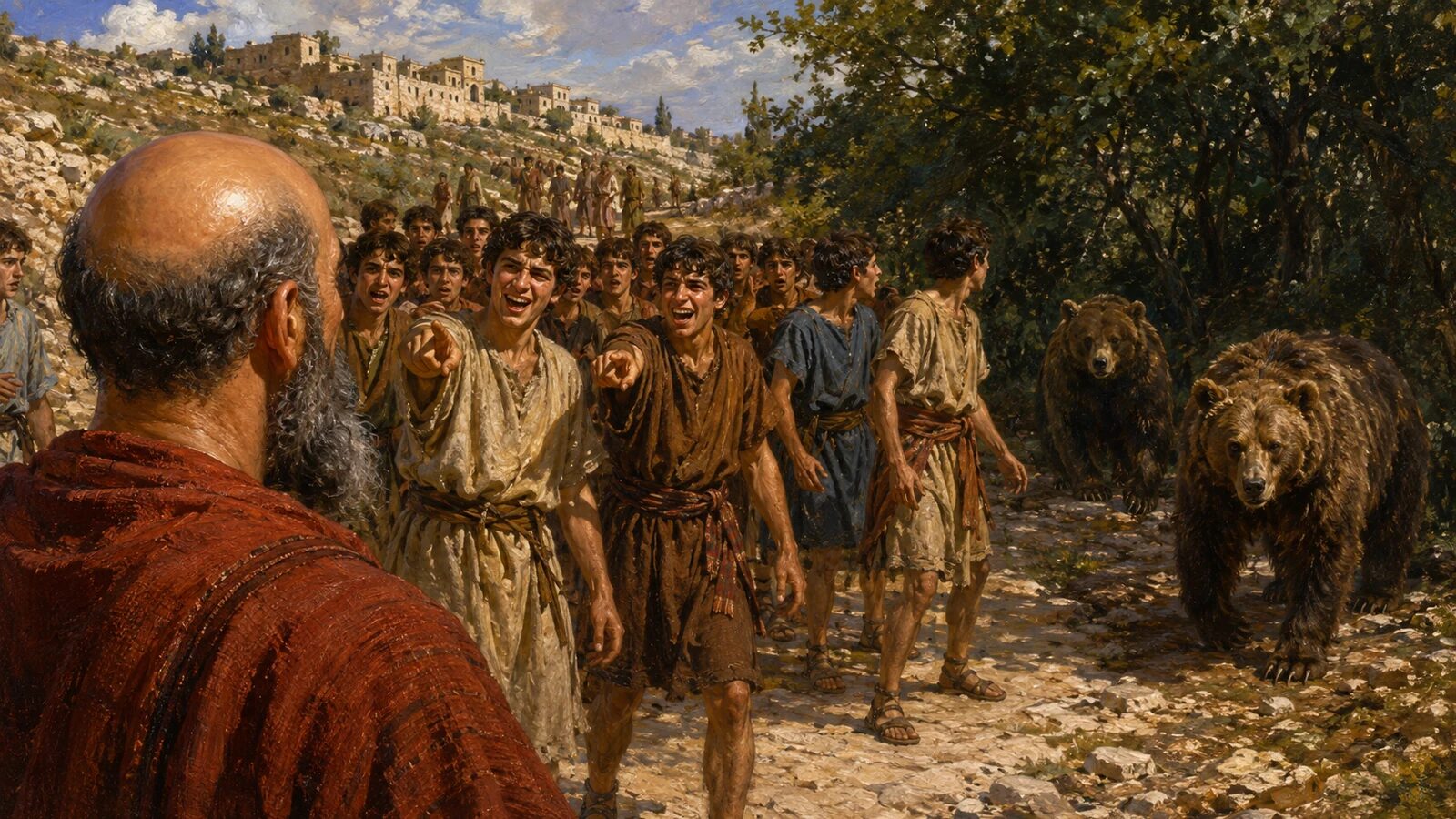
Did Elisha really call down a curse because some little children laughed at his bald head? That is how 2 Kings 2:23-25 is often retold, and I can understand why that description raises questions. But before deciding what happened, we need to look at the youths who confronted him and the city they came from. The setting at Bethel helps us understand why the Lord answered their mockery with such severe judgment.
Two female bears mauled forty-two members of the group, and there is no way to read that lightly. Still, the severity does not make this random violence or mean that God was acting out of wounded pride. Nor does the passage say that everyone who was mauled died. I want to take the judgment seriously without either softening what Scripture records or making it say more than it does.
Elisha Confirmed as Elijah’s Successor
The beginning of 2 Kings 2 helps us understand the confrontation that followed. The Lord was continuing His prophetic word through Elisha after taking Elijah up. Elijah had confronted Ahab and exposed Baal worship, praying during the drought and again when the rain returned. Throughout that ministry he called Israel away from idolatry, and he trained Elisha to carry the work forward.
Elisha’s request for a double portion of Elijah’s spirit belongs in that setting. Under Israel’s inheritance law, the firstborn received a double portion as he carried the family’s responsibility forward. Elisha was asking to be recognized as the heir of Elijah’s prophetic ministry and to receive from God what he needed to serve. He was not asking for twice the fame or twice the power.
And so it was, when they had crossed over, that Elijah said to Elisha, “Ask! What may I do for you, before I am taken away from you?” Elisha said, “Please let a double portion of your spirit be upon me.” So he said, “You have asked a hard thing. Nevertheless, if you see me when I am taken from you, it shall be so for you; but if not, it shall not be so.”
Elijah called this a hard request because the Spirit of God was not his to give. He could tell Elisha what sign to watch for, but only God could grant and confirm the calling. Elisha did see Elijah taken up. When Elijah’s mantle, or cloak, fell to the ground, Elisha picked it up and returned to the Jordan.
What happened at the Jordan publicly confirmed Elisha’s calling. He struck the water with the mantle, and the river parted before him. The sons of the prophets saw it and understood that the Lord’s work through Elijah would continue through Elisha.
Then he took the mantle of Elijah that had fallen from him, and struck the water, and said, “Where is the LORD God of Elijah?” And when he also had struck the water, it was divided this way and that; and Elisha crossed over. Now when the sons of the prophets who were from Jericho saw him, they said, “The spirit of Elijah rests on Elisha.” And they came to meet him, and bowed to the ground before him.
Other prophets witnessed the Jordan parting, so the confirmation of Elisha’s calling was public. They recognized that God was continuing Elijah’s ministry through him, rather than merely watching Elisha perform something impressive. That helps me understand the confrontation later in the chapter. The crowd would be treating a publicly confirmed prophetic office as though it meant nothing.
At Jericho, Elisha encountered bad water that was harming the land, and the Lord healed it through him. By the time he set out for Bethel, both the Jordan and Jericho had given evidence that God had established him as His prophet. Elisha had not appointed himself. Israel now had to respond to the man the Lord had confirmed.
Bethel and the Meaning of the Mockery
Bethel’s history makes the coming confrontation especially serious. Jacob had encountered God there, seeing the ladder that reached to heaven and hearing the covenant promises. He called it Bethel, meaning house of God, and when he later returned he put away the idols carried in his household. The city’s very name should have recalled God’s presence and faithfulness to Israel.
By the time of the divided kingdom, Bethel had become a center of false worship. Jeroboam feared that his people would return to the house of David if they kept traveling to Jerusalem. He answered that political fear by creating a counterfeit religious system. He made golden calves and placed one at Bethel and the other at Dan.
Therefore the king asked advice, made two calves of gold, and said to the people, “It is too much for you to go up to Jerusalem. Here are your gods, O Israel, which brought you up from the land of Egypt!” And he set up one in Bethel, and the other he put in Dan. Now this thing became a sin, for the people went to worship before the one as far as Dan.
By Elisha’s day, false worship was accepted in Bethel with the state’s approval. That helps me understand how open contempt for the Lord’s prophet could grow there. When a community is taught to accept counterfeit worship, it eventually loses reverence for the true God and His Word.
Jeroboam had made disobedience convenient by telling the people that the journey to Jerusalem was too much for them. His alternative protected his throne, so political fear shaped the worship he offered them. Convenience helped that lie take root. Bethel kept its name, house of God, even while the worship practiced there resisted God’s command.
Bethel had already received a warning about that worship. In 1 Kings 13, a man of God came from Judah and spoke against Jeroboam’s altar. The king ordered his arrest, but his own hand withered and remained that way until the prophet prayed for him. The city had seen how seriously the Lord regarded false worship. Generations later, a crowd on the road near Bethel openly mocked the prophet God had just confirmed.
2 Kings gives the event in only a few sentences. Elisha was going up the road when a group came out of the city and chanted at him:
“Go up, you baldhead! Go up, you baldhead!”
The Hebrew word translated “youths,” commonly written as na’ar, does not settle their exact ages. It can refer to a child, but in other settings it describes a teenager or young man, and it can also describe a servant. Understanding that range helps us read the passage more accurately. It does not prove that everyone was an adult, and it does not support picturing a few helpless toddlers wandering out of the city.
The size of the group also affects how I understand this encounter. At least forty-two people were present, since that many were mauled afterward, and the whole crowd may have been larger. They came out from Bethel and repeated their chant at Elisha. We are reading about a public confrontation, not one child making a private insult on a street corner.
Elisha was one man traveling along the road when this crowd came out from the city to confront him. Scripture does not say that every individual shouted, but it records the repeated taunt as the group’s public response. That is a very different situation from harmless playground teasing.
Their words “go up” likely echoed Elijah’s recent departure when he was taken up. We cannot make that connection more certain than the passage allows, but at the very least they were telling Elisha to leave and treating his prophetic office with contempt. God had just confirmed that Elijah’s ministry would continue through Elisha. The crowd’s taunt rejected that succession, so the issue went beyond a joke about his appearance.
The Curse and the Bears as Covenant Judgment
Elisha turned and looked at the youths, then cursed them in the name of the LORD. In Israel’s covenant setting, this was a solemn declaration placing rebellion under God’s judgment. It was not profanity or a magical spell, nor was it an angry wish for personal revenge. I cannot overlook the words “in the name of the LORD” and reduce the encounter to a sensitive man losing his temper over his appearance.
A true prophet spoke as God’s servant, not as a spiritual celebrity acting on his own authority. Deuteronomy 18 says that God would put His words in the prophet’s mouth and hold people accountable for their response. The prophets were not sinless, but despising the word God sent through a confirmed prophet was an offense against more than the man himself. At Bethel, the crowd mocked the office the Lord had just established.
Two female bears came out of the woods and mauled forty-two members of the group. The account presents this as the Lord’s answer to their public contempt, following Elisha’s curse in His name. It does not describe a coincidence, and it does not say that Elisha controlled the animals by private magic. The judgment came from God.
Forty-two people were mauled, so this was an extensive judgment in public, not a passing fright for one or two members of the crowd. At the outset of Elisha’s confirmed ministry, the Lord made clear that people were accountable for their contempt toward His prophetic Word.
The Hebrew verb behind “mauled” is often written as baqa and can describe splitting or tearing something open. That meaning prevents us from treating the attack as a harmless scare. But the passage gives no total of those who died. Some may have died, and others may have survived with terrible wounds. We should not claim to know more. Accepting the severity does not require adding a death count God never gave.
The Law had warned Israel that continued covenant rebellion would bring discipline in the land. That warning included danger from wild beasts:
I will also send wild beasts among you, which shall rob you of your children, destroy your livestock, and make you few in number; and your highways shall be desolate.
The setting is why I understand this attack as covenant judgment. It happened in Israel near a center of idolatry. A crowd publicly mocked Elisha, whom God had just confirmed as His prophet, and the attack followed immediately after Elisha cursed them in the Lord’s name. Taken together with the covenant warning, those details explain this particular event. They do not mean that every animal attack in history is a direct act of divine judgment.
Even the detail that the bears were female belongs to a concrete report of what happened. The Lord used real animals in a real place, and their description records what happened rather than merely adding drama. The Lord did not dismiss Bethel’s contempt for His messenger as harmless noise.
Mockery cannot diminish God’s glory, and He does not need human approval. His response came from holiness, not insecurity. He remained righteous in judging rebellion that had hardened into public contempt for His Word. The severity should make us reconsider a retelling that treats the offense as trivial.
What This Passage Does and Does Not Teach
We should not take Elisha’s action as permission to curse people who annoy or mock us. He was acting as the Lord’s prophet within Israel’s covenant setting. Later, when James and John wanted fire to fall on a Samaritan village that rejected Jesus, He rebuked them. Christians are told to bless those who persecute them, so we must leave judgment with God rather than seek personal vengeance.
Reading about this judgment should make me more careful with my own speech, not eager to see someone else suffer. Taking God’s judgment seriously does not excuse cruelty or require us to become hardhearted. The severity is meant to sober us.
Reducing the confrontation to baldness also makes God appear petty. This crowd came from a city shaped by state-supported idolatry and rejected the prophetic succession God had confirmed earlier in the chapter. Its repeated chant publicly expressed contempt for the Lord’s Word.
Elisha’s authority rested on the Lord’s calling rather than his personality or his own decision to become a prophet. He had trained under Elijah and seen him taken up before receiving the fallen mantle. God then parted the Jordan before him and healed Jericho’s water through him. Defending Elisha’s prophetic office was therefore a defense of the authority of God’s own Word.
The mockery also shows us how contempt can become familiar. Repeatedly making light of God can leave a person so hardened that reverence begins to sound strange. That is why I cannot assume every joke is harmless. The same habit can shape a home or a church and spread through a culture.
God’s patience must not be mistaken for weakness. Some judgments are delayed while others come quickly, but God is not mocked in either case. Galatians 6:7 says that a man will reap what he sows. Bethel had sown false worship and contempt for generations, and this event brought a terrifying warning.
We should also remember the mercy God showed through Elisha. He had already healed Jericho’s water and would later help a widow and raise a child. Naaman would be cleansed, and hungry prophets would be fed. Even the recovery of a lost axe head showed His care for an ordinary human need. The judgment at Bethel belongs alongside those acts of mercy in our understanding of Elisha’s ministry.
I need to take both sides of Elisha’s ministry seriously instead of choosing the picture of God I find easiest to accept. Focusing only on severity can make us feel strong, while focusing only on gentleness can seem easier to defend. Neither gives us the whole picture Scripture presents. The Lord warns because He is patient and judges because He is righteous. His kindness does not lessen His holiness.
Reverence, Mercy, and the Believer’s Response
The youths came from a community where adults had made counterfeit worship normal. That should make anyone whose example influences another person stop and think. A community’s attitude toward God helps shape the next generation, and children may learn to mock openly what adults treat casually.
I would not equate every disrespectful young person with the crowd at Bethel. But neither should adults blame a generation without examining what their own example has taught. What our families and churches repeatedly honor shapes the young people among us, as does the wider community. What adults make light of may become the next generation’s open rebellion.
Our own speech deserves that scrutiny too. Sarcasm can feed contempt until a person no longer trembles before God. Truth and grace should govern how we speak, with a real fear of the Lord behind our words. Humor should never become a way to practice unbelief or teach someone else to despise what God calls holy.
Knowing that God sees contempt for His Word also gives us a reason to leave vengeance alone. He is present, knows every heart, and will judge rightly. I do not have to take His place. We can bless those who persecute us and entrust justice to the Judge of all the earth.
This passage brings me to our need for Christ, because every sinner has treated God with contempt. Even respectful words cannot undo a life that has rejected His rightful rule. We cannot place our hope in having shown enough reverence. Jesus, the eternal Son, is fully God and fully man and lived without sin. Wicked men physically tortured Him and shed His blood, then killed Him. He willingly bore that real punishment for our sins in His innocent body and rose bodily from the grave. The Father did not punish or curse Jesus, nor did He abandon Him. He did not strike or bruise His Son or pour wrath on Him. Father and Son remained united in the work of redemption.
Christ died for the sins of the whole world, and God genuinely offers salvation to every person, though people can resist and reject it. The sinner who repents and trusts in Jesus is forgiven and born again. The Holy Spirit dwells within him and seals him, and his eternal life is secure in Christ. That security gives no permission for lawlessness, and a shallow profession without new life does not prove genuine faith. We learn reverence because we have received mercy, not as a price we must pay to receive it.
For related studies, see The Word of the Lord in the Old Testament, The Name of the Lord, and A Complete Bible Study on Prayer.
My Final Thoughts
Reading 2 Kings 2 alongside Bethel’s history, I do not see an angry prophet taking revenge on a few toddlers. The crowd came from a city steeped in counterfeit worship and publicly despised a prophet whom God had confirmed as Elijah’s successor. The bears brought severe covenant judgment, although Scripture does not tell us that all forty-two youths died. That judgment gives me no right to retaliate when someone mocks me. It should make me careful with my own speech and attentive to God’s Word. We can trust Him to judge rightly while gratefully receiving the mercy He offers through Christ.