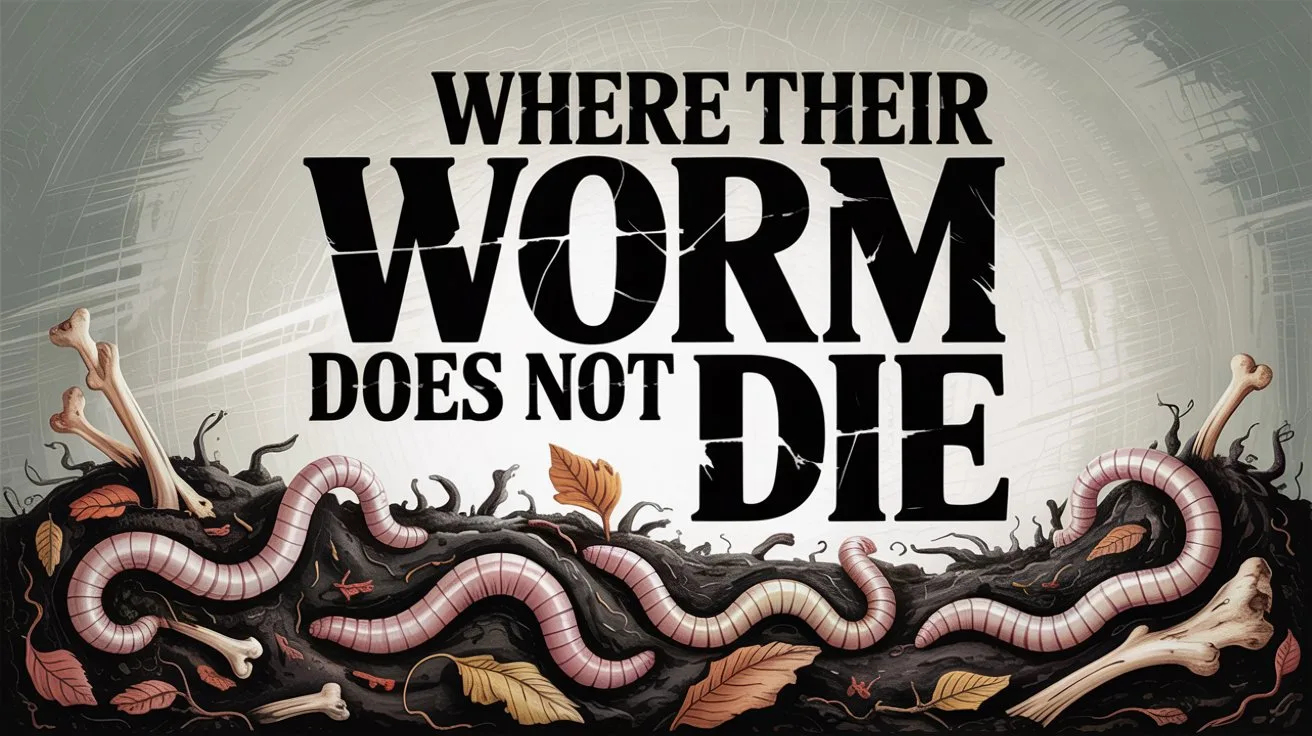
Mark 9 is not a speculative teaching on the metaphysics of the afterlife. It is a pastoral warning spoken by Jesus to His disciples about the seriousness of sin, stumbling blocks, and the cost of discipleship. The language is intentionally severe because the consequences are severe. But severity does not automatically mean eternal conscious torment, and it certainly does not give us permission to read ideas into the text that are not there.
Jesus says:
“Where their worm does not die
And the fire is not quenched.” (Mark 9:48)
At first glance, this verse sounds like a description of endless suffering. Many readers stop there. But Jesus did not speak these words in a vacuum, nor did His Jewish audience hear them that way. The critical question is simple and unavoidable: Is Jesus introducing a new doctrine, or is He quoting Scripture?
The answer is… He is quoting Scripture.
Jesus Is Quoting Isaiah 66:24
Mark 9:48 is a direct quotation of the final verse of the book of Isaiah:
“And they shall go forth and look
Upon the corpses of the men
Who have transgressed against Me.
For their worm does not die,
And their fire is not quenched.
They shall be an abhorrence to all flesh.” (Isaiah 66:24, NKJV)
This matters immensely, because Isaiah 66 is not describing conscious souls suffering endlessly. It is describing dead bodies… corpses, after divine judgment. The Hebrew word used is explicit that these are slain rebels. The scene is public, visible, and final. People “go forth and look” at the outcome of rebellion against God.
Jesus is not redefining Isaiah. He is reinforcing it.
Corpses, Not Conscious Spirits
Isaiah’s picture is unmistakable. The objects being consumed are not living beings experiencing pain. They are corpses. Dead bodies lying exposed after judgment. The horror of the scene is not eternal torment, but total defeat, disgrace, and destruction.
This is critical because Scripture consistently distinguishes between judgment and process. Isaiah is describing the aftermath of judgment, not the experience of the wicked while alive.
Jesus adopts this imagery precisely because His audience knew Isaiah. When He speaks of Gehenna, He is invoking a familiar prophetic warning rooted in Israel’s Scriptures, not Greek philosophical ideas about immortal souls.
“Where Their Worm Does Not Die”
The “worm” in both Isaiah 66:24 and Mark 9:48 refers to maggots… creatures that consume dead flesh. This is not symbolic of an immortal soul being eaten forever. It is a picture of shame and completeness.
The worm “does not die” because the bodies are not rescued, buried, or preserved. Nothing interrupts the process. The consumption is thorough. The judgment will not be reversed.
Nowhere does Scripture say the wicked are worms, or that humans are eternally gnawed by worms while alive. That idea comes from later theological imagination, not the text.
“The Fire Is Not Quenched”
This phrase also has a defined biblical meaning. An “unquenchable” fire is not one that burns forever. It is one that cannot be stopped until it has accomplished its purpose.
Consider Jeremiah 17:27:
“Then I will kindle a fire in its gates,
And it shall devour the palaces of Jerusalem,
And it shall not be quenched.” (Jeremiah 17:27, NKJV)
That fire is no longer burning today. It was unquenchable because no one could put it out, not because it was everlasting.
The same language appears in Ezekiel 20:47–48:
“Behold, I will kindle a fire in you,
And it shall devour every green tree and every dry tree in you;
The blazing flame shall not be quenched…” (Ezekiel 20:47–48, NKJV)
Again, the fire was unstoppable, not everlasting.
Jesus is using this exact prophetic language. The fire of judgment cannot be resisted, escaped, or extinguished prematurely. It does its work fully.
Gehenna and the Valley of Hinnom
When Jesus warns about Gehenna, He is not introducing a new theological concept. He is using a term already loaded with meaning for His Jewish audience. Gehenna is the Greek form of the Hebrew Ge Hinnom, the Valley of Hinnom… an actual, physical location just outside Jerusalem.
The Valley of Hinnom had a long and dark history in Israel. In the Old Testament, it was infamous as the place where apostate Israelites practiced child sacrifice to Molech.
“They built the high places of Baal, which are in the Valley of the Son of Hinnom, to cause their sons and their daughters to pass through the fire to Molech…” (Jeremiah 32:35, NKJV)
Because of this abomination, God pronounced judgment on the valley and renamed it a place of slaughter rather than worship.
“Therefore behold, the days are coming, says the LORD, that it shall no more be called Tophet, or the Valley of the Son of Hinnom, but the Valley of Slaughter.” (Jeremiah 7:32, NKJV)
This is the biblical foundation of Gehenna. It is a place associated with idolatry, judgment, death, defilement, and divine wrath. Importantly, the Old Testament never associates the Valley of Hinnom with the conscious torment of living people forever. It is associated with death and destruction.
Was Gehenna a Burning Trash Dump?
A common claim is that Gehenna was a perpetually burning garbage dump outside Jerusalem, where refuse and corpses were constantly consumed by fire. This idea is popular in sermons, but it must be handled carefully.
There is no direct Old Testament text that explicitly describes Gehenna as a municipal trash incinerator. Most references to this idea come from later rabbinic writings and medieval sources, not from Scripture itself. Some scholars believe the valley may have been used for the disposal of refuse or unclean remains at certain periods, but the evidence is limited and debated.
What is certain is more important… even if Gehenna was not a continuously burning landfill, it was unquestionably viewed as a defiled place of judgment and death. Whether through fire, decay, or exposure, what ended up there was destroyed, not preserved.
Jesus does not ground His warning in civic sanitation practices. He grounds it in prophetic imagery already established in Isaiah, Jeremiah, and Kings. The force of His warning comes from Scripture, not from folklore.
Gehenna in Jewish Thought Outside the Bible
By the Second Temple period, Gehenna had taken on a broader symbolic meaning in Jewish thought. Intertestamental literature and later rabbinic writings often use Gehenna as a metaphor for divine judgment. Some Jewish texts describe Gehenna as corrective or temporary. Others describe it as a place of destruction. The diversity itself is significant and there was no single, settled doctrine of what it meant in first-century Judaism that Jesus was affirming.
This is critical. Because, if Jesus intended to teach eternal conscious torment, He would have needed to explain it clearly. Instead, He consistently sticks with Old Testament judgment language… a fire that consumes, destruction that is final, death that is irreversible. All images of a total final destruction. His language matches Isaiah 66:24: dead bodies, disgrace, fire completing its work, and nothing being rescued.
Gehenna represents the final outcome of a rebellion against God. It is the place where judgment is executed and finished. The emphasis is not on how long something burns, but on the certainty that it will burn and that no one can stop it.
This aligns perfectly with Jesus’ own words elsewhere:
“But fear Him who is able to destroy both soul and body in hell.” (Matthew 10:28)
So how did Jesus describe the punishment? Destruction, not perpetual preservation.
What Gehenna Is Not
Gehenna is not a philosophical torture chamber derived from Greek thought. It is not a place where God keeps people alive forever for the purpose of suffering. That idea comes later and from outside the biblical framework.
Gehenna is a biblical warning rooted in Israel’s history… rebellion leads to judgment, judgment leads to destruction, and that destruction is final.
Jesus uses Gehenna because it was the clearest, most sobering image His audience had for total loss, divine judgment, and irreversible ruin.
This Fits the Broader Teaching of Jesus
Again, Jesus Himself defines the outcome of judgment elsewhere:
“But fear Him who is able to destroy both soul and body in hell.” (Matthew 10:28)
Destruction is the stated outcome, not endless sustaining of life in torment. Paul even specifies this exact interpretation:
“These shall be punished with everlasting destruction from the presence of the Lord…” (2 Thessalonians 1:9, NKJV)
Everlasting destruction is not everlasting destroying. It is a destruction whose result is permanent.
The Psalms also speak the same way:
“But the wicked shall perish…
They shall vanish.
Into smoke they shall vanish away.” (Psalm 37:20)
Smoke does not scream forever. It dissipates.
What Is Not Said in Mark 9:48
Notably absent from Mark 9:48 are words commonly associated with conscious torment. There is no reference to pain, agony, suffering, or torment. The Greek word basanizō is not used. That is because Jesus is not describing the experience of the wicked, He is describing the certainty and finality of judgment using Isaiah’s imagery.
The warning is real. The fear is appropriate. The judgment is severe. But it is destructive, not preservative.
Some object and say, “If it’s destruction, why warn so strongly?” The answer is simple… the second death is terrifying. It is irreversible. A Judgment which is not something to trivialize.
Jesus warns because life and death are at stake. He does not warn because God delights in suffering, but because God desires repentance and life.
Let Scripture Interprets Scripture
When Mark 9:48 is read in isolation, confusion is understandable. But, when it is read in light of Isaiah 66:24, the meaning becomes clear. Jesus is not redefining judgment, He is reaffirming it.
Dead rebels. Public shame. Total destruction. A fire that can’t be put out and finishes its work. A worm that completely eats corpses. Nobody is rescued, nobody is preserved.
That is the picture we are given from our Lord.
My Final Thoughts
Mark 9:48 is one of the strongest warnings Jesus ever gave, but it is not a proof text for eternal conscious torment. Jesus is quoting Isaiah, not inventing a new doctrine. Isaiah’s picture is one of corpses after judgment, not living souls in endless pain. The worm and the fire speak of completeness and inevitability, not perpetual suffering.
Scripture consistently teaches that the wages of sin is death, that the wicked are destroyed, that they perish, and that their end is final. Judgment is real. Hell is real. The second death is real. But nowhere does Jesus say God preserves the wicked forever for the purpose of torment.
We must let Scripture define its own terms. When we do, Mark 9:48 becomes a sobering warning grounded in prophetic truth, not a contradiction of the gospel, but a call to repentance and life.



 Get the book that teaches you how to evangelize and disarm doctrines from every single major cult and religion.