
Nebuchadnezzar is one of the most important rulers in the Bible’s record, not because he was godly, but because God used his life to display a timeless truth: the Most High rules in the kingdom of men, and He will bring every human empire to its appointed end. In Daniel, we are shown how the Lord confronted a proud king with revelation, judgment, patience, and finally humility.
This study will walk carefully through the key passages that involve Nebuchadnezzar, with special focus on his dream of the great statue in Daniel 2. We will also connect that prophecy to the wider prophetic framework of Daniel and Revelation, always letting Scripture interpret Scripture and keeping our attention on the central point God intended: His kingdom will stand forever.
Nebuchadnezzar in God’s Plan
When we first meet Nebuchadnezzar in Daniel, he is the emperor of Babylon, the dominant world power of that era. He is not presented as a seeker of the true God. He is presented as a conqueror who has taken Jerusalem and carried Judah into exile. Yet even in that painful event, Scripture makes clear that God was not absent. He was working through discipline, keeping His promises, and preparing the stage for future revelation.
In Daniel 1, we learn that God allowed Judah to be delivered into Babylon’s hand, and God also gave Daniel favor and wisdom while he lived under a pagan regime. This is important because Daniel does not interpret dreams and reveal mysteries by political savvy or personal brilliance. God Himself gives insight. That sets the theme for everything that follows: God can speak in Babylon, God can sustain His people in exile, and God can humble the greatest king on earth.
“And the Lord gave Jehoiakim king of Judah into his hand, with some of the articles of the house of God, which he carried into the land of Shinar to the house of his god; and he brought the articles into the treasure house of his god.” (Daniel 1:2)
That verse does not excuse Babylon’s sin, but it does show that the exile was not random. God was dealing with His covenant people, and at the same time God was setting up a moment in history where He would announce, through a pagan king’s dream and a Hebrew prophet’s interpretation, the general outline of Gentile world empires until the establishment of God’s everlasting kingdom.
The Crisis That Opened Heaven
Daniel 2 begins with a problem that would terrify any ruler. Nebuchadnezzar has a dream that troubles him deeply, but he demands not only the interpretation, he demands that the wise men tell him the dream itself. In other words, he will accept no guesswork, no manipulation, and no religious performance. If they truly have access to the divine realm, they must prove it.
This moment highlights the emptiness of Babylon’s spiritual system. The king’s counselors are forced to confess a limitation: what the king is asking cannot be done by human ability. That confession becomes the doorway for God to demonstrate that He alone reveals mysteries. The Lord does not reveal the dream because Nebuchadnezzar deserved it, but because God intended to make His name known, strengthen His people, and declare the future course of kingdoms.
“The Chaldeans answered the king, and said, ‘There is not a man on earth who can tell the king’s matter; therefore no king, lord, or ruler has ever asked such things of any magician, astrologer, or Chaldean.’” (Daniel 2:10)
Daniel’s response is not panic, and it is not bravado. He asks for time, gathers his friends to seek mercy from God, and then God reveals the mystery. This pattern matters. When God gives prophetic truth, it is not to entertain the curious. It is given in response to prayer and for the purpose of glorifying God and strengthening faithful obedience.
“Then the secret was revealed to Daniel in a night vision. So Daniel blessed the God of heaven.” (Daniel 2:19)
Daniel’s blessing includes a crucial statement: God changes times and seasons, removes kings and raises up kings. That does not eliminate human responsibility, but it does establish the reality that history is not ultimate. God is ultimate. Kings rule, but not independently of God’s rule over history.
The Great Statue Revealed
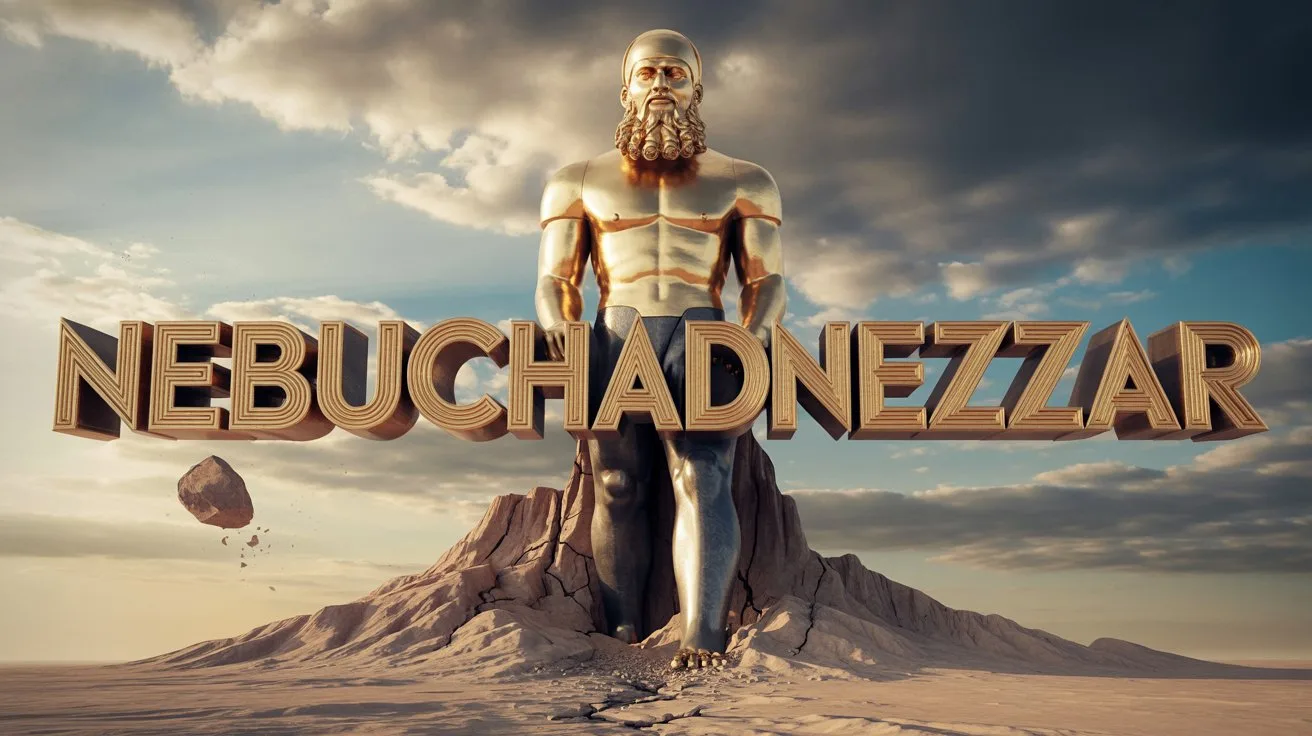
Nebuchadnezzar’s dream, as Daniel recounts it, is a striking vision: a single statue made of different materials, decreasing in value from gold to silver to bronze to iron, and ending with feet mixed with iron and clay. The dream is not merely about Babylon. It is about a sequence of Gentile empires and how they relate to God’s final kingdom.
Daniel describes the statue plainly. The head is gold. The chest and arms are silver. The belly and thighs are bronze. The legs are iron. The feet and toes are partly iron and partly clay. Then the dream turns: a stone, cut without hands, strikes the statue at its feet, breaks it completely, and becomes a great mountain that fills the whole earth.
“You, O king, were watching; and behold, a great image! This great image, whose splendor was excellent, stood before you; and its form was awesome. This image’s head was of fine gold, its chest and arms of silver, its belly and thighs of bronze, its legs of iron, its feet partly of iron and partly of clay.” (Daniel 2:31-33)
The vision communicates something about human kingdoms as a whole. They may look impressive, unified, and towering, but they are not permanent. Their glory fades, their strength shifts, and in the end they are shattered, not improved, by the arrival of God’s kingdom.
“You watched while a stone was cut out without hands, which struck the image on its feet of iron and clay, and broke them in pieces.” (Daniel 2:34)
The detail that the stone is “cut out without hands” matters. In Scripture, “hands” frequently represent human action and human craftsmanship. The stone’s origin is not human. What destroys the statue is not the next empire in the sequence. It is something altogether different: a divine intervention that ends the entire system of earthly dominion and replaces it with an everlasting kingdom.
Babylon The Head of Gold
Daniel begins the interpretation by addressing Nebuchadnezzar directly. There is no ambiguity about the head of gold. Nebuchadnezzar and his kingdom represent the first part of the statue. Babylon’s wealth, architectural achievements, and imperial authority make the symbolism of gold fitting. Yet gold also carries a moral warning: outward splendor often hides inward pride.
“You, O king, are a king of kings. For the God of heaven has given you a kingdom, power, strength, and glory; and wherever the children of men dwell, or the beasts of the field and the birds of the heaven, He has given them into your hand, and has made you ruler over them all. You are this head of gold.” (Daniel 2:37-38)
Notice how Daniel speaks. He does not flatter the king as if Nebuchadnezzar earned his position by sheer greatness. Daniel plainly says the God of heaven gave him his kingdom. This is a direct challenge to Babylon’s ideology, which credited the gods of Babylon and the greatness of the emperor. Daniel makes it personal: Nebuchadnezzar is accountable to the God he does not know.
Babylon also becomes a lasting biblical symbol. Later Scripture uses “Babylon” as a picture of human arrogance, spiritual confusion, and idolatrous world systems. Revelation 17-18 portrays “Babylon” as a final expression of worldly power and corruption opposed to God. Even if the symbol develops across Scripture, the moral lesson is consistent: when human glory is detached from submission to the true God, it becomes ripe for judgment.
At the same time, we should not miss God’s mercy. God did not simply destroy Nebuchadnezzar without warning. He confronted him with truth and invited him, through Daniel’s witness, to recognize the true God. The Lord was giving light to a ruler in darkness.
Medo Persia and Greece
After Babylon, Daniel speaks of another kingdom that will arise, “inferior” in splendor, represented by silver. The statue’s chest and arms being two-part fits well with the Medo-Persian Empire, a dual kingdom that succeeded Babylon. Historically, Babylon fell in 539 BC, and the Medes and Persians became the next dominant power.
“But after you shall arise another kingdom inferior to yours; then another, a third kingdom of bronze, which shall rule over all the earth.” (Daniel 2:39)
The “inferior” nature should not be read as weaker in every way, but as lower in the statue’s descending scale of metals. Silver is less valuable than gold. It suggests a decline in glory, even if the empire was extensive and administratively powerful. Scripture elsewhere highlights the certainty of this transition. Isaiah even named Cyrus long before he rose, showing that God can identify rulers before their generation arrives.
“Thus says the Lord to His anointed, to Cyrus, whose right hand I have held.” (Isaiah 45:1)
Then comes the bronze kingdom, widely understood as Greece under Alexander the Great and the Hellenistic world that followed. Bronze was common in armor and weaponry in the ancient world, and Greece was known for military conquest as well as cultural influence. The Greek language and Hellenistic culture formed much of the environment into which the New Testament was later delivered. God was moving history, even through empires that did not worship Him, to prepare roads, languages, and conditions in which the gospel would spread rapidly in the first century.
What we should notice in Daniel 2 is the simplicity: Babylon, then another, then another. The point is not merely academic identification. The point is that God knows the flow of history in advance. Empires rise, flourish, and fall, and none of them is ultimate.
Rome and the Divided Kingdom
The fourth kingdom is described differently. It is not mainly described by its splendor but by its crushing strength. Iron breaks and shatters. The symbolism aligns well with Rome, known for its military discipline, legal structure, and ability to crush resistance. Rome also forms the immediate political backdrop to the earthly life and crucifixion of Jesus the Messiah.
“And the fourth kingdom shall be as strong as iron, inasmuch as iron breaks in pieces and shatters everything; and like iron that crushes, that kingdom will break in pieces and crush all the others.” (Daniel 2:40)
The legs being two also has often been understood to reflect aspects of Rome’s eventual division, though interpreters have approached that detail in different ways. What is unmistakable is that the vision continues beyond strong iron legs to a final stage: feet and toes mixed with iron and clay. This mixture represents a form of divided strength and weakness. Iron remains, but it is combined with brittle material, resulting in instability.
“Whereas you saw the feet and toes, partly of potter’s clay and partly of iron, the kingdom shall be divided; yet the strength of the iron shall be in it, just as you saw the iron mixed with ceramic clay.” (Daniel 2:41)
Daniel explains that this mixture does not truly bond. It is not a durable unity. There is some strength, but it is compromised by fragility and division.
“As you saw iron mixed with ceramic clay, they will mingle with the seed of men; but they will not adhere to one another, just as iron does not mix with clay.” (Daniel 2:43)
Many understand this as pointing to the fragmented condition of kingdoms that emerged after Rome’s decline, especially in regions once dominated by Roman power. Whether one emphasizes Europe, the Mediterranean world, or the broader legacy of Rome’s political influence, the theme is clear: the final stage of Gentile dominion is not a single pure metal. It is mixed, unstable, and vulnerable to sudden collapse when God’s appointed time comes.
This prepares us for the dream’s main turning point. The statue is not gradually improved by human progress. It is decisively judged by the arrival of God’s kingdom. The future is not ultimately in the hands of the strongest empire, but in the hands of the God who sets up a kingdom that will never be destroyed.
The Stone Cut Without Hands
The most powerful image in the dream is the stone. It is not part of the statue. It is not another metal. It does not arise from the same system. It comes from outside the image, and it is “cut out without hands.” Then it strikes the statue at its weakest point, the feet, and the whole structure collapses. The materials become like chaff blown away by the wind. The stone then becomes a great mountain and fills the whole earth.
“Then the iron, the clay, the bronze, the silver, and the gold were crushed together, and became like chaff from the summer threshing floors; the wind carried them away so that no trace of them was found. And the stone that struck the image became a great mountain and filled the whole earth.” (Daniel 2:35)
Daniel interprets the meaning plainly: the God of heaven will set up a kingdom that will never be destroyed. It will not be left to other people. It will break in pieces and consume all these kingdoms. It will stand forever.
“And in the days of these kings the God of heaven will set up a kingdom which shall never be destroyed; and the kingdom shall not be left to other people; it shall break in pieces and consume all these kingdoms, and it shall stand forever.” (Daniel 2:44)
This is where we should be careful and biblical. The stone ultimately represents God’s kingdom established by divine action, not human political construction. It is reasonable, in light of the whole Bible, to see the stone connected to the Messiah Himself. Psalm 118 speaks of a stone rejected that becomes chief cornerstone. Jesus applies that imagery to Himself. The New Testament also presents Christ as the cornerstone and the coming King who will rule the nations.
“Jesus said to them, ‘Have you never read in the Scriptures: “The stone which the builders rejected Has become the chief cornerstone. This was the Lord’s doing, And it is marvelous in our eyes”?’” (Matthew 21:42)
Daniel 2 emphasizes the decisive end of earthly kingdoms when God’s kingdom comes in its fullness. Christians have long recognized a “now and not yet” aspect to the kingdom in the New Testament. Christ has already come, and He is already exalted at the right hand of God. Yet Scripture also teaches a future, visible fulfillment when He returns, judges, and reigns in righteousness. The dream’s language about crushing all kingdoms and filling the earth points us toward that consummation.
So the statue is not merely a timeline. It is a sermon in visual form: man builds empires, boasts in power, and trusts in strength, but God will end the whole system and establish what cannot be shaken.
Nebuchadnezzar’s Humbling Lessons
It is easy to treat Daniel 2 as only a prophecy chart. But Daniel is also the record of God dealing with Nebuchadnezzar personally. God does not only reveal the future to him. God confronts his pride in the present.
In Daniel 3, Nebuchadnezzar builds a massive image of gold and demands worship. The account shows the same heart that appears in Daniel 2, a man impressed with glory and determined to control worship. Yet God preserves Shadrach, Meshach, and Abed-Nego in the fiery furnace. Nebuchadnezzar is forced to admit that their God is able to deliver.
“Nebuchadnezzar spoke, saying, ‘Blessed be the God of Shadrach, Meshach, and Abed-Nego, who sent His Angel and delivered His servants who trusted in Him!’” (Daniel 3:28)
That confession is significant, but it is not the end of his pride. In Daniel 4, God gives Nebuchadnezzar another dream, this time about a great tree that is cut down. Daniel warns the king that the dream speaks of judgment coming upon him, and he urges repentance and mercy toward the poor. That call shows God’s heart: warning comes before discipline, and discipline aims at restoration.
“Therefore, O king, let my advice be acceptable to you; break off your sins by being righteous, and your iniquities by showing mercy to the poor. Perhaps there may be a lengthening of your prosperity.” (Daniel 4:27)
Nebuchadnezzar does not heed the warning. He boasts over Babylon, and immediately God’s word falls. He is humbled, losing his sanity for a time, until he learns the lesson that rulers most need to learn: God reigns, and human pride is madness.
“And they shall drive you from men, and your dwelling shall be with the beasts of the field… till you know that the Most High rules in the kingdom of men, and gives it to whomever He chooses.” (Daniel 4:25)
Daniel 4 is one of the most personal chapters in prophetic Scripture because it contains Nebuchadnezzar’s own testimony of being brought low and then restored. When his understanding returns, he blesses the Most High and praises and honors Him. He finally speaks as a man who has learned that God’s rule is not theoretical. It is real, and it reaches into the palace.
“Now I, Nebuchadnezzar, praise and extol and honor the King of heaven, all of whose works are truth, and His ways justice. And those who walk in pride He is able to put down.” (Daniel 4:37)
Was Nebuchadnezzar truly converted? Daniel does not give us a systematic statement of his faith like we might want. But it does give us his confession of the true God and his acknowledgment of God’s justice and authority. At minimum, we should say the Lord brought him from arrogant self-worship to humble recognition of the King of heaven. And we should see in that transformation both warning and hope. God can humble the proud, and God can grant mercy to the humbled.
Connection to Revelation
The prophecy of Daniel does not stand alone. Later biblical prophecy builds on the same basic themes: human kingdoms oppose God, human power becomes idolatrous and persecuting, and then God intervenes decisively through the Messiah to establish His reign. Revelation describes a final concentration of rebellious world power under “the beast.” While Daniel 2 gives the overview of successive empires, Revelation emphasizes the final conflict and the ultimate victory of Christ.
Revelation draws imagery from Daniel in multiple places, including beasts representing kingdoms and rulers. The point is not to sensationalize current events but to remain faithful to what God has said: there is an endpoint to human rebellion, and Christ will reign.
“Then I stood on the sand of the sea. And I saw a beast rising up out of the sea, having seven heads and ten horns.” (Revelation 13:1)
When Daniel describes the feet and toes, he emphasizes division, mixture, and instability, yet still connected to iron. Many see a correspondence between Daniel’s final stage and Revelation’s final world system, especially where Revelation references ten horns and a final coalition of power. Without being dogmatic beyond Scripture, it is responsible to say that Daniel’s statue points toward an end-time world arrangement that is both strong and fragile, and that will finally be shattered by the direct intervention of God’s King.
Revelation also gives us the clearest picture of Christ’s victorious return. He does not negotiate with the kingdoms of this world. He overcomes them.
“And the seventh angel sounded: And there were loud voices in heaven, saying, ‘The kingdoms of this world have become the kingdoms of our Lord and of His Christ, and He shall reign forever and ever!’” (Revelation 11:15)
Daniel’s stone becomes a mountain that fills the whole earth. Revelation’s Christ reigns forever and ever. The harmony is unmistakable: earthly empires are temporary, but the kingdom of God is eternal. The Bible does not leave history unresolved. It moves toward a conclusion where righteousness is established, evil is judged, and the rightful King is honored openly.
My Final Thoughts
Nebuchadnezzar’s life is a mirror held up to every generation: human power is real, but it is not ultimate; human pride is common, but it is not safe. God confronted a pagan king with truth, humbled him when he refused correction, and taught him that the King of heaven rules over all. That same God still calls people to humility, repentance, and faith.
The statue in Daniel 2 reminds us not to anchor our hope in any nation, system, or leader. Everything human eventually becomes dust before God’s everlasting kingdom. The wise response is to bow willingly now, trust the Lord Jesus Christ, and live faithfully with confidence that God will finish what He has promised.
 Get the book that teaches you how to evangelize and disarm doctrines from every single major cult and religion.