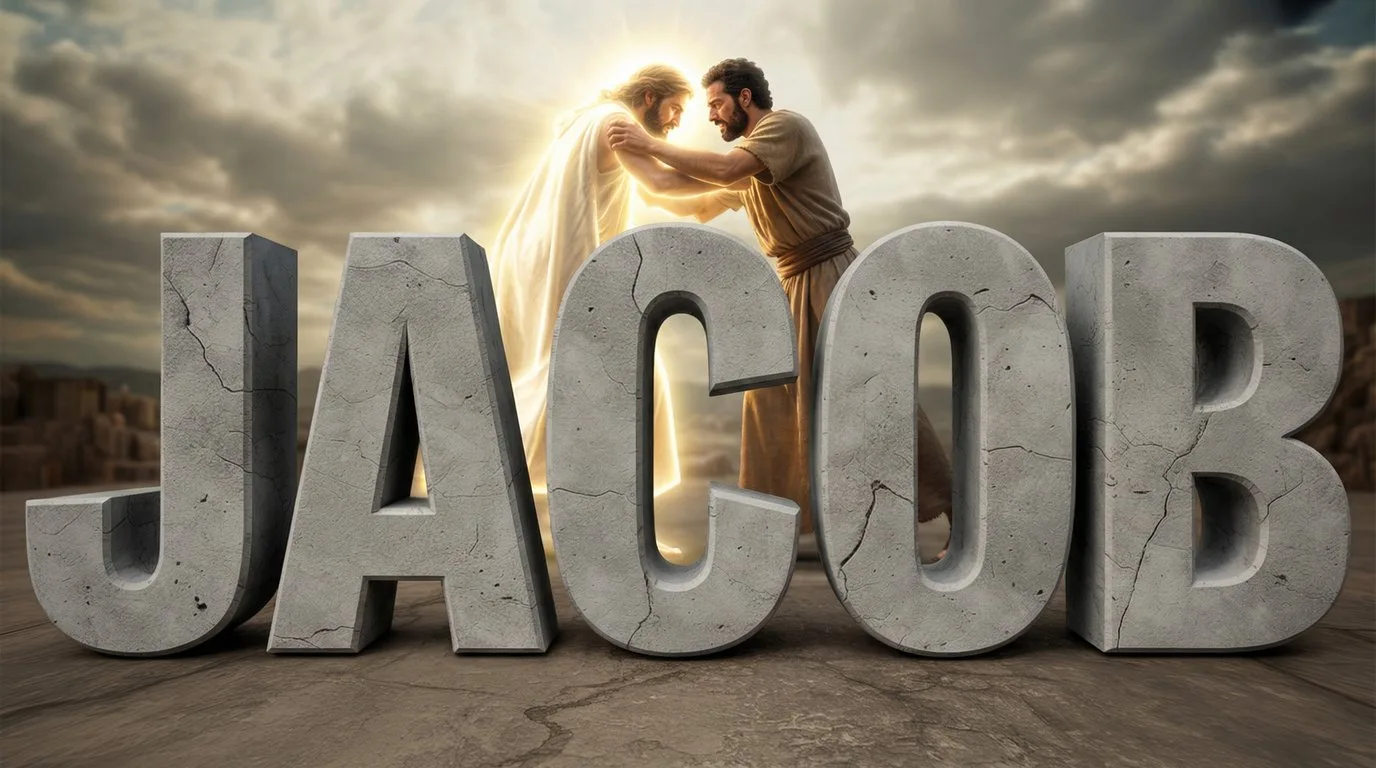
Jacob is one of the most honestly portrayed men in Genesis. He is a man of faith and a man of schemes, sometimes in the same chapter. God carries the promises given to Abraham and Isaac forward through him, and Jacob becomes the father of the twelve tribes. If you want one verse that sets the direction from the very start, it is Genesis 25:23, where God speaks about the two sons still in Rebekah’s womb.
Chosen before birth
Jacob’s account starts before Jacob ever makes a choice. Rebekah’s pregnancy is unusually hard, and she goes to the Lord about it. The struggle in her womb is not random, and God tells her what it means. This is the first big interpretive key for everything that follows with Jacob and Esau.
And the LORD said to her: "Two nations are in your womb, Two peoples shall be separated from your body; One people shall be stronger than the other, And the older shall serve the younger." (Genesis 25:23)
God says there are two nations in her womb, two peoples who will be separated, and the older will serve the younger. In that culture, the firstborn normally carried the family leadership and the main inheritance rights. God is saying, up front, that He is moving the covenant line forward in a way that overturns normal expectations.
You see that kind of reversal more than once in Genesis: Abel instead of Cain, Isaac instead of Ishmael, Jacob instead of Esau. God is not making a rule that younger is always better. He is showing that His promises advance by His decision, not by human custom.
Promise and responsibility
We do need to keep this straight. A prophecy about where God is taking history is not a permission slip to sin. Genesis never treats it that way. God’s word tells you where things are headed, but people are still responsible for the crooked paths they choose.
Here is an easy-to-miss detail: Genesis 25:23 is about nations and peoples, not only two boys as individuals. The wording goes bigger than their personal rivalry. Jacob and Esau matter as men, but the Lord is also talking about what will come from them. That helps you understand why the conflict keeps echoing through Scripture, long after the twins are gone.
Rivalry at home
Genesis shows the brothers are different, but it also shows the home is divided. Isaac favors Esau and Rebekah favors Jacob. That is not a throwaway line. When a home is split like that, kids learn to play angles, to perform for love, and to compete for it. That environment does not force anyone to sin, but it does give sin plenty of room to grow.
Then comes the birthright moment. Esau is hungry, and Jacob offers food in exchange for the birthright. Later Scripture explains that the birthright involved leadership in the family and a double portion of inheritance.
But he shall acknowledge the son of the unloved wife as the firstborn by giving him a double portion of all that he has, for he is the beginning of his strength; the right of the firstborn is his. (Deuteronomy 21:17)
In this family, the birthright also mattered because God’s promises were tied to the covenant line. Esau’s choice exposes his heart. He treats something weighty as if it is disposable. Hebrews later points back to him as an example of someone who did not value what God had placed in front of him.
lest there be any fornicator or profane person like Esau, who for one morsel of food sold his birthright. (Hebrews 12:16)
Jacob does not come off clean either. He sees Esau’s weakness and presses it. He is not trusting the Lord to carry out the promise in the Lord’s way. He is grabbing. Both brothers are wrong, just in different directions.
A name with teeth
Jacob’s name is tied to his birth scene where he comes out grasping Esau’s heel. The Hebrew name is related to the word for heel, and it became connected with the idea of tripping up or taking another’s place. Names in Genesis often signal character, and Jacob’s early life sadly fits. He lives like a man who gets ahead by getting around people.
That makes the rest of Genesis feel even more honest. God does not pretend Jacob is already a steady man. God works on him over time, and God does it in the real world, with consequences.
Deception and flight
The conflict over the blessing is where the family sin comes to a head. In Genesis, the birthright and the blessing are related but not identical. The birthright is the status of the firstborn. The blessing is the patriarch’s spoken pronouncement about future direction, favor, and leadership. Isaac intends to bless Esau. Rebekah intervenes. Jacob participates. Deception becomes the method.
Sin spreads across the whole household. Isaac bears blame because he seems set on Esau, even with earlier warnings in the text about Esau’s choices. Rebekah bears blame for plotting. Jacob bears blame for lying and carrying it out. Esau bears blame for both his earlier contempt and his later rage. Genesis does not let you pin this on only one person.
And the immediate consequence is exile. Jacob ends up running for his life, carrying the blessing but not enjoying it. That is a hard lesson many people learn. You can get what you wanted and still be miserable because you got it the wrong way.
Bethel and grace
Jacob leaves with fear and guilt and not much else. He is alone, sleeping outside with a stone under his head, and God meets him. The dream of the stairway with angels is not given to satisfy curiosity about angels. It shows that heaven is not closed, and the God of Abraham is not distant. God is involved, even when Jacob is on the run.
And behold, the LORD stood above it and said: "I am the LORD God of Abraham your father and the God of Isaac; the land on which you lie I will give to you and your descendants. Also your descendants shall be as the dust of the earth; you shall spread abroad to the west and the east, to the north and the south; and in you and in your seed all the families of the earth shall be blessed. Behold, I am with you and will keep you wherever you go, and will bring you back to this land; for I will not leave you until I have done what I have spoken to you." (Genesis 28:13-15)
God identifies Himself as the God of Abraham and Isaac and then restates the covenant promises: land, offspring, and worldwide blessing. Then God adds personal promises Jacob needs to hear: God will be with him, keep him, bring him back, and not leave him until He has done what He said.
That is grace. Jacob did not earn this meeting. He did not clean himself up first. God is committing Himself to His own word. This is not God calling deception good. It is God showing that His faithfulness runs deeper than Jacob’s unfaithfulness.
Jacob’s vow
Jacob responds with fear and reverence and names the place Bethel, meaning house of God. Then he makes a vow with a lot of if language. That is not Jacob bargaining for salvation. It is Jacob showing immature faith. He is starting to believe, but he is still thinking like a man who has to protect himself and make sure things work out.
The Bible later ties this scene to something bigger. Jesus alludes to the Bethel imagery when He speaks of angels ascending and descending in connection with the Son of Man. Jacob’s dream pointed beyond itself to the true connection between heaven and earth found in Christ.
And He said to him, "Most assuredly, I say to you, hereafter you shall see heaven open, and the angels of God ascending and descending upon the Son of Man." (John 1:51)
That does not turn Jacob’s dream into a secret code. It simply shows the unity of Scripture. God was already moving history toward the Messiah, even while Jacob was still learning how to walk straight.
Haran and discipline
Jacob arrives in Haran and meets Rachel. He agrees to work seven years to marry her. Then Laban switches Leah in on the wedding night. The deceiver is deceived. Genesis is not cracking jokes here. God is disciplining Jacob through the reality of living in a world where sin comes back around.
So it came to pass in the morning, that behold, it was Leah. And he said to Laban, "What is this you have done to me? Was it not for Rachel that I served you? Why then have you deceived me?" (Genesis 29:25)
What follows is a painful household. Two sisters compete. Jacob is pulled between them. Children are born into tension. Genesis does not romanticize polygamy. It records the trouble that comes from it.
Yet God is still building the family that will become Israel. Leah, the unloved wife, is seen by the Lord. Rachel, the loved wife, is barren for a time. The Lord keeps showing that human preference is not the same thing as God’s attention.
Jacob also learns what it is like to be exploited. Laban changes his wages repeatedly. Jacob works, waits, and watches God provide. When Genesis sums it up, it is plain about who deserves the credit: God is the One who protected Jacob and transferred the increase to him. Some readers get lost in the flock details and miss that, but Genesis is clear.
So God has taken away the livestock of your father and given them to me. (Genesis 31:9)
Haran is a long schoolroom. Jacob goes in as a young man running from his past. He comes out with a household, a slower pace, and a little more sense that the Lord can provide without Jacob having to scheme his way there.
Returning under fear
After years in Haran, God tells Jacob to return. Jacob is not going back because he finally feels brave. He is going back because God commands him and promises to be with him. There is a big difference between running from trouble and obeying God into something hard.
Then the LORD said to Jacob, "Return to the land of your fathers and to your family, and I will be with you." (Genesis 31:3)
As Jacob gets closer to home, his old fear rises. Esau is coming with four hundred men. Jacob does what he has always done when he is scared: he plans, divides the camp, and sends gifts ahead. Some of that is prudence. None of it can cleanse a guilty conscience.
The real issue is not Esau’s strength. The real issue is Jacob’s guilt and whether Jacob will trust God without trying to control the outcome.
A prayer with roots
Jacob’s prayer in Genesis 32 is one of the clearest signs of growth in his whole life. He appeals to what God has said, and he admits he is not worthy of God’s kindness. That is different from the early Jacob who grabbed and manipulated. This Jacob is learning to bow inside.
This is what sanctification looks like. Sanctification is the process where God changes a believer over time. It is usually slower than we want, and it is often tied to pressure that exposes what is still in us. Jacob is not suddenly perfect. He is starting to lean his weight on the Lord’s promise instead of his own reflexes.
Wrestling and a name
At night at the Jabbok, Jacob is left alone, and a Man wrestles with him until daybreak. The text is intentionally mysterious, but it is not confusing about the main point. This is not an even match. The Man can disable Jacob’s hip with a touch. Jacob is allowed to struggle until he is reduced from fighting to clinging.
Then Jacob was left alone; and a Man wrestled with him until the breaking of day. Now when He saw that He did not prevail against him, He touched the socket of his hip; and the socket of Jacob's hip was out of joint as He wrestled with him. And He said, "Let Me go, for the day breaks." But he said, "I will not let You go unless You bless me!" So He said to him, "What is your name?" He said, "Jacob." And He said, "Your name shall no longer be called Jacob, but Israel; for you have struggled with God and with men, and have prevailed." (Genesis 32:24-28)
The key is not that Jacob overpowers God. God overpowers Jacob’s self-reliance. Jacob ends up holding on and asking for blessing because he has nowhere else to go. That is what God has been working toward all along.
Why the question hits
The Man asks Jacob a question that sounds simple: what is your name? Jacob answers: Jacob. That moment is deeper than it looks. In Scripture, naming is tied to identity. Jacob has to say, out loud, who he has been. He is not hiding behind excuses or family blame. He is owning his name.
Then God gives him a new name, Israel. A brief Hebrew note helps here. The name Israel is tied to striving or contending, and El is a common short form for God. The name marks a new identity shaped by this encounter. It is not a trophy for beating God. It is a reminder that Jacob’s life is now defined by clinging to God and being changed by Him.
Jacob limps away. That detail is not decoration. The limp is a lasting reminder that Jacob is not to rely on natural strength. God sometimes leaves a weakness in place so a man remembers where his help comes from.
Then Jacob meets Esau, and it is not what Jacob expected. Esau embraces him, and they weep. The Lord went ahead of Jacob and did what Jacob’s schemes never could do. That does not mean every broken relationship in our lives will be restored the same way, on our timeline. But it does show the Lord can soften hearts and bring peace where fear has lived for years.
Patriarch and prophet
Jacob’s later years still include deep grief. Rachel dies. Jacob later believes Joseph is dead and mourns for a long time. Genesis does not treat faith as emotional numbness. Godly people can grieve hard. The difference is that God does not let grief cancel His promises.
Near the end, Jacob speaks prophetic blessings over his sons. These are not sentimental wishes. They set directions for the tribes. Judah’s blessing points toward kingship, and later Scripture shows the Messiah comes through Judah. Joseph’s blessing speaks of fruitfulness and strength under attack, and Joseph’s life has already shown how God can use suffering to preserve many lives.
One detail readers often miss if they rush Genesis 49 is how Jacob’s name becomes tied to the way people speak about God. The text connects God’s strength with Jacob in a way that shows God’s faithfulness over Jacob’s whole lifetime. The man who started out known for grabbing ends up known as a living reminder that God keeps His word.
Later prophets even use Jacob’s name as a poetic name for the whole nation. Jeremiah speaks of a future time of severe distress called Jacob’s trouble, followed by deliverance. The trouble is real, and the deliverance is real too.
Alas! For that day is great, So that none is like it; And it is the time of Jacob's trouble, But he shall be saved out of it. (Jeremiah 30:7)
That pattern fits the man Jacob and it fits the nation that came from him: chosen by God, often striving in the flesh, disciplined by God, and preserved because God does not drop His promises.
My Final Thoughts
Jacob’s life teaches you not to confuse God’s promise with your own scheming. God told Rebekah what He was going to do in Genesis 25:23, and He did it. But Jacob still paid a painful price for trying to force outcomes through deception. God was faithful to His word, and God was also faithful to discipline His son.
If you are in Christ, the answer is not to grab harder. It is to cling to the Lord with honest repentance and real trust. God is patient, and He finishes what He starts. Jacob limped, but he came out with a new name.




 Get the book that teaches you how to evangelize and disarm doctrines from every single major cult and religion.