
Ishmael was born into a household where people tried to secure God’s promise on their own terms. Their decision caused lasting sorrow, but God did not treat the child or his mother as disposable. I want to keep His covenant with Isaac clear while giving Hagar and Ishmael the attention Scripture gives them. They were people whom God heard and helped, not merely reminders of what Abram and Sarai had done wrong.
Ishmael, Promise, and the God Who Hears
Genesis records Hagar in the wilderness on two separate occasions. She was pregnant when she first fled from Sarai in chapter 16. Years later, in chapter 21, she was sent away with Ishmael, who was by then an older boy. Between those encounters, God had identified Isaac as the son through whom He would establish His covenant. The separation was painful, but His promise about Ishmael’s future remained in force.
Faith Before the Shortcut
Before Ishmael was conceived, Abram asked God about the heir he still did not have. In Genesis 15, the Lord promised a son from Abram’s own body and directed his attention to the stars:
Then He brought him outside and said, “Look now toward heaven, and count the stars if you are able to number them.” And He said to him, “So shall your descendants be.” And he believed in the LORD, and He accounted it to him for righteousness.
The word translated “accounted” means reckoned or credited. Abram believed what the Lord told him, and God credited that faith to him for righteousness. He had not accomplished some great religious work that put God in his debt. Paul later quoted this passage to explain justification, our being declared righteous before God by faith:
For what does the Scripture say? “Abraham believed God, and it was accounted to him for righteousness.”
I need to remember that verdict when I reach Abram’s failure in Genesis 16. His earlier faith was real, even though he later responded badly to the pressure of waiting. Scripture does not call that faith a sham because a believer acted impatiently. We should name the failure honestly without contradicting what God has already said about the man.
God had promised Abram a son in Genesis 15, but had not yet identified Sarai as the promised son’s mother; that explicit promise comes in chapter 17. Sarai still had no child, and the household faced the question of what to do while they waited. The arrangement they chose was their own proposal, not something the Lord had instructed them to undertake.
Hagar and the Cost of Human Control
Sarai proposed obtaining children through Hagar, her Egyptian maidservant. I can sympathize with her longing for a child without defending the way she and Abram tried to obtain one. Hagar had far less power than the two people deciding that she should bear Abram’s child:
Now Sarai, Abram’s wife, had borne him no children. And she had an Egyptian maidservant whose name was Hagar. So Sarai said to Abram, “See now, the LORD has restrained me from bearing children. Please, go in to my maid; perhaps I shall obtain children by her.” And Abram heeded the voice of Sarai.
Sarai acknowledged the Lord when she described her barrenness, but she was proposing a course He had not directed. Abram agreed to it. He could not shift responsibility to his wife simply because she had suggested the plan; he chose to participate and failed to lead his household faithfully.
The words “heeded the voice” recall Adam listening to his wife in the earlier account of disobedience. These were different circumstances, but the resemblance warns me against treating a loved one’s advice as sufficient reason to proceed. I still need to ask whether the counsel agrees with God’s Word.
Once Hagar conceived, she despised Sarai, and Sarai blamed Abram for what followed. Abram left Hagar under her mistress’s authority, and Sarai’s treatment became so harsh that the pregnant woman fled:
Then Sarai dealt harshly with her, and she fled from her presence.
Hagar’s contempt was sinful, but it did not justify cruelty from the people who had arranged her pregnancy. Abram and Sarai remained responsible for their own conduct toward her. She left the household in distress, and the Lord found her beside a spring in the wilderness.
Covenant Promise and God’s Care for Ishmael
The One who found Hagar is called the Angel of the LORD. He told her to return and submit to Sarai, then made this promise:
Then the Angel of the LORD said to her, “I will multiply your descendants exceedingly, so that they shall not be counted for multitude.”
He said, “I will multiply,” speaking with divine authority about a future multitude. He also named the son Hagar was carrying and explained why that name was appropriate:
And the Angel of the LORD said to her: “Behold, you are with child, And you shall bear a son. You shall call his name Ishmael, Because the LORD has heard your affliction.”
Ishmael means “God hears.” Hagar’s affliction had not escaped His notice simply because she was away from Abram’s household. Those with authority over her had failed to care for her properly, but God addressed her personally and gave her a promise about the child.
His description of Ishmael’s future included independence and conflict: he would be a wild man, his hand against every man and every man’s hand against him, dwelling in the presence of his brethren. Genesis later describes his life in the wilderness and the settlements of his descendants. We should not turn those words into an accusation against every descendant or force them into a modern ethnic or political dispute.
Hagar responded to the One who had spoken to her:
Then she called the name of the LORD who spoke to her, You-Are-the-God-Who-Sees; for she said, “Have I also here seen Him who sees me?”
Genesis calls the One who spoke to Hagar the LORD, and Hagar responded to Him as the God who sees. He also promised that He Himself would multiply her descendants. Those details lead me to identify this encounter as a Christophany, an appearance of the eternal Son before He became man. The word angel means messenger, so we must look at what the passage says about this Messenger to understand who He is.
Jesus did not begin to exist at Bethlehem. He is eternally God, and at His incarnation He took on true humanity. John 1:18 explains that the Son makes the unseen Father known. This divine Messenger, revealing God to an afflicted woman and speaking with His authority, fits that wider biblical witness.
His instruction to return was given directly to Hagar in this encounter, along with His personal promise. It did not make Sarai’s harshness right. Nor does it give us authority to order an abused person back into danger as though every case were Hagar’s. The Lord had heard her affliction and was addressing her particular circumstances.
Hagar returned, and Ishmael was born. For years he was Abram’s only son. In Genesis 17, God changed Abram and Sarai’s names to Abraham and Sarah and promised a son through Sarah herself. Abraham responded by pleading for the boy he already loved:
And Abraham said to God, “Oh, that Ishmael might live before You!” Then God said: “No, Sarah your wife shall bear you a son, and you shall call his name Isaac; I will establish My covenant with him for an everlasting covenant, and with his descendants after him. And as for Ishmael, I have heard you. Behold, I have blessed him, and will make him fruitful, and will multiply him exceedingly. He shall beget twelve princes, and I will make him a great nation. But My covenant I will establish with Isaac, whom Sarah shall bear to you at this set time next year.”
God heard Abraham’s plea for Ishmael without transferring the covenant to him. Isaac would be born to Sarah, and God would establish His covenant with that son. Through Isaac’s line would come Israel and ultimately the Messiah. Ishmael would also receive a genuine blessing: he would become fruitful and father twelve princes, and his descendants would grow into a great nation.
When Isaac was born, Genesis emphasized that the Lord had done what He said, at the time He had appointed:
And the LORD visited Sarah as He had said, and the LORD did for Sarah as He had spoken. For Sarah conceived and bore Abraham a son in his old age, at the set time of which God had spoken to him.
God had fulfilled His word to Sarah without needing the arrangement she and Abram had made with Hagar. Their plan had caused real suffering, and Isaac’s birth did not make that harm something to ignore.
At the feast celebrating Isaac’s weaning, Sarah saw Ishmael scoffing. Paul later described this as persecution of the son born according to the Spirit. We should not picture Ishmael here as a baby: he was already thirteen in Genesis 17, before Isaac was born. His exact age at the feast is not given.
Sarah demanded that Hagar and Ishmael be sent away. Abraham was deeply distressed because Ishmael was his son, but God instructed him to listen to Sarah:
And the matter was very displeasing in Abraham’s sight because of his son. But God said to Abraham, “Do not let it be displeasing in your sight because of the lad or because of your bondwoman. Whatever Sarah has said to you, listen to her voice; for in Isaac your seed shall be called. Yet I will also make a nation of the son of the bondwoman, because he is your seed.”
Earlier, Abram had listened to Sarai’s proposal concerning Hagar without God directing that arrangement. Here, God Himself told Abraham to listen because Isaac was the covenant heir. That instruction did not vindicate the earlier mistreatment of Hagar, and it came with a renewed promise that Ishmael would become a nation because he too was Abraham’s son.
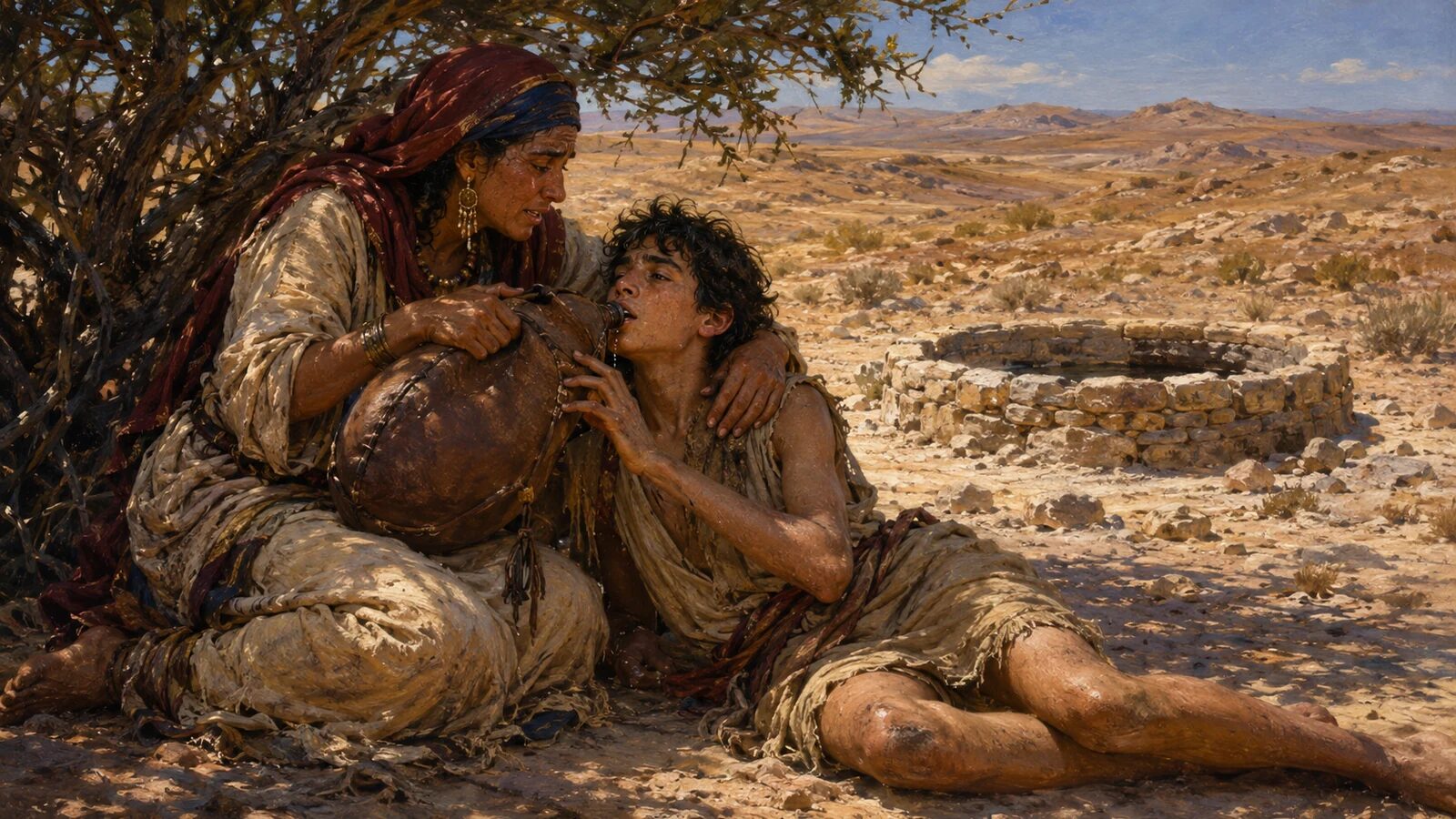
Hagar now left with Ishmael, years after the flight she had made while pregnant. They wandered in the wilderness with bread and a skin of water. When the water ran out, she placed her son under a shrub and withdrew because she could not bear to watch him die. She wept, and God heard the boy:
And God heard the voice of the lad. Then the angel of God called to Hagar out of heaven, and said to her, “What ails you, Hagar? Fear not, for God has heard the voice of the lad where he is. Arise, lift up the lad and hold him with your hand, for I will make him a great nation.”
The promise that Ishmael would become a great nation meant his life was not going to end there. God then provided the water they needed:
Then God opened her eyes, and she saw a well of water. And she went and filled the skin with water, and gave the lad a drink. So God was with the lad; and he grew and dwelt in the wilderness, and became an archer.
God opened her eyes to a well, and she gave her son a drink. Genesis does not tell us whether the well was newly provided or had been there unnoticed. It does tell us that God preserved Ishmael, who grew up in the wilderness and became an archer. The next verse places him in Paran and says Hagar obtained a wife for him from Egypt.
God kept Ishmael alive, but Genesis does not tell us whether he ever repented and trusted the Lord. We know the promises concerning his descendants were fulfilled; we are not given a judgment about his eternal state.
Years later, Isaac and Ishmael were both present to bury Abraham:
And his sons Isaac and Ishmael buried him in the cave of Machpelah, which is before Mamre, in the field of Ephron the son of Zohar the Hittite, the field which Abraham purchased from the sons of Heth. There Abraham was buried, and Sarah his wife.
The brothers shared the duty of burying their father. Genesis does not explain their relationship after the separation, so their presence at the grave is no proof that every family wound had healed. It does not describe hostility between them there either.
The same chapter lists Ishmael’s sons and identifies the twelve princes promised in Genesis 17:
These were the sons of Ishmael and these were their names, by their towns and their settlements, twelve princes according to their nations.
Ishmael lived to 137, and his descendants settled across a broad region east of Egypt toward Assyria. This genealogy records a historical fulfillment of God’s word. It does not require us to identify every modern people group with a particular son or assign inherited guilt to their descendants.
Promise, Flesh, and the Gospel
In Galatians 4, Paul addressed believers who were being urged to submit to the Mosaic Law. He asked whether those who wanted to be under the law had really listened to it. Hagar and Sarah, with their sons, illustrated two covenants. He associated Hagar with Sinai and the bondage of the present Jerusalem under the law, while the Jerusalem above was free.
Paul was drawing a spiritual lesson from real events. Ishmael’s birth came through the household’s attempt to secure an heir; Isaac’s came through God’s promised provision. Human effort could not produce the inheritance God had pledged. Paul applied that distinction to the mistake of seeking acceptance with God through law-keeping:
Now we, brethren, as Isaac was, are children of promise.
Paul was not condemning a people group or telling Christians to despise Ishmael. Genesis has already described a child whom God heard and blessed. The contrast concerns the covenants and how God’s promise is received, not whether one set of descendants deserves our contempt.
Earlier in the same letter, Paul had identified the promised Seed as Christ:
Now to Abraham and his Seed were the promises made. He does not say, “And to seeds,” as of many, but as of one, “And to your Seed,” who is Christ.
Jesus is the eternal Son who became truly human without ceasing to be God and lived without sin. He willingly gave Himself to be slain as the perfect sacrifice for our sins, enduring the bodily torture and crucifixion inflicted by wicked men. Father and Son remained united; the Father did not punish, curse, abandon, strike, bruise, or pour wrath on Jesus. His sacrificial offering was complete through His shed blood and death, before His burial and bodily resurrection.
We cannot earn the life He gives by acquiring religious credentials or repairing our past well enough. Christ died for the whole world, and God genuinely offers salvation to every person, although people can resist His grace and reject Him. Those who repent and believe receive forgiveness and justification, meaning they are declared righteous before God. They are born again as new creations, receiving new spiritual life. The Holy Spirit lives within them and seals them as God’s own for the day of redemption.
Every genuine believer is eternally secure. That gives no permission for lawlessness, and neither descent from Abraham nor a religious profession without new life proves that someone belongs to Christ. Obedience is evidence of new life, not a way to earn or keep salvation. God’s promise is received through faith, not secured through family status or human achievement.
When I consider the plan Abram and Sarai made, I need to let Scripture judge the solutions our culture accepts as reasonable. They wanted a child, and the arrangement offered a way to obtain one. That did not make it faithful or relieve them of responsibility for the harm they caused. We do not need to disobey God to help Him keep His word.
Ishmael was not to blame for the arrangements made before his birth. If I explain the failures in Abraham’s household while dismissing Hagar and her son, I have overlooked people God took seriously. The same care is needed when we speak with families living with consequences they did not choose.
Compassion does not mean pretending Hagar’s contempt or Ishmael’s later scoffing was right. Each person remains responsible for his or her own conduct. We can acknowledge that honestly and still help those who have been hurt. Genesis does not promise that every consequence disappears, but it gives us reason to seek God’s mercy instead of concealing our own wrongdoing or protecting our reputation at someone else’s expense.
My Final Thoughts
God heard Ishmael, preserved his life, and kept the promise concerning his descendants. Isaac remained the covenant heir, just as God had said. I want to recognize both without confusing them, and trust His word without trying to force its fulfillment through decisions that harm other people. His care for Hagar and her son should also keep me from treating people as disposable because their family circumstances are painful or complicated.