
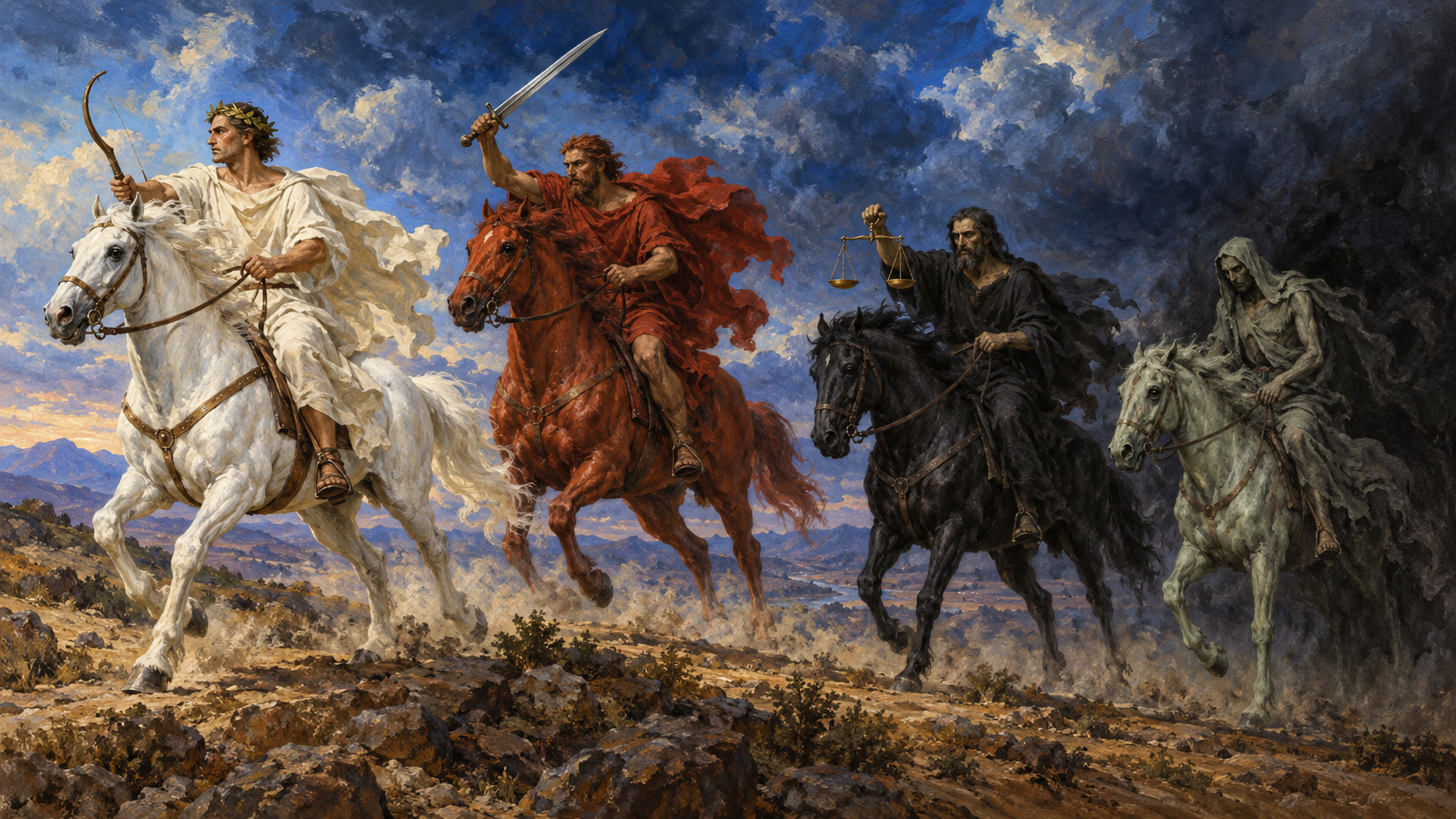
Who are the four riders in Revelation 6, and why does the first one look enough like Christ to cause debate? Before trying to identify them, I want to notice who opens the seals and what John actually says. That keeps the study centered on the Lamb instead of on headlines or speculation.
The Worthy Lamb Opens the Seals
John gives us a carefully ordered scene in Revelation 6. The Lamb opens the first four seals, and each living creature summons a rider. Conquest begins the movement before peace is removed from the earth. Severe scarcity follows, and then Death spreads across an immense portion of the world. I think we should read these as connected judgments rather than isolated images, because they belong to an ordered sequence within the book.
The word apocalypse comes from the Greek title of Revelation and means an unveiling. It does not mean that every disaster is automatically one of the seals. John is shown what God will bring to pass within the ordered movement of the whole book. He sees the throne before the horsemen appear, and the Lamb receives the scroll before opening it. The remaining seals then lead into the trumpets. The bowls follow later rather than appearing as disconnected symbols.
I understand the four horsemen as future judgments during the opening phase of the literal seven-year Tribulation. Christ gathers His church before that worldwide hour of trial. The riders then go out beneath the Lamb’s authority. A final ruler begins his conquest before peace is removed from the earth. Food becomes crushingly scarce, and death spreads across an immense portion of the world.
This conclusion does not give us permission to identify a current political leader with confidence. Neither should a present war or disease be announced as the certain fulfillment of a seal. Revelation gives no basis for naming a modern currency or diplomatic treaty in the passage. Jesus told His people to resist both deception and date-setting. The text gives us enough to understand the riders’ character, purpose, and order, even though many modern details remain unstated.
Revelation 6 must be read in light of chapters 4 and 5. John first sees the throne as worship fills heaven. A scroll sealed with seven seals rests in God’s right hand, but no created person is worthy to open it. John weeps until one of the elders directs him to the Lion of the tribe of Judah. When he looks, he sees a Lamb who bears the marks of slaughter yet stands alive.
And I saw in the right hand of Him who sat on the throne a scroll written inside and on the back, sealed with seven seals. Then I saw a strong angel proclaiming with a loud voice, “Who is worthy to open the scroll and to loose its seals?” And no one in heaven or on the earth or under the earth was able to open the scroll, or to look at it. So I wept much, because no one was found worthy to open and read the scroll, or to look at it. But one of the elders said to me, “Do not weep. Behold, the Lion of the tribe of Judah, the Root of David, has prevailed to open the scroll and to loose its seven seals.” And I looked, and behold, in the midst of the throne and of the four living creatures, and in the midst of the elders, stood a Lamb as though it had been slain, having seven horns and seven eyes, which are the seven Spirits of God sent out into all the earth. Then He came and took the scroll out of the right hand of Him who sat on the throne. Now when He had taken the scroll, the four living creatures and the twenty-four elders fell down before the Lamb, each having a harp, and golden bowls full of incense, which are the prayers of the saints. And they sang a new song, saying: “You are worthy to take the scroll, And to open its seals; For You were slain, And have redeemed us to God by Your blood Out of every tribe and tongue and people and nation, And have made us kings and priests to our God; And we shall reign on the earth.”
The Lamb is worthy because of who He is and what He has accomplished. Jesus is the eternal Son who is fully God and fully man. He was born of a virgin and remained completely sinless. Wicked men physically tortured and killed Him on the cross, shedding His blood. Jesus willingly bore that real punishment for our sins in His innocent body and then rose bodily. The Father did not punish or curse Jesus. He did not abandon His Son, strike or bruise Him, or pour wrath upon Him. The risen Christ has conquered death and possesses the right to bring history to its appointed end.
Each horseman appears only when the Lamb opens the corresponding seal. The riders are terrible, but none of them is sovereign. They receive a limited authority and go out in an order established from heaven. The reach of every judgment remains bounded. God does not become the author of human wickedness, and the agents who commit violence remain responsible for their rebellion. Yet evil cannot exceed the judgment the Lamb permits.
This context also keeps prophecy centered upon worship. Heaven does not admire the horsemen; it worships the Lamb. I believe any study that produces fascination with Antichrist while leaving Christ in the background has missed the center of Revelation.
The White Horse and the First Conqueror
When the first seal opens, John hears one of the living creatures speak with a voice like thunder. A rider appears on a white horse and carries a bow. He receives a crown before going out to continue his conquest.
Now I saw when the Lamb opened one of the seals; and I heard one of the four living creatures saying with a voice like thunder, “Come and see.” And I looked, and behold, a white horse. He who sat on it had a bow; and a crown was given to him, and he went out conquering and to conquer.
The interpretation must begin with what John actually records. The horse is white, and its rider carries a bow. A crown is given to him before he goes out to continue conquering. The verse never names this rider or mentions a treaty. It does not describe him as peaceful, and it says nothing about whether his bow has arrows.
I find the old claim that the rider’s bow has no arrows and therefore proves bloodless deception especially weak. Revelation is silent about arrows in either direction, so we cannot turn an unmentioned object into the decisive symbol. The rider can still represent Antichrist without that argument.
John uses the Greek word toxon for the rider’s bow and stephanos for the crown given to him. Toxon simply means a bow; it tells us nothing about whether arrows are present. A stephanos is a victory wreath or crown. Because the crown is given to this rider, his authority is received and limited. Revelation uses this kind of crown positively elsewhere, so the word itself is not evil. The color white can likewise communicate victory and may speak of purity in other settings. None of these details settles the rider’s identity by itself.
Serious interpreters have proposed several identities for the first rider. Some see Christ because the horse is white and the crowned rider conquers. Others understand the image as the victorious advance of the gospel. A third approach treats the rider as generic military conquest or a succession of empires. Futurist interpreters commonly identify him with Antichrist or with the conquering power that marks his initial rise.
The Christ or gospel reading notices real features and should not be mocked. Revelation does use white positively, and Christ truly is a conqueror. The difficulty lies in the immediate setting. The Lamb is already present in heaven as the One opening the seal. An unnamed agent is then summoned into a sequence of judgment. Slaughter follows his conquest, and scarcity soon gives way to death. Nothing in the verse identifies the first rider’s activity as gospel preaching.
The generic-conquest view captures the action but may stop too soon. Daniel 9 describes a final ruler who confirms a covenant and later violates it. He stops the sacrifice and brings desolation. 2 Thessalonians 2 describes the man of sin exalting himself in a temple setting before the Lord destroys him at His coming. Revelation 13 later shows the beast receiving authority during the final crisis. He demands worship while exercising worldwide rule. Together, these passages give the first rider’s conquest a personal end-time focus.
I therefore conclude that the rider represents Antichrist’s opening conquest. We should still distinguish conclusion from explicit wording: Revelation 6:2 never uses the name Antichrist. The identification comes from the sequence and the larger prophetic picture.
The common expression “false peace” also requires care. The second rider removes peace from the earth, while Daniel’s final ruler confirms a covenant and later violates it. 1 Thessalonians 5 says that sudden destruction comes while people are speaking about peace and safety. These passages support the presence of deceptive security around the final ruler’s rise. Revelation 6:2 itself speaks only of conquest and never names a peace treaty.
Revelation itself provides the necessary contrast. Near the end of the Tribulation, heaven opens and Jesus appears publicly. This Rider is not left unnamed or ambiguous.
Now I saw heaven opened, and behold, a white horse. And He who sat on him was called Faithful and True, and in righteousness He judges and makes war. His eyes were like a flame of fire, and on His head were many crowns. He had a name written that no one knew except Himself. He was clothed with a robe dipped in blood, and His name is called The Word of God. And the armies in heaven, clothed in fine linen, white and clean, followed Him on white horses. Now out of His mouth goes a sharp sword, that with it He should strike the nations. And He Himself will rule them with a rod of iron. He Himself treads the winepress of the fierceness and wrath of Almighty God. And He has on His robe and on His thigh a name written: KING OF KINGS AND LORD OF LORDS.
Christ is explicitly called Faithful and True as well as the Word of God. He judges in righteousness and wears many royal diadems, or crowns. The armies of heaven follow Him when He comes to rule the nations. A sword proceeds from His mouth, portraying the irresistible authority of His spoken judgment. Jesus does not struggle for uncertain power. He arrives as King of kings and Lord of lords.
The contrast with Revelation 6 is broader than weapon or crown. In chapter 6, the Lamb opens a seal and releases an unnamed conqueror whose appearance begins a chain of calamity. In chapter 19, heaven opens and Christ Himself ends the beast’s rule. The first rider receives a crown and goes out to extend his conquest. Jesus possesses many diadems and comes with the authority that belongs to Him.
Revelation 19 also keeps this prophecy from ending in despair. Antichrist may rise, but his rule is temporary. The final word belongs to Jesus, whose public return cannot be mistaken for a secret claimant or political savior.
War, Scarcity, and Death
The second seal strips away peace. John sees a fiery red horse, and its rider receives authority that results in people slaughtering one another.
When He opened the second seal, I heard the second living creature saying, “Come and see.” Another horse, fiery red, went out. And it was granted to the one who sat on it to take peace from the earth, and that people should kill one another; and there was given to him a great sword.
The fiery red color fits bloodshed, but the rider’s action provides the interpretation. Peace is taken from the earth, and people begin slaughtering one another. This wording reaches beyond a single battlefield. International war may converge with civil conflict as social order collapses. Personal violence can spread at the same time. The verse never names any modern alliance or weapon.
A great sword is given to the rider. As with the first crown, the passive wording reminds us that his authority is permitted and bounded. The sword does not make violence righteous. People who kill remain accountable, while the Lamb judges a world that has rejected the Prince of Peace.
The sequence corrects the dream that human conquest can secure lasting peace. The first rider’s victory gives way to the second rider’s slaughter. Political power can suppress conflict for a time, but it cannot heal rebellion against God or renew the human heart.
When the third seal opens, the black-horse rider carries scales. A voice from the midst of the living creatures announces the cost of wheat and barley and places a boundary around oil and wine.
When He opened the third seal, I heard the third living creature say, “Come and see.” So I looked, and behold, a black horse, and he who sat on it had a pair of scales in his hand. And I heard a voice in the midst of the four living creatures saying, “A quart of wheat for a denarius, and three quarts of barley for a denarius; and do not harm the oil and the wine.”
The scales point to food being weighed carefully during a severe shortage. In Matthew 20:2, a denarius is the agreed wage for a full day of labor. During the third seal, that entire wage purchases roughly one person’s daily ration of wheat. The same amount can buy a larger measure of cheaper barley, but a worker may still spend everything earned without feeding the household. The scene portrays strict rationing and ruinous prices that produce economic anguish.
The text does not yet use the word famine for this rider, but the scarcity is unmistakable. The fourth seal later names hunger as a means of death. War often disrupts planting and destroys the transportation systems that bring food to market. Trade and ordinary work may collapse as well. This makes the progression natural without requiring us to know every economic mechanism in advance.
The command not to harm the oil and wine has produced several interpretations. Some readers see luxury goods being protected while ordinary people cannot afford staple food, which would expose deep inequality. Others understand the words as a limit upon how far the judgment may reach or as protection for particular crops. I think the safest conclusion is that the devastation is not yet total and may affect people unevenly. The verse does not provide enough information to construct a complete class system or market forecast from these commodities.
The final rider is the only one John names. Death rides the pale horse, while Hades follows behind him. Their given authority combines several forms of judgment already established in Scripture.
When He opened the fourth seal, I heard the voice of the fourth living creature saying, “Come and see.” So I looked, and behold, a pale horse. And the name of him who sat on it was Death, and Hades followed with him. And power was given to them over a fourth of the earth, to kill with sword, with hunger, with death, and by the beasts of the earth.
The Greek adjective chloros can describe green vegetation. In this scene, however, the greenish pallor belongs to Death. The word “pale” therefore fits the rider’s sickly, corpse-like appearance. This color must not be turned into a modern flag. Neither does the verse support a chemical theory or a hidden disease code.
Hades follows Death just as the realm of the dead follows the act of dying. Revelation 20 later shows both enemies being thrown into the Lake of Fire. Their final destruction confirms that neither Death nor Hades will rule permanently.
Authority extends over a fourth of the earth. Death comes through the sword and through hunger. The verse also names death itself and attacks by the beasts of the earth. The scale is staggering. Because the grammar has led interpreters to debate whether the quarter emphasizes territory or population, it is wiser to state the text than calculate a precise contemporary body count. An immense portion of the earth comes under lethal judgment through overlapping means.
Ezekiel supplies the Old Testament background. When Jerusalem persisted in idolatry, the LORD named four severe judgments. The sword and famine would come against the city. Wild beasts and pestilence would also take life.
For thus says the Lord GOD: “How much more it shall be when I send My four severe judgments on Jerusalem–the sword and famine and wild beasts and pestilence–to cut off man and beast from it? Yet behold, there shall be left in it a remnant who will be brought out, both sons and daughters; surely they will come out to you, and you will see their ways and their doings. Then you will be comforted concerning the disaster that I have brought upon Jerusalem, all that I have brought upon it. And they will comfort you, when you see their ways and their doings; and you shall know that I have done nothing without cause that I have done in it,” says the Lord GOD.
Revelation expands that familiar covenant-judgment pattern to the Tribulation. The NKJV renders the fourth means in Revelation 6 as “death,” while the connection with Ezekiel helps explain why pestilence is often included in discussion. We should retain Revelation’s wording and use Ezekiel as background rather than silently rewriting the verse.
The Sequence and Israel’s Future Trouble
The four riders form a progression. Conquest first destabilizes the world. Once peace is removed, people begin slaughtering one another and ordinary life breaks apart. Food must then be weighed carefully because its price has moved beyond ordinary reach. Death gathers the results through the sword and hunger, while attacks by wild beasts deepen the judgment.
These causes can overlap. War destroys crops and supply routes, while scarcity can inflame further violence. Disease may spread among displaced populations. Wild animals can also become a greater threat across devastated land. Revelation gives an ordered sequence without requiring every earlier force to stop when the next rider appears.
Jesus’ Olivet Discourse contains strong parallels with the opening seals. He first warns His disciples against deception and then speaks about coming wars. Famines and pestilences follow as earthquakes strike in various places. Jesus identifies these events as the beginning of sorrows.
And Jesus answered and said to them: “Take heed that no one deceives you. For many will come in My name, saying, ‘I am the Christ,’ and will deceive many. And you will hear of wars and rumors of wars. See that you are not troubled; for all these things must come to pass, but the end is not yet. For nation will rise against nation, and kingdom against kingdom. And there will be famines, pestilences, and earthquakes in various places. All these are the beginning of sorrows.
These parallels help locate the horsemen within the opening birth pains of the final crisis. They should not be forced into a mechanical code that assigns every phrase of Matthew 24 to exactly one seal. Jesus gives His own discourse, while John receives the seal vision. Together, the passages reveal deception intensifying into conflict. Scarcity and death follow before cosmic upheaval announces the approach of Christ’s public return.
The horsemen do not exhaust Revelation 6. Under the fifth seal, martyrs call upon God for righteous judgment. The sixth seal brings a great earthquake as the sun becomes black and the moon appears like blood. Stars fall while terrified rulers try to hide from the Lamb. The seventh seal then opens into the trumpet judgments. The severity increases as the appointed end approaches.
The Tribulation affects the whole world, but Scripture gives Israel a distinct place within it. Jeremiah addresses Jacob and describes a day of unparalleled distress. The same prophecy promises restoration and declares that Jacob will be saved out of that trouble.
Now these are the words that the LORD spoke concerning Israel and Judah. “For thus says the LORD: ‘We have heard a voice of trembling, Of fear, and not of peace. Ask now, and see, Whether a man is ever in labor with child? So why do I see every man with his hands on his loins Like a woman in labor, And all faces turned pale? Alas! For that day is great, So that none is like it; And it is the time of Jacob’s trouble, But he shall be saved out of it. ‘For it shall come to pass in that day,’ Says the LORD of hosts, ‘That I will break his yoke from your neck, And will burst your bonds; Foreigners shall no more enslave them. But they shall serve the LORD their God, And David their king, Whom I will raise up for them. ‘Therefore do not fear, O My servant Jacob,’ says the LORD, ‘Nor be dismayed, O Israel; For behold, I will save you from afar, And your seed from the land of their captivity. Jacob shall return, have rest and be quiet, And no one shall make him afraid. For I am with you,’ says the LORD, ‘to save you; Though I make a full end of all nations where I have scattered you, Yet I will not make a complete end of you. But I will correct you in justice, And will not let you go altogether unpunished.’
Jeremiah does not end with terror. The LORD promises to deliver and restore His people so that they will serve Him and David their king. This future cannot be fulfilled by erasing Israel into the church. Gentile believers share in blessing through Israel’s Messiah. Even so, Gabriel’s prophecy still concerns Daniel’s people and his holy city. Paul likewise expects Israel’s future turning to Christ.
Zechariah 12-13 adds Jerusalem’s mourning over the One who was pierced. A fountain is opened for cleansing while severe judgment falls upon the land. God preserves a remnant who call upon the LORD. We should never speak casually about this suffering, as though human pain were only a step on a prophecy chart. Judgment is dreadful, yet grace preserves a people and brings them to genuine recognition of the Messiah.
Daniel 9 gives the seven-year framework. The coming ruler confirms a covenant for one prophetic week. At the midpoint, he violates the established order and brings desolation until God destroys him. Revelation’s horsemen fit the opening movement of this defined future period. Later chapters reveal the beast’s full blasphemy and persecution.
The Church’s Hope and Our Response
Christians experience tribulation in the present world. Across many centuries, the church has endured persecution and war. Believers have also suffered through famine and disease before finally facing death. Present suffering is real. A pre-Tribulation hope must never make believers smug toward saints who suffer.
The future seven-year Tribulation is a distinct worldwide hour of divine judgment. 1 Thessalonians 5 says the church is not appointed to wrath, and Revelation 3:10 promises to keep the faithful from the hour of trial coming upon the whole world. Before that hour, the Lord gathers His church.
But I do not want you to be ignorant, brethren, concerning those who have fallen asleep, lest you sorrow as others who have no hope. For if we believe that Jesus died and rose again, even so God will bring with Him those who sleep in Jesus. For this we say to you by the word of the Lord, that we who are alive and remain until the coming of the Lord will by no means precede those who are asleep. For the Lord Himself will descend from heaven with a shout, with the voice of an archangel, and with the trumpet of God. And the dead in Christ will rise first. Then we who are alive and remain shall be caught up together with them in the clouds to meet the Lord in the air. And thus we shall always be with the Lord. Therefore comfort one another with these words.
Paul’s emphasis is comfort. The dead in Christ rise first, and living believers are then caught up together with them. From that moment forward, everyone gathered will remain with the Lord. This event is distinct from Revelation 19, where Christ later returns publicly in judgment. The armies of heaven accompany Him when He ends the beast’s reign.
The church’s blessed hope is Jesus, not our ability to identify the first rider in advance. We should study Antichrist because Scripture warns about deception, but fascination with evil must never displace affection for Christ. I want to keep returning to the simple truth that the Lamb who opens the seals is also the Savior who gathers His people.
That hope should make us refuse headline prophecy. A present war may be serious without marking the opening of a seal. The same is true of a price increase or an epidemic. Neither a diplomatic agreement nor the rise of a powerful leader should be announced as certain fulfillment. The church is still here, and Scripture places its gathering before the Tribulation. Treating every crisis as fulfilled prophecy eventually trains people to dismiss the real thing.
It should also make us reject counterfeit saviors now. The first rider reveals how attractive conquest can appear. People long for a ruler who promises to restore order and prosperity. The offer of safety can quickly become a demand for loyalty, especially when victory appears close. No political leader can cure sin or take Christ’s place. Christians may act responsibly in public life while placing their worship and hope in Jesus alone.
The coming scarcity should make us generous now. The black horse shows a world in which daily food consumes an entire day’s wages. Believers who have food today should receive it with gratitude and share with people in need. They should resist waste rather than building their identity upon luxury. Scripture leads us toward compassion, not hoarding driven by prophetic panic.
Most of all, we should preach the gospel while mercy is being offered. The horsemen show that stronger signs and harsher judgments do not automatically produce repentance. A person must hear God’s Word and respond by turning from sin to trust in Jesus Christ. He died for the sins of the whole world, so God’s offer is genuine for every person, though people can resist and reject it. Everyone who comes to Christ in faith is forgiven and born again. The Holy Spirit indwells and seals that believer, who is eternally secure. Eternal security is not permission for lawlessness, and a shallow profession without new life is not proof of genuine faith.
After considering all four riders, I believe the study should return us to worship of the Lamb. History does not end with Death riding a pale horse. Christ returns as Faithful and True to destroy the beast’s rule, then reigns for a literal thousand years before judging the lost at the Great White Throne. In the final new creation, Jesus removes death itself. Human souls are not inherently immortal. Lost people face the irreversible destruction of both body and soul in the Lake of Fire, while those in Christ inherit eternal life with Him.
My Final Thoughts
After following these riders through Revelation, I believe the first one portrays Antichrist’s opening conquest rather than Jesus Christ. John does not name him, and he never mentions an arrowless bow or a modern treaty. He certainly does not identify any present political leader, so we should not pretend to know more than the text says. What Scripture does make clear is that every rider goes out beneath the authority of the worthy Lamb. The church’s hope is not found in decoding headlines but in Christ, who will gather His people and later return publicly to end the beast’s rule. Until then, the coming judgment should deepen our worship and loosen our grip on present abundance. Above all, it should keep us proclaiming the gospel while mercy is offered.