
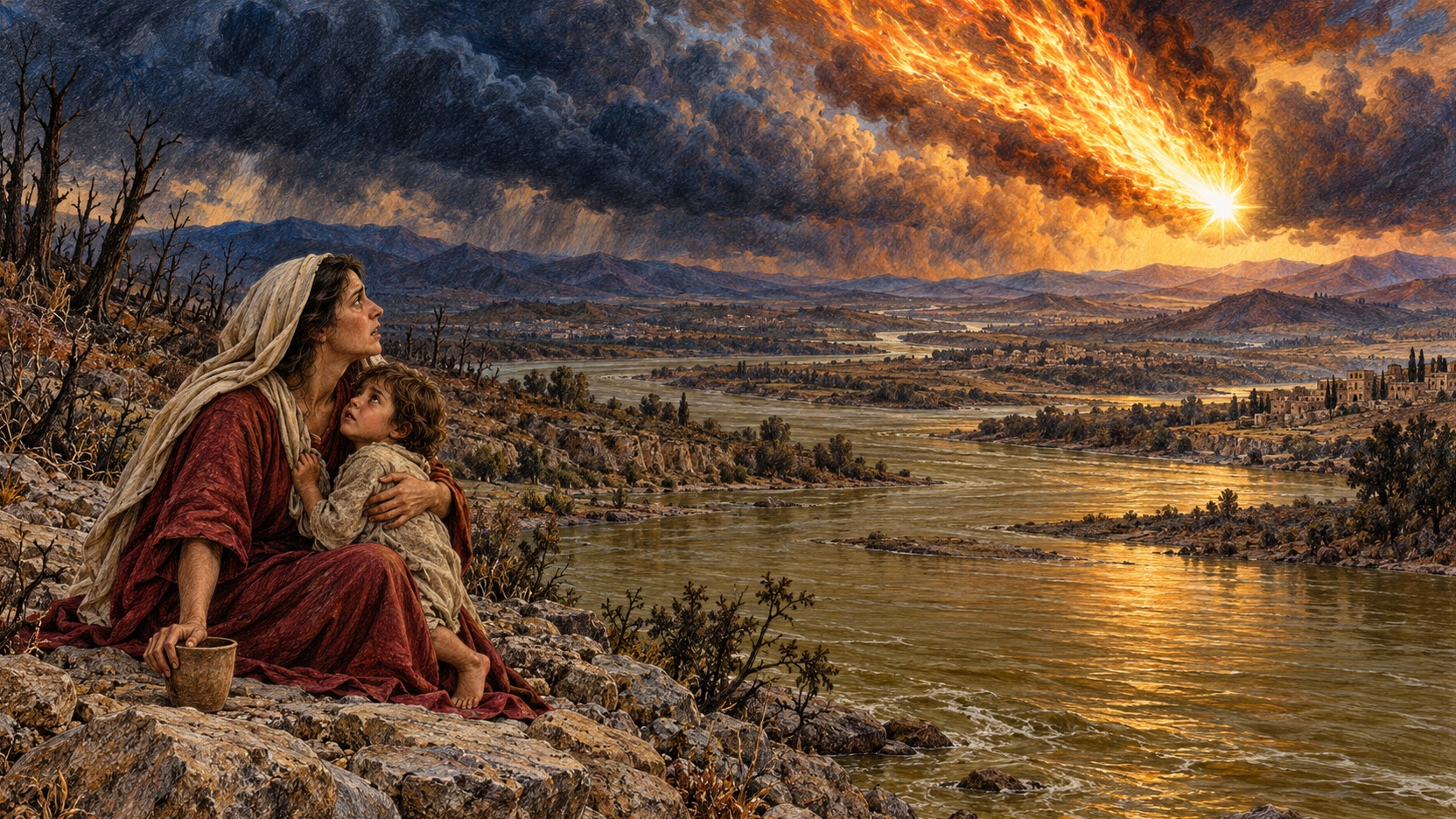
Wormwood is the name of a burning star John sees fall on rivers and springs in Revelation 8. The waters become bitter, and many people die because they drink from them. I understand this to describe a real future judgment, but the name also has a history in Scripture that helps us understand why God uses it here.
Earlier passages speak of wormwood when warning people about turning away from the Lord and when describing the sorrow that follows judgment. So the question involves more than identifying something in the sky. To show you what I mean, let’s look at where this event belongs in Revelation and then compare the passages that use its name.
Wormwood in the Trumpet Sequence
Revelation records the visions God gave to John, and the judgment on the waters comes within a sequence that begins before chapter 8. In chapter 5, John sees a scroll in the hand of the One seated on God’s throne. It is closed with seven seals, and no one is found worthy to open it until Jesus Christ appears as the Lamb who was slain. That title identifies Him as the Savior who gave His life as the sacrifice for sin. He alone is worthy to take the scroll and open its seals.
As He opens them in chapters 6 through 8, judgments unfold on the earth. The opening of the seventh seal is followed by seven angels receiving trumpets before God. Those angels prepare to sound them, and each trumpet introduces another judgment. I understand these events to belong to the future seven-year Tribulation, the period of judgment that precedes Christ’s public return to reign on the earth.
The first trumpet brings hail and fire mingled with blood, burning a third of the trees and all the green grass. At the second trumpet, John sees something like a great burning mountain thrown into the sea. A third of the sea becomes blood, a third of its living creatures die, and a third of the ships are destroyed. The third trumpet then affects rivers and springs, the freshwater people depend on for drinking.
After that, the fourth trumpet strikes a third of the sun, moon, and stars, and a third of the day and night is without light. These judgments reach into the things that make ordinary life possible. The repeated fraction also tells us that the destruction has limits at this stage. God has not yet brought the whole creation to its end.
I would not mistake those limits for a mild warning. Many people die, and those who remain face enormous devastation. But there are still people alive who can respond to God, and the warning is not over. At the end of chapter 8, John hears an announcement of further woes because three angels have yet to sound their trumpets.
Within that sequence, John describes the third trumpet this way.
Then the third angel sounded: And a great star fell from heaven, burning like a torch, and it fell on a third of the rivers and on the springs of water. The name of the star is Wormwood. A third of the waters became wormwood, and many men died from the water, because it was made bitter.
The words about people dying explain how seriously we should take the bitterness. This is more than water with an unpleasant taste. It has become deadly. The NKJV’s use of men refers here to human beings, not a judgment restricted to adult males. People are dying from the water they need to live, and I do not believe we should reduce that physical consequence to an image of confusion or emotional distress.
John tells us what the star looks like as it falls: it is burning like a torch. That comparison gives us a visible description, but it does not identify a modern astronomical category. A meteor or another physical means could be involved. I cannot go from John’s comparison to a confident claim that he has identified a particular asteroid or comet. He gives us the event and its effect on the waters without explaining the mechanism.
There is also a reason to read the surrounding chapters before assuming that every star in Revelation must mean the same thing. In Revelation 9:1-2, at the fifth trumpet, John sees a star that has fallen from heaven. That star is given a key and opens the bottomless pit, a place of confinement from which smoke and tormenting locusts emerge. The description presents the star as someone who acts, which is why the passage gives reason to consider an angelic identity.
Revelation 8 does not give Wormwood a key or describe it carrying out those actions. It describes a blazing star falling on waters and making them bitter. Comparing the passages helps us recognize the question without claiming an answer the third-trumpet passage does not give. I understand the judgment to affect actual freshwater, while leaving the precise means God uses unresolved.
John also leaves the rivers unnamed. He does not identify a modern nation, and he does not describe an event limited to one particular lake. A third of the waters become bitter. That is the extent he gives us, and it should govern how we discuss the prophecy instead of filling in a location of our own.
The name Wormwood translates the Greek apsinthos, a word for a bitter plant. The Hebrew word commonly translated wormwood in the Old Testament is la’anah. The bitterness of the plant had already been used to describe what rebellion against God produces. That gives the name a meaning a reader of the earlier Scriptures could recognize, without giving us a chemical formula for what happens to the water.
Wormwood’s Old Testament Background
In Deuteronomy 29, Moses addresses the Israelites, whom he had led after God brought them out of Egypt. They stand before the Lord to enter into His covenant, the relationship in which He gives them His promises and commands their obedience. They had seen the idols of the nations around them, and Moses warns that someone among them might turn to those gods. He describes the danger through the image of a bitter root.
so that there may not be among you man or woman or family or tribe, whose heart turns away today from the LORD our God, to go and serve the gods of these nations, and that there may not be among you a root bearing bitterness or wormwood;
The departure begins in a person’s heart, but Moses does not treat it as harmless because it has not yet become a national practice. In the next verse he describes someone hearing the covenant warning and still assuring himself that he will have peace while following his own desires. That person wants to continue disregarding God’s Word while assuming the announced consequences will not reach him.
I think we can understand the danger of the root by considering how one person’s choices can affect a household. A father might defend idolatry as his private decision, but his children see whom he worships and hear the reasons he gives. If he teaches them to ignore God’s command, the harm has reached beyond the person who first made the choice. Moses names individuals, families, and tribes because the community cannot safely dismiss what is taking root among them.
Being part of Israel did not make such presumption safe. God had warned His people, and belonging to the covenant community did not turn disobedience into obedience. That is the setting in which Moses speaks of wormwood: turning from the Lord produces something bitter, even when the person making the choice tells himself that all will be well.
Centuries later, the prophet Jeremiah spoke to Judah, the kingdom whose capital was Jerusalem, about a similar refusal to listen. God had set His law before them, but they had followed their own desires and the Baals, the false gods their fathers had taught them to worship. The Lord explained the judgment He was announcing.
And the LORD said, “Because they have forsaken My law which I set before them, and have not obeyed My voice, nor walked according to it, but they have walked according to the dictates of their own hearts and after the Baals, which their fathers taught them,” therefore thus says the LORD of hosts, the God of Israel: “Behold, I will feed them, this people, with wormwood, and give them water of gall to drink.”
Those customs had been passed down, but their age did not make them faithful to God. The people were continuing what they had been taught even though it contradicted His law. The Lord who had sustained them would now make them experience the bitterness of their rebellion. Gall refers here to a bitter, poisonous substance, so the promise of water of gall describes judgment in the very provision people depend on for life.
We hear the grief after judgment in Lamentations, a book mourning the devastation of Jerusalem. In chapter 3, the speaker describes deep affliction and the loss of peace. He uses wormwood to express what that suffering is like.
He has filled me with bitterness, He has made me drink wormwood.
This is not the language of a minor disappointment. The speaker describes sorrow that has overwhelmed him. When we come to Revelation 8 with these passages in view, the name of the star is no longer an isolated detail. Wormwood has appeared in a warning against idolatry, in an announcement of judgment, and in the grief of people living through devastation. I understand its use in Revelation as fitting the world’s continued rejection of God.
That connection does not authorize me to look at a person suffering today and announce that his illness or bereavement proves God is punishing him for rebellion. Scripture also records faithful people enduring terrible affliction. In the passages we have read, God identifies the unfaithfulness He is judging. Revelation likewise identifies a particular future judgment. I need to respect that setting instead of using the name of the star to explain every painful event I encounter.
John’s description also makes us consider what has happened to something people ordinarily receive as a gift. In Revelation 8 the rivers and springs have not merely dried up. The water is still there, but drinking it brings death. What people depend on to sustain their lives has become a means of judgment.
Other passages show God providing water to preserve life. In Genesis 21, Hagar, the mother of Abraham’s son Ishmael, had left Abraham’s household with her son and a supply of water. After that supply ran out in the wilderness, she feared the boy would die. God opened her eyes to a well, and she filled her water container and gave him a drink.
Later, when Moses was leading Israel after their deliverance from Egypt, the people had no water at Rephidim. God told Moses to strike the rock at Horeb, and He provided water for them there (Exodus 17:1-7). In both accounts, the water was an expression of the Lord’s care for people who could not sustain themselves.
The prophets also describe water when speaking of restoration. Isaiah 35:6-7 tells of streams in the desert and springs in thirsty ground when God comes to save. Jesus offers living water to those who come to Him, and Revelation itself ends with the river of the water of life. Those passages help us see the severity of the third trumpet. The God who supplies what gives life also has authority to judge a world that refuses Him.
We can look back to the events before Israel left Egypt for another judgment on water. Pharaoh, the king of Egypt, refused the Lord’s command to release the Israelites from slavery. God sent Moses to confront him, and He told Moses to instruct his brother Aaron to stretch out his rod over Egypt’s waters. Those waters would become blood.
The fish that were in the river died, the river stank, and the Egyptians could not drink the water of the river. So there was blood throughout all the land of Egypt.
The Nile had supplied water the Egyptians needed, but now its fish were dead and its water could not be drunk. God had announced what He would do, and Moses and Aaron carried out His command before Pharaoh. This was a judgment on a ruler and nation resisting the Lord’s demand to release His people.
Egypt’s plague and Wormwood belong to different events. One occurred as God was delivering Israel from slavery; the other belongs to the future Tribulation. But the comparison shows that striking the water people depend on is not something Scripture introduces for the first time in Revelation. In both settings, the Lord confronts defiance, and the false gods people worship cannot protect them from Him.
That dependence has not disappeared because we know more about water or have developed better ways to supply it. Testing water and building treatment systems are useful applications of human knowledge. They do not create the water itself or place it outside God’s authority. A wealthy nation with advanced equipment still needs water just as surely as a poor nation does. Understanding a physical process does not make us independent of its Creator.
Warning, Repentance, and Careful Interpretation
Because Revelation describes water becoming deadly, a modern disaster involving contaminated water may remind someone of Wormwood. A resemblance, however, does not establish that the third trumpet has sounded. John places this event after earlier judgments and before later ones. We have to consider that sequence, the extent of the judgment, and what the passage actually says before claiming a fulfillment.
Jesus warned His disciples about deception when He spoke about coming events, and He called them to remain ready because they did not know the day and hour of His coming (Matthew 24:4; 36-44). I do not have permission to turn a disaster into a date for His return. Taking prophecy seriously includes refusing to claim information God has not given us.
My understanding of where these judgments belong is pre-Tribulation and premillennial. By pre-Tribulation, I mean that Jesus will gather His church to Himself before the coming seven-year Tribulation. By premillennial, I mean that He will later return publicly to establish His literal thousand-year reign on earth, the reign described in Revelation 20.
I came to that understanding of the church’s gathering by comparing several promises. In 1 Thessalonians 4:13-18, Paul comforts believers who were grieving over Christians who had died. He explains that the Lord will descend, the dead in Christ will rise first, and believers still living will be caught up with them to meet Him in the air. In the following chapter, Paul tells them that God has not appointed them to wrath, but to salvation through Jesus Christ (1 Thessalonians 5:9).
Jesus also speaks to the church in the ancient city of Philadelphia in Revelation 3:10. He promises to keep them from an hour of trial that will come upon the whole world. I read that promise together with Paul’s description of our gathering and his assurance concerning wrath. I understand them as grounds for expecting Christ to gather His church before the trumpet judgments fall.
That does not mean no one can turn to Him during the Tribulation. Revelation describes people who belong to God in that period, including the multitude in chapter 7 who have come out of the great tribulation and have been cleansed through the Lamb’s blood. The presence of those believers does not require me to move the church’s gathering into the middle of the judgments.
Nor does the hope of being gathered to Christ give me a reason to be indifferent toward people who do not yet know Him. Judgment is coming, and there is an opportunity to tell them the gospel now. The same Christ who saves has authority over these judgments, and the world’s resistance will not prevent His return or His reign.
I might expect people who survive such devastation to be ready to abandon their idols. But Revelation does not describe suffering as something that automatically produces repentance. After the fifth and sixth trumpets bring further plagues in chapter 9, John tells us how the survivors respond.
But the rest of mankind, who were not killed by these plagues, did not repent of the works of their hands, that they should not worship demons, and idols of gold, silver, brass, stone, and wood, which can neither see nor hear nor walk. And they did not repent of their murders or their sorceries or their sexual immorality or their thefts.
These people are still worshiping what their own hands have made. Their idols cannot see, hear, or walk, yet the survivors will not turn from them. John also names conduct they refuse to abandon, including murder, sexual immorality, and theft. The devastation around them has not made them willing to obey God.
That should make us careful about assuming we can postpone repentance until a warning becomes frightening enough. Being terrified by a catastrophe is not the same as turning to Christ. A person can become more determined to defend the very sin he has been excusing. Revelation’s survivors remain alive to respond, but they continue to reject the Lord.
The mercy they need is the mercy God offers through Jesus Christ. He is the eternal Son who became fully man without ceasing to be fully God, and He lived without sin. He willingly gave Himself to be slain as the perfect sacrifice for our sins. Wicked men tortured and crucified Him, but the Father did not punish or abandon Him. Father and Son remained united in this saving work.
Christ’s shed blood and death accomplished our redemption before His burial and bodily resurrection. He rose as the living Savior, and forgiveness is genuinely offered to every person. People can resist His grace and reject Him, but everyone who repents and believes in Christ is forgiven and receives everlasting life. The warning about judgment gives us reason to receive that mercy, rather than imagine that fear alone has put us right with God.
From Bitter Water to Living Water
The Savior who has authority to judge also describes His gift in the language of water. In John 4, Jesus was resting beside Jacob’s well in Samaria while His disciples went to buy food. A Samaritan woman came to draw water, and He asked her for a drink. He then told her that, if she knew who was speaking to her, she would ask Him for living water.
She could see that the well was deep and that He had nothing with which to draw from it. Her question concerned how He could provide water. Jesus explained that the life He offered would do what another drink from the well could never do.
Jesus answered and said to her, “Whoever drinks of this water will thirst again, but whoever drinks of the water that I shall give him will never thirst. But the water that I shall give him will become in him a fountain of water springing up into everlasting life.”
The woman needed ordinary water, but she also needed the everlasting life Jesus was offering. As the conversation continued, He told her that she had had five husbands and that the man she now had was not her husband (John 4:16-18). He already knew the truth about her life when He offered His gift.
A better bucket could have made drawing water easier without bringing her into a right relationship with God. A more respectable reputation or less complicated circumstances could not have supplied that life either. She needed to receive Christ’s gift, just as every other sinner does.
Later, Jesus gave a public invitation during the Feast of Tabernacles, one of Israel’s appointed gatherings for worship. The feast recalled God’s care for Israel after He brought them out of Egypt. In John 7, Jesus calls the thirsty to come to Him, and John explains what He means.
On the last day, that great day of the feast, Jesus stood and cried out, saying, “If anyone thirsts, let him come to Me and drink. He who believes in Me, as the Scripture has said, out of his heart will flow rivers of living water.” But this He spoke concerning the Spirit, whom those believing in Him would receive; for the Holy Spirit was not yet given, because Jesus was not yet glorified.
Coming and drinking are explained in terms of believing in Jesus, and the rivers of living water are connected with the Holy Spirit. The Spirit was already active before this promise; John is not saying that He had never been present or at work. He is looking ahead to the Spirit’s promised ministry following Jesus’ glorification through His death, bodily resurrection, and ascension to the Father.
Under the New Covenant, God’s provision of forgiveness and new life through Christ, the Spirit comes to dwell within the believer. The person who is genuinely born again becomes a new creation and is sealed by the Spirit for the day of redemption (2 Corinthians 5:17; Ephesians 1:13-14; 4:30). That seal identifies the believer as God’s own, and his salvation is eternally secure in Christ.
Regeneration is the new birth God gives, so we should not confuse it with merely adopting a Christian label. The life of someone who has received the Spirit should show evidence of His work. That does not mean a believer never sins, and obedience does not earn salvation or keep it in place. But assurance in Christ gives me no grounds to defend lawlessness as though His commands no longer concern me. The Savior who gives life also calls His people to obey Him.
John’s visions eventually take us beyond these judgments to the new heaven and new earth. Revelation 21 describes the holy city, the New Jerusalem, coming down from God, and chapter 22 describes the river of the water of life flowing from the throne of God and the Lamb. The book that warns of bitter waters also shows us life with God, and it closes with an invitation to those who hear its words now.
And the Spirit and the bride say, “Come!” And let him who hears say, “Come!” And let him who thirsts come. Whoever desires, let him take the water of life freely.
The bride is Christ’s people, joining the Spirit in saying to come. The thirsty person is invited to receive the water of life freely. I cannot purchase that gift or make myself deserving of it, because Christ has already borne the cost of redemption. I come to receive the mercy He provides.
Wormwood warns about the bitterness of persisting in rebellion, while this invitation directs the hearer to the living Savior. I want our conversations about prophecy to carry that invitation to people. Leaving someone with only fearful curiosity about a future disaster would leave out the mercy the same book urges him to receive.
My Final Thoughts
I understand Wormwood to be a real future judgment in which freshwater becomes deadly and many people die. Its place in the trumpet sequence keeps me from treating any similar disaster as its fulfillment, and its Old Testament background explains why its name speaks of the bitterness of rejecting God. The precise means remains unresolved, but the warning itself is plain enough to take seriously.
Knowing more about the star cannot reconcile me to the Lord. Christ provides the forgiveness and life I need, and His invitation is open now. I do not want to put off repentance on the assumption that a greater warning will make me willing to listen later. I want to bring people His invitation now, while they can still respond in repentance and faith.