
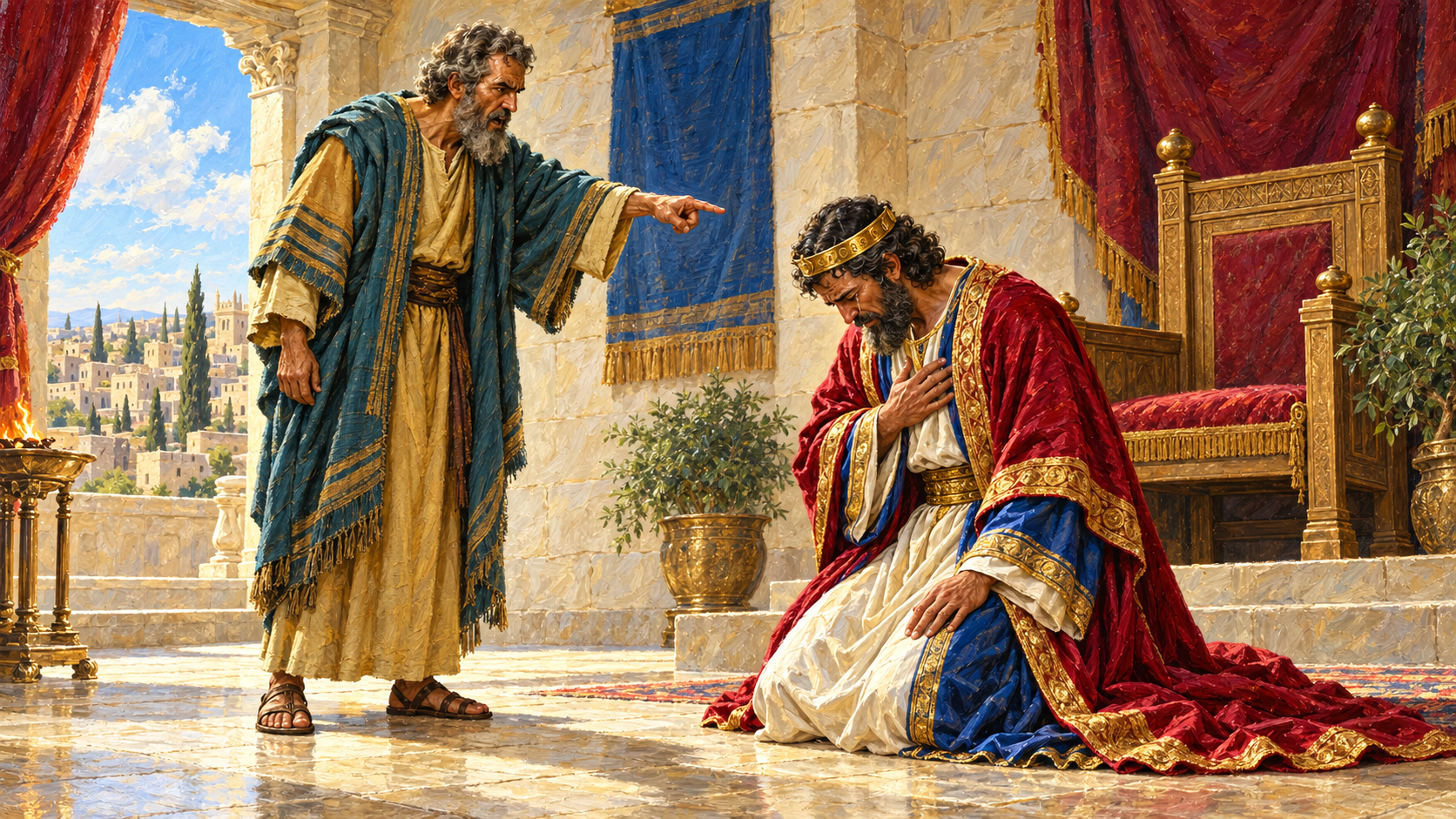
David was a shepherd when he faced Goliath, trusting God to help him. Later, as king, he abused his power and tried to conceal terrible sin. That leaves me with a question I cannot ignore: how can Scripture still call him a man after God’s own heart?
The Whole Life of David
We need both David’s faith and his failures to understand his life. His courage does not erase the warnings, and his sin does not erase God’s faithfulness. Nathan’s rebuke prevents us from using David to excuse ourselves, while the mercy David received when he confessed gives us reason not to despair. God’s covenant promise also takes us beyond David to Jesus Christ, where the account is leading.
David was called “a man after God’s own heart,” but that does not mean he was sinless. God chose him to be a king who would do His will, in contrast to Saul’s rebellious self-rule. David showed genuine faith and also genuinely failed. God’s work through his life led toward Jesus Christ, the Son of David whose kingdom will never end.
We follow David’s life from 1 Samuel 16 through the opening of 1 Kings. In 1 Chronicles, important events from his reign are retold with particular attention to worship and the ark, along with temple preparations and his family line. Many Psalms let us hear David’s voice through their opening inscriptions or historical settings. Their inspired themes also express his fear and search for refuge, his confession and praise for deliverance, and his worship and hope.
I would miss too much by stopping with one familiar passage. David’s victory over Goliath is true, but it does not tell us everything about him. Psalm 23 does not cancel the confession of Psalm 51, and the Davidic Covenant does not make David the final king. Scripture takes time with his life, and we need to follow it patiently.
And when He had removed him, He raised up for them David as king, to whom also He gave testimony and said, “I have found David the son of Jesse, a man after My own heart, who will do all My will.”
Paul’s sermon in Acts remembers David as God’s chosen servant before turning to Jesus. David served his generation, then died and his body decayed. Jesus rose without His body seeing decay. God used David’s life in a remarkable way, but David could not save anyone. Paul’s movement from David to Christ helps me keep the servant’s place distinct from the Savior’s.
From Bethlehem to the Throne
David’s early life began with hidden preparation in Bethlehem, where shepherding taught him watchfulness and trust in God (1 Samuel 16). Samuel likely anointed him while he was still a teenager. His service in Saul’s court and victory over Goliath then made him known in Israel, but his young adult years were spent fleeing Saul and waiting for God’s timing (1 Samuel 16-31).
David began reigning over Judah at about thirty years old (2 Samuel 2:1-4). After seven and a half years in Hebron, all Israel recognized him as the shepherd-king God had chosen (2 Samuel 5:1-5). He captured Jerusalem, brought the ark there, and received God’s covenant promise during the established years of his reign (2 Samuel 5-7). Later, his abuse of power against Bathsheba and Uriah brought confession and forgiveness, but also lasting consequences (2 Samuel 11-12; Psalm 51).
The closing years brought grief within David’s household through Amnon and Absalom, followed by civil war (2 Samuel 13-19; Psalm 3). David later sinned by counting Israel’s military strength. After confessing, he purchased the threshing floor that would be connected with the temple (2 Samuel 24; 1 Chronicles 21). Near the end of his life, he prepared Solomon to take the throne and gathered what the temple would need (1 Chronicles 22, 28-29; 1 Kings 1-2).
The description “man after God’s own heart” needs to be understood beside Saul’s kingship. Saul repeatedly tried to preserve his throne through appearances and excuses, with impatience and partial obedience shaping his decisions. He offered a sacrifice Samuel had not authorized and spared what God had commanded him to destroy. Even afterward, he spoke as though public honor could cover his disobedience. Repeating the phrase about David without that contrast weakens its meaning.
David was not sinless, but his allegiance was directed toward the LORD. He trusted God’s power and valued His presence. When God rebuked him, he received that correction and confessed, and his desire for God’s house expressed his worship. The heart language concerns the inward person responding to God in obedience and repentance, not simply warm feelings.
But the LORD said to Samuel, “Do not look at his appearance or at his physical stature, because I have refused him. For the LORD does not see as man sees; for man looks at the outward appearance, but the LORD looks at the heart.”
Knowing God did not excuse David’s later sins. It made them more serious, because he rebelled against the One he knew. That warns me that a person after God’s heart can still fall terribly when he stops guarding his own heart. We can find comfort in mercy toward those who stop hiding and confess without pretending their sin was small.
David came from Bethlehem, which would later be inseparable from the Messiah’s birth. His family line included Ruth, who had come into Israel by faith, and Boaz, who had redeemed. Obed fathered Jesse, whose sons Samuel came to see when anointing the next king. Eliab looked so kingly that even Samuel was impressed, but the LORD corrected the prophet before appearance determined his choice.
David was with the sheep when his brothers were first presented to Samuel. That time out of view had trained him to be watchful and courageous, caring for the flock in dependence on God. He had protected lambs from lion and bear, preparing him to understand Israel as a flock entrusted to his care. Yet David was not the final shepherd. His work prepared language Scripture would use for the LORD Himself and for Christ.
So he sent and brought him in. Now he was ruddy, with bright eyes, and good-looking. And the LORD said, “Arise, anoint him; for this is the one!” Then Samuel took the horn of oil and anointed him in the midst of his brothers; and the Spirit of the LORD came upon David from that day forward. So Samuel arose and went to Ramah.
In Psalm 23, David’s words “The LORD is my shepherd” place the man who had led sheep under God’s care himself. I do not read that as mere poetic decoration. David knew he needed to be led too. A king becomes dangerous when he forgets that he remains a sheep under the LORD, while remembering the Lord’s restoring care teaches a believer to pray humbly.
The LORD is my shepherd; I shall not want. He makes me to lie down in green pastures; He leads me beside the still waters. He restores my soul; He leads me in the paths of righteousness For His name’s sake.
When Samuel anointed David, the Spirit of the LORD came upon him from that day forward. The next verse in 1 Samuel says the Spirit departed from Saul and a distressing spirit troubled him. These events concern God’s choice of king: He removed Saul from covenant kingship and empowered David for the calling ahead.
That royal setting helps me understand David’s later plea in Psalm 51: “Do not cast me away from Your presence, and do not take Your Holy Spirit from me.” He knew what had happened to Saul and feared losing royal fellowship and empowering as Saul had. He prayed as a repentant Old Testament king. New Testament believers are indwelt and sealed by the Holy Spirit, so David’s cry should not be made to teach that a born-again believer can become spiritually unborn.
The Holy Spirit who empowered David is God, a divine Person rather than an impersonal force. He inspired Scripture and now convicts of sin and indwells believers. We should not reduce His work to a worship atmosphere or a vague feeling.
When David faced Goliath, the living God was being defied and Israel’s king and army were afraid. Goliath’s size and armor made him a real threat, as did his weapons. David did not deny that danger. He understood the battle through covenant faith and trusted that the LORD was greater. Reducing the account to small people chasing large dreams misses what David was defending.
Then David spoke to the men who stood by him, saying, “What shall be done for the man who kills this Philistine and takes away the reproach from Israel? For who is this uncircumcised Philistine, that he should defy the armies of the living God?”
David heard more than an insult to Israel’s soldiers. Goliath had defied the armies of the living God, and David remembered how that God had delivered him from lion and bear. His courage on the battlefield grew from the trust he had learned while protecting sheep. The circumstances had changed, but the God on whom he depended had not.
Your servant has killed both lion and bear; and this uncircumcised Philistine will be like one of them, seeing he has defied the armies of the living God.” Moreover David said, “The LORD, who delivered me from the paw of the lion and from the paw of the bear, He will deliver me from the hand of this Philistine.” And Saul said to David, “Go, and the LORD be with you!”
David had not tested the armor Saul offered, so he went with his sling and stones. His confidence rested in the name of the LORD of hosts, unlike Goliath’s reliance on sword, spear, and javelin. The victory would show Israel that the LORD did not need sword and spear to save.
Then David said to the Philistine, “You come to me with a sword, with a spear, and with a javelin. But I come to you in the name of the LORD of hosts, the God of the armies of Israel, whom you have defied. This day the LORD will deliver you into my hand, and I will strike you and take your head from you. And this day I will give the carcasses of the camp of the Philistines to the birds of the air and the wild beasts of the earth, that all the earth may know that there is a God in Israel. Then all this assembly shall know that the LORD does not save with sword and spear; for the battle is the LORD’s, and He will give you into our hands.”
As Israel’s representative warrior, David won a victory that points by pattern to Christ, the true King who defeats what His people cannot. I would keep that comparison tied to what the passage emphasizes: the LORD’s name and His gift of deliverance through the public defeat of the one defying Him. The five stones are not hidden symbols for us to decode. Jesus is greater than David because He was sinless and bore in His innocent body the real punishment wicked men inflicted. He shed His blood and died, then rose bodily in victory over sin and death.
After the victory, Saul placed David over men of war. David acted wisely and was welcomed by both the people and Saul’s servants. But the song “Saul has slain his thousands, and David his ten thousands” exposed Saul’s jealousy. Rather than thank God for deliverance, he heard a threat to his own image and throne.
So the women sang as they danced, and said: “Saul has slain his thousands, And David his ten thousands.” Then Saul was very angry, and the saying displeased him; and he said, “They have ascribed to David ten thousands, and to me they have ascribed only thousands. Now what more can he have but the kingdom?” So Saul eyed David from that day forward.
Saul’s jealousy eventually led him to try to kill David. He threw spears at him and used marriage and military danger as traps before ordering others to kill him. Jonathan, however, remained loyal. As Saul’s son, he had every natural reason to view David as a rival, yet he recognized God’s hand on David and made a covenant with him.
Then Jonathan and David made a covenant, because he loved him as his own soul. And Jonathan took off the robe that was on him and gave it to David, with his armor, even to his sword and his bow and his belt.
Jonathan’s gift of his robe and weapons expressed humility before God’s revealed choice. He was willing to yield succession rather than sacrifice truth to personal ambition. His loyalty to David honored the LORD’s purpose.
David’s anointing did not bring him quickly to the throne. Danger followed, and public honor gave way to exile. Michal and Jonathan helped him escape Saul, while Samuel sheltered him for a time. At Nob, Ahimelech gave him holy bread before he fled to Gath. Distressed men later gathered to him at Adullam, and he moved through wilderness strongholds as Saul continued hunting him.
David’s fear and deception at Nob helped put Ahimelech and the priests in danger. Saul’s rage became monstrous when Doeg killed the priests. David later acknowledged responsibility for what his own actions had set in motion. I need to keep that failure in view alongside his faith: he often trusted God, but fear could still lead him to compromise the truth.
At Adullam, men burdened by distress, debt, and bitterness gathered around David and accepted him as their captain. God was forming a company for the future kingdom from this rough beginning, far from the polished court Saul tried to preserve.
The accounts of David’s travels tell us where he went, while the Psalms let us hear how he prayed. Psalm 57 seeks refuge in the shadow of God’s wings, and Psalm 63 expresses thirst for God in a dry, weary land. Psalm 34 remembers His deliverance. Through these prayers we can hear David’s inner life during the fugitive years.
Be merciful to me, O God, be merciful to me! For my soul trusts in You; And in the shadow of Your wings I will make my refuge, Until these calamities have passed by.
Nabal’s insult nearly led David to shed blood in anger, but Abigail intervened with wisdom and courage expressed humbly. David recognized that the LORD had used her to prevent him from taking vengeance with his own hand. His response makes me consider how I receive correction. A teachable heart accepts faithful intervention before sin develops, and even David needed that help before he became king.
While living among the Philistines, David returned to Ziklag to find it burned and the families taken captive. His men spoke of stoning him. Scripture says he strengthened himself in the LORD his God and asked the LORD what to do. He pursued and recovered everything, then shared the spoil with those too exhausted to continue. Under severe pressure, his dependence on God shaped the leadership he gave his men.
David twice had an opportunity to kill Saul and refused to take the throne through assassination. At En Gedi, he cut a corner from Saul’s robe in the cave and was troubled even by that symbolic act. At Ziph, Abishai wanted to strike Saul immediately, but David stopped him.
But David said to Abishai, “Do not destroy him; for who can stretch out his hand against the LORD’s anointed, and be guiltless?” David said furthermore, “As the LORD lives, the LORD shall strike him, or his day shall come to die, or he shall go out to battle and perish. The LORD forbid that I should stretch out my hand against the LORD’s anointed. But please, take now the spear and the jug of water that are by his head, and let us go.”
David refused private vengeance and an unlawful seizure of the throne without pretending Saul was righteous. He called Saul’s pursuit evil and appealed to the LORD as judge, while staying beyond Saul’s reach. His restraint did not excuse Saul’s wrongdoing or require silence about it. Refusing assassination was compatible with naming evil and avoiding danger.
Saul held the throne but did not trust God, while David waited for God’s timing without yet possessing it. Their responses exposed the difference between them and help explain why God was building one house while removing the other.
Jonathan’s loyalty involved more than affection. He spoke well of David to Saul and warned David as the danger grew, strengthening his hand in God. Knowing David would be king, he asked him to show covenant kindness to his household when the LORD gave David rest from his enemies. Their friendship gives us a clear example of covenant loyalty.
In 2 Samuel 1, David grieved for both Saul, the fallen king, and Jonathan, his beloved friend. His description of Jonathan’s love as surpassing the love of women belongs to their covenant loyalty, not a sexual relationship. Modern readings that make it sexual overlook a royal setting where succession usually produced suspicion and rivalry, often ending in bloodshed. Jonathan had surrendered personal ambition and remained faithful to David under pressure.
I am distressed for you, my brother Jonathan; You have been very pleasant to me; Your love to me was wonderful, Surpassing the love of women.
David later kept that covenant by giving Jonathan’s son Mephibosheth a place at his table. Instead of destroying Saul’s surviving household to secure his own position, he cared for Jonathan’s lame son. Covenant loyalty took the form of mercy toward someone he could have treated as a rival.
After Saul died, David asked the LORD for direction rather than immediately seizing everything. He went to Hebron, where Judah’s men anointed him king at about thirty years of age. Saul’s commander Abner meanwhile made Saul’s son Ishbosheth king over Israel. David ruled in Hebron for seven years and six months before all Israel came to him.
Conflict continued between Saul’s house and David’s during those years. Abner killed Asahel in battle, and Joab later killed Abner in revenge. Men who thought David would reward them murdered Ishbosheth, but David condemned the murders. He refused to establish his kingdom by treachery. God was bringing His chosen king to the throne amid the wrongs committed by sinful people.
Then all the tribes of Israel came to David at Hebron and spoke, saying, “Indeed we are your bone and your flesh. Also, in time past, when Saul was king over us, you were the one who led Israel out and brought them in; and the LORD said to you, ‘You shall shepherd My people Israel, and be ruler over Israel.'”
The elders acknowledged what had been true for years: God had appointed David to shepherd and rule Israel. David made a covenant with them before the LORD, and they anointed him king. Calling him a shepherd reminds us that he was to care for God’s people while remaining under God’s authority himself.
Jerusalem, Worship, and God’s Covenant
David captured Jerusalem and made it his royal center, the city of David. He also wanted the ark there because the LORD’s presence should be central to the nation. The city’s place in Israel’s public life was to express more than royal power.
The first attempt to bring the ark to Jerusalem showed why zeal needed to be governed by God’s Word. Uzzah touched it when the oxen stumbled and died there. David became afraid, and the ark stayed at Obed-Edom’s house for three months. David’s desire for worship was not excessive, but sincerity could not replace proper reverence. The ark was later brought up with gladness and in the proper order.
Now it was told King David, saying, “The LORD has blessed the house of Obed-Edom and all that belongs to him, because of the ark of God.” So David went and brought up the ark of God from the house of Obed-Edom to the City of David with gladness. And so it was, when those bearing the ark of the LORD had gone six paces, that he sacrificed oxen and fatted sheep. Then David danced before the LORD with all his might; and David was wearing a linen ephod.
Michal despised David’s worship, but he answered her in humility before the LORD who had chosen him, rather than as a performer seeking the crowd’s approval. He rejoiced before God while also learning to fear Him. I see no need to separate glad worship from reverence here. Sincerity belongs with obedience to God’s instruction, not in place of it.
Once the ark was in Jerusalem, David wanted to build a house for the LORD. Nathan encouraged him at first, but God corrected the plan that night. Instead of David building the house he envisioned, God promised to build David a house: a dynasty that would carry the covenant promise forward. This promise became a foundation of biblical hope.
since the time that I commanded judges to be over My people Israel, and have caused you to rest from all your enemies. Also the LORD tells you that He will make you a house. “When your days are fulfilled and you rest with your fathers, I will set up your seed after you, who will come from your body, and I will establish his kingdom. He shall build a house for My name, and I will establish the throne of his kingdom forever.
God’s promise included David’s immediate successors but reached far beyond them. Solomon would be David’s own son and would build the temple. David’s family line would continue. Individual kings could be disciplined for disobedience. Yet no ordinary descendant could reign forever, so the promised enduring house and kingdom, with its throne, pointed beyond Solomon.
And your house and your kingdom shall be established forever before you. Your throne shall be established forever.
Psalm 89 remembers God’s oath to David, and the prophets continue to speak of that promise. Isaiah describes a child whose government and peace on David’s throne will never end, while Jeremiah promises a righteous Branch. Gabriel later tells Mary that Jesus will receive His father David’s throne and reign over Jacob’s house forever. I cannot reduce these promises to a vague spiritual influence. Jesus reigns now and will return bodily, with a visible kingdom that is righteous and everlasting.
In 2 Samuel 9, David asked whether anyone from Saul’s house remained to whom he could show kindness for Jonathan’s sake. Jonathan’s death had not ended their covenant. The word often associated with such kindness is hesed, which describes loyal mercy rooted in commitment. That meaning helps us understand why David was looking for someone from this family to help.
Mephibosheth was lame in his feet and lived away from the royal center. David summoned him, restored Saul’s land to him, and gave him a place at the king’s table. Ancient kings often eliminated rival households, so David’s treatment of Jonathan’s son showed covenant mercy where he might otherwise have faced hostility.
Mephibosheth received mercy for Jonathan’s sake, which helps me appreciate kindness resting on another person’s covenant. I would not make every detail a picture of salvation. The connection is that believers receive grace through Jesus Christ rather than through personal worthiness.
David’s Sin, Repentance, and Consequences
In 2 Samuel 11, David remained in Jerusalem when kings went out to battle. That sets the scene for his darkest chapter, but we should not make the detail say more than Scripture does. He saw Bathsheba and asked about her, then sent messengers and took her even after learning she was Eliam’s daughter and Uriah’s wife. He slept with her, and when she reported her pregnancy he tried to manipulate Uriah. After making him drunk, David finally arranged his death.
Nothing in the passage gives me a reason to invent motives that make Bathsheba the lure. It identifies her as Uriah’s wife before David sent for her and directs our attention to his use of royal power. David acted, tried to conceal it, and ultimately ordered murder. Uriah refused to go home while the ark and the people of Israel and Judah remained in the field, along with Joab and his lord’s servants. The faithful soldier’s integrity exposed his king’s corruption.
And he wrote in the letter, saying, “Set Uriah in the forefront of the hottest battle, and retreat from him, that he may be struck down and die.”
Ordering someone else to kill Uriah did not make David less responsible for murder. Other soldiers died with him, and Joab participated in the scheme, but the command was David’s. Marrying Bathsheba after her mourning could not conceal what he had done from God.
And when her mourning was over, David sent and brought her to his house, and she became his wife and bore him a son. But the thing that David had done displeased the LORD.
Nathan told David a parable about a rich man who took a poor man’s lamb. David grew angry at the man in the parable before Nathan told him, “You are the man.” He had condemned the kind of sin he himself had committed before recognizing himself in it. His answer was a brief confession rather than a long defense.
So David said to Nathan, “I have sinned against the LORD.” And Nathan said to David, “The LORD also has put away your sin; you shall not die.”
God forgave David without removing every consequence. The child died, and David was told that the sword would not depart from his house and adversity would arise within his family. Forgiveness and discipline are not contradictory. God can remove guilt while allowing the consequences of sin to unfold in this life.
In Psalm 51, David asked for mercy after Nathan confronted him. He acknowledged his transgression instead of shifting blame and asked God to wash him clean. His confession included bloodguilt, and his plea for inward renewal showed that he needed more than an outward religious act. He needed a clean heart.
Have mercy upon me, O God, According to Your lovingkindness; According to the multitude of Your tender mercies, Blot out my transgressions. Wash me thoroughly from my iniquity, And cleanse me from my sin.
When David says “Against You, You only, have I sinned,” he is not denying the wrong he did to Bathsheba or Uriah. He also sinned against the other soldiers who died, against Joab and the child, and against Israel. We must not erase those people when we read his confession. He was acknowledging that every sin is ultimately committed before the holy LORD and against Him, which deepens the guilt rather than diminishing the human harm.
Create in me a clean heart, O God, And renew a steadfast spirit within me. Do not cast me away from Your presence, And do not take Your Holy Spirit from me.
Psalm 32 lets us hear what hiding sin did to David and the relief forgiveness brought. He described the misery of remaining silent, then the blessedness of forgiveness. Neither psalm treats repentance casually. Confession brings the sinner into God’s mercy and requires telling the truth rather than protecting the lie.
When I kept silent, my bones grew old Through my groaning all the day long. For day and night Your hand was heavy upon me; My vitality was turned into the drought of summer. Selah
David’s household suffered grievously after his sin concerning Bathsheba and Uriah. Amnon raped Tamar, and although David became very angry, Scripture records no discipline of Amnon. Absalom took Tamar into his house and hated Amnon. He waited before murdering him. Sympathy for Tamar cannot make that vengeance right: Amnon was responsible for rape, David for his failures as king and father, and Absalom for murder and rebellion. Their actions also brought public disorder.
Absalom returned from exile without true reconciliation and began building his public image. He stole the hearts of Israel’s men and led a rebellion, made more openly shameful by Ahithophel’s counsel. David fled Jerusalem in tears and prayer, then grieved bitterly when Absalom died. Psalm 3 gives us his words of trust in God when so many had risen against him.
LORD, how they have increased who trouble me! Many are they who rise up against me. Many are they who say of me, “There is no help for him in God.” Selah
David cried over Absalom, “O my son Absalom, my son, my son Absalom; if only I had died in your place!” His longing is painful to read because wishing could not enable him to redeem his son. It directs us beyond David to Christ, the true Son of David who actually gave Himself for sinners.
Late in his reign, David insisted on counting Israel’s fighting men despite Joab’s objection. We need to read the complementary accounts in 2 Samuel 24 and 1 Chronicles 21 carefully. Joab’s objection shows the spiritual danger in the command. The sin seems connected with pride and misplaced confidence in military strength, as though human force could secure Israel.
And David’s heart condemned him after he had numbered the people. So David said to the LORD, “I have sinned greatly in what I have done; but now, I pray, O LORD, take away the iniquity of Your servant, for I have done very foolishly.”
When judgment came through a plague, David saw his people being destroyed and confessed with deep concern for the flock entrusted to him. He was not claiming that they were innocent in every ultimate sense. He knew that he had acted wickedly as their king.
Then David spoke to the LORD when he saw the angel who was striking the people, and said, “Surely I have sinned, and I have done wickedly; but these sheep, what have they done? Let Your hand, I pray, be against me and against my father’s house.”
David was told to build an altar on the threshing floor of Araunah, also called Ornan in Chronicles. He refused to offer the LORD something that cost him nothing, and the plague was restrained. The site would later be connected with the temple. God was mercifully advancing His redemptive purpose through judgment and David’s confession and sacrifice, without making David’s failure good.
David’s Final Years and His Psalms
God appointed Solomon to build the temple David desired. David accepted that he would not see his own wish completed and devoted himself to preparation. He gathered materials and prepared plans, organizing the priests and Levites and charging the leaders with their responsibilities. He also urged Solomon to serve the LORD with a loyal heart and willing mind.
“As for you, my son Solomon, know the God of your father, and serve Him with a loyal heart and with a willing mind; for the LORD searches all hearts and understands all the intent of the thoughts. If you seek Him, He will be found by you; but if you forsake Him, He will cast you off forever.
Adonijah tried to take the throne by exalting himself, so the final succession was still contested. Nathan and Bathsheba appealed to David, and Zadok the priest and Nathan the prophet anointed Solomon at Gihon. Benaiah supported this rightful succession. David’s final charge to Solomon included loyalty to God’s law and the unresolved dangers posed by Joab and Shimei. I need to read those instructions in Israel’s royal and judicial setting. This was a covenant monarchy, not a private feud or permission for personal revenge.
In his final public prayer in 1 Chronicles 29, David acknowledged that everything gathered for the temple had already come from God. I appreciate how that keeps human generosity in perspective. Giving back what He provides does not put Him in our debt.
Yours, O LORD, is the greatness, The power and the glory, The victory and the majesty; For all that is in heaven and in earth is Yours; Yours is the kingdom, O LORD, And You are exalted as head over all.
David died at a good old age, full of days, riches, and honor, and Solomon succeeded him. Acts tells us that he served his generation by God’s will before dying and being buried with his fathers. His body decayed. God’s chosen servant was still mortal, so we must look beyond him to the One whose body did not see decay.
The Psalms let us return to David’s inner life after the historical account has reached his death. They are not a private diary in the modern sense, and we cannot attach every Davidic psalm to a precise day. Yet they let us hear inspired prayer from someone who knew danger and guilt as well as mercy and hope. His worship shows a man bringing his inner life before God, more than a political figure.
Psalm 23 brings David’s experience as a shepherd into worship of the LORD who restores and leads His own. His fugitive years give context to the refuge in Psalm 57 and the thirst for God in the wilderness expressed in Psalm 63. In Psalm 3, during Absalom’s rebellion, he confessed that the LORD remained his shield and glory despite those rising against him.
Concealment and forgiveness come together in Psalm 32, while Psalm 51 asks for mercy and a clean heart after Nathan’s rebuke. Psalm 18 praises the LORD for deliverance from Saul and other enemies. Psalm 110 takes us further, with David speaking of the Messiah as both his Son and his Lord.
Jesus asked how the Christ could be both David’s Son and David’s Lord, drawing attention to Psalm 110. Jesus truly descended from David according to the flesh, yet He is also the eternal Son of God. Who He is answers the question: David’s promised throne belongs finally to a King greater than David himself.
Reading David’s Life Carefully
We should honor David’s faith without making his evil smaller. Being a man after God’s heart did not excuse what he did, and grace gives us no reason to soften it. Nor should we treat remaining in Jerusalem as the sin explicitly identified in 2 Samuel 11. That detail introduces the events. The account condemns David’s conduct as he saw and inquired about Bathsheba, took her and concealed what he had done, and arranged Uriah’s death.
We have no biblical basis for saying Bathsheba lured David. The account emphasizes his royal power and his commands to conceal what he had done. Nor does his earlier refusal to kill Saul exempt leaders from being challenged. David rejected assassination and private vengeance without shielding Saul from truth or exposure. He did not place Saul beyond God’s judgment or lawful accountability.
David and Jonathan’s friendship needs the context of their covenant. Their loyalty involved humility over royal succession and grief at loss, not a sexual relationship. Psalm 51 also requires its covenant setting: David was an Old Testament king who knew Saul had lost his royal empowering. New Testament believers, by contrast, are indwelt and sealed by the Holy Spirit.
God’s covenant with David promises more than a present spiritual influence. Jesus reigns now and will return bodily to reign over the house of Jacob. His kingdom will never end.
Jesus Christ, the Greater Son of David
The New Testament opens by deliberately naming Jesus as the Son of David and the Son of Abraham. The promise began with the Seed of the woman and continued through Abraham’s seed into Judah’s line. It then came to David’s house and reached Christ. Jesus has the legal royal connection to David through Joseph and was truly born of David’s seed according to the flesh. He is also David’s Lord, the eternal Son who became fully man without ceasing to be fully God.
And behold, you will conceive in your womb and bring forth a Son, and shall call His name JESUS. He will be great, and will be called the Son of the Highest; and the Lord God will give Him the throne of His father David. And He will reign over the house of Jacob forever, and of His kingdom there will be no end.
David’s shepherding points us to Jesus, the good Shepherd who gives His life for the sheep. David’s kingship likewise points beyond him to the King of kings. Unlike David, who needed cleansing for his sins, Jesus was entirely sinless. He actually gave Himself for sinners, accomplishing what David could only wish to do for Absalom. And while David prepared for a temple, Jesus is greater than the temple and will rule from God’s promised throne.
Jesus Christ, the eternal Son of God, became truly man and lived without sin. He went willingly to the cross, where wicked men physically tortured and punished Him before killing Him. He bore that punishment in His innocent body and shed His blood for our sins. After His death and burial, He rose bodily. Salvation is in His blood and comes to us by grace through faith. He died for the whole world, so God’s offer is genuine even though people can resist and reject it. Everyone who truly believes is born again. The Holy Spirit dwells within that believer and seals him, making him eternally secure in Christ.
I, Jesus, have sent My angel to testify to you these things in the churches. I am the Root and the Offspring of David, the Bright and Morning Star.
For related studies:
David’s Sin With Bathsheba: A focused study on David’s abuse of power, Nathan’s rebuke, Psalm 51, and the consequences in David’s house.
King Saul: A companion study showing the contrast between Saul’s rebellious kingship and David’s chosen line.
The Davidic Covenant: A deeper look at God’s promise of an everlasting house, throne, and kingdom fulfilled in Christ.
My Final Thoughts
David’s faith gives me reason to trust God, while his failures warn me to guard my own heart. A person who knows the Lord can still do terrible harm, and David’s repentance shows why we must stop hiding when God exposes our sin. I cannot turn him into either a flawless hero or a hopeless failure. God’s covenant faithfulness takes us beyond David himself to Jesus Christ, his sinless Son and Lord, whose kingdom will never end.