
Melchizedek appears in only a few verses of Genesis, but Psalm 110 and Hebrews keep returning to him. Who is this king and priest, and why does Scripture connect him so closely with Jesus Christ? I want to follow those passages carefully because the answer helps us see why Christ’s priesthood can never end.
Melchizedek Meets Abram After the Battle
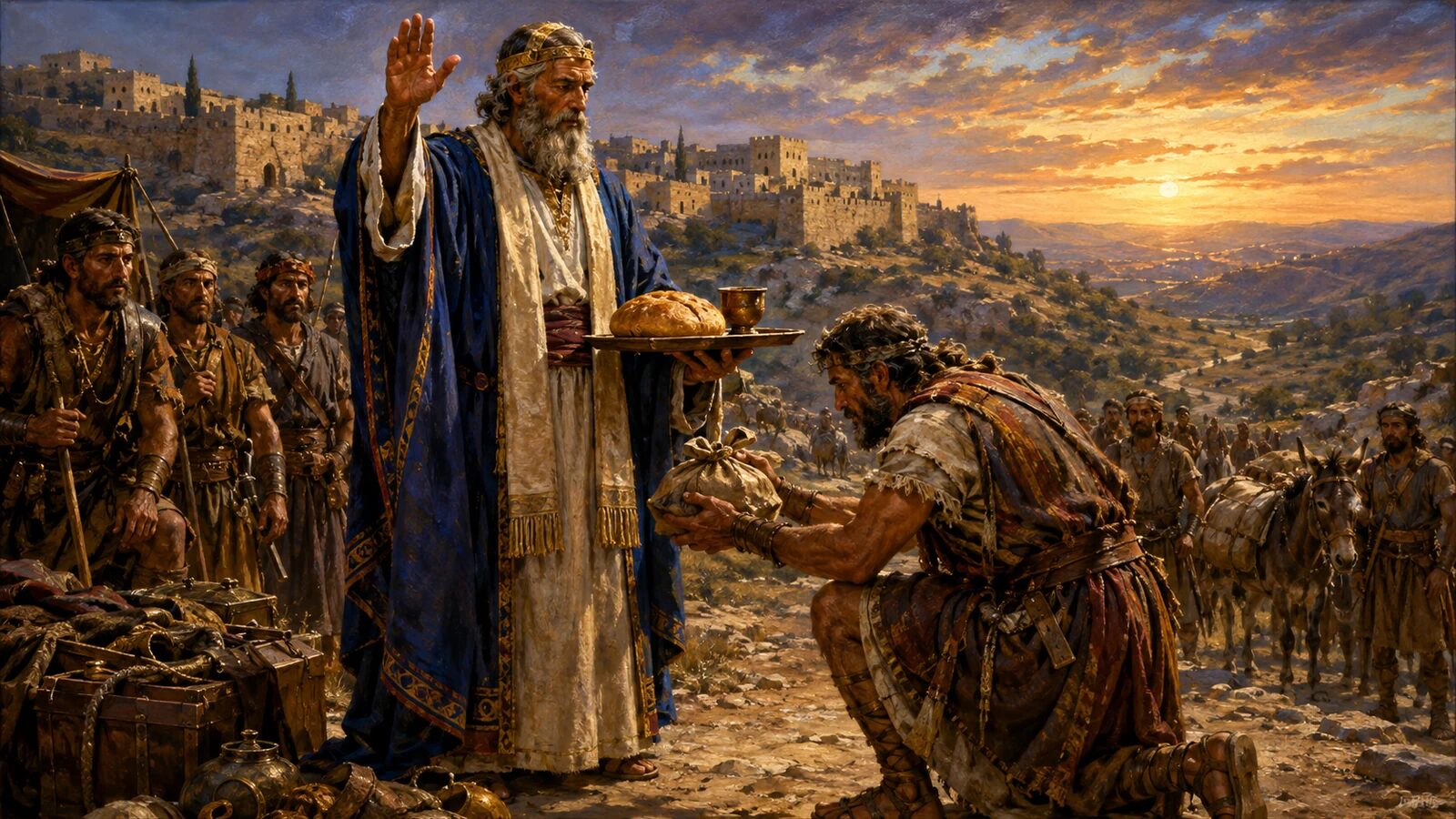
Several kings had gone to war, and Lot had been taken captive. Abram pursued the enemy and won the battle, recovering the people and their possessions. As he returned, two very different kings came to meet him: the king of Sodom approached from one direction, while Melchizedek, king of Salem, came from the other.
The king of Sodom offered Abram goods from a wicked city, while Melchizedek brought bread and wine and blessed him in the name of God Most High. I notice that this meeting came after Abram’s victory, when the fighting was over but he still faced a choice about how to respond. He could have taken the credit himself, and Sodom’s goods could have drawn him into an alliance with its king. Melchizedek directed his attention to the God who had delivered his enemies into his hand.
Then Melchizedek king of Salem brought out bread and wine; he was the priest of God Most High. And he blessed him and said: “Blessed be Abram of God Most High, Possessor of heaven and earth; And blessed be God Most High, Who has delivered your enemies into your hand.” And he gave him a tithe of all.
Genesis identifies Melchizedek as king of Salem and priest of God Most High without yet explaining who this mysterious figure was. He provided refreshment and then blessed Abram, who responded by giving him a tenth of everything.
Although Abram had fought and won the battle, he was not the greatest figure in this meeting. He received Melchizedek’s blessing and gave to him. Hebrews later explains why that is significant: the lesser is blessed by the better. Even Abraham, the patriarch who received God’s promises, honored Melchizedek’s greater priestly standing.
The bread and wine first provided refreshment after a hard battle. Genesis does not say Melchizedek was holding the Lord’s Supper, so I would not read that later institution back into his meeting with Abram. Still, I can see a connection when I consider how the true Priest-King later gave bread and the cup as signs of His body and blood. Genesis does not explain that doctrine here, but the God who gave us this account also gave us the passages about Christ’s sacrifice.
The Righteous King of Peace
Under the Law of Moses, the offices Melchizedek held were usually kept separate. David’s royal line came from Judah, while Israel’s priests descended from Levi through Aaron. God judged King Uzziah when he tried to take priestly honor for himself in 2 Chronicles 26. A desire for more power gave no man the right to claim either office, because both depended on God’s appointment.
Melchizedek was both king of Salem and priest of God Most High long before Sinai. Scripture draws our attention to those combined offices without rebuking him for holding them. His priesthood belonged to a different order, so it did not violate the Levitical order established later.
Hebrews explains that Melchizedek means “king of righteousness,” while king of Salem means “king of peace.” The order of those titles helps me understand the peace Christ gives. Biblical peace does not ignore guilt so that we can feel calm; sin has to be dealt with through righteousness. Jesus fulfills both titles as the righteous King who made peace through His blood. He did not give us peace by pretending our sin was harmless.
Melchizedek called God El Elyon, meaning “God Most High.” In Genesis 14, earthly kings were fighting over land, but the God Melchizedek proclaimed owned heaven and earth. He was not a local god whose authority ended with one people or place. I need to keep that in view when looking at Abram’s victory. It showed that God Most High had delivered the enemy into his hand, not that Abram had become the greatest man in the region.
Salem is connected with Jerusalem elsewhere in Scripture. Psalm 76 speaks of God’s dwelling in Salem and then uses Zion as a parallel name. Genesis does not pause to explain the city’s later history, but the connection places this king-priest in the city that would become the home of David’s throne and the temple. It would also become central to the Messiah’s saving work.
Melchizedek blessed Abraham as both king and priest, and Abraham honored him. His titles bring righteousness and peace together under God’s supreme rule. Psalm 110 takes us further by showing that this priestly order belongs to the promised Messiah.
The LORD said to my Lord, “Sit at My right hand, Till I make Your enemies Your footstool.”
David spoke by the Spirit about One who was both his descendant and his Lord. Jesus used this verse in Matthew 22 to question leaders who could call the Messiah David’s Son but could not explain why David called Him Lord. Their answer failed to account for the full picture David gave. The LORD exalts the Messiah to His right hand and promises to place every enemy beneath His feet.
Then the psalm brings priesthood into the promise.
The LORD has sworn And will not relent, “You are a priest forever According to the order of Melchizedek.”
God’s oath will never be revoked, so the Messiah’s priesthood cannot be temporary. He is a priest forever according to Melchizedek’s order rather than a priest from Aaron’s line. That does not make the Levitical priesthood unholy; God gave it. But it could not have been His final plan when David, long after Abraham and Levi, announced another order that would continue forever.
Psalm 110 therefore joins the offices that Israel’s later institutions normally kept apart. The Messiah reigns as King while serving as Priest. That is why this psalm becomes central to the argument in Hebrews. If God swore that another priestly order would arise, Aaron’s line could not be the last word.
How Hebrews Reads the Details
Hebrews explains how Genesis 14 and Psalm 110 reveal Jesus as the final Priest whose eternal work is completely sufficient. I understand the apostle Paul to be the writer of Hebrews, although the letter does not name him in its opening. Some readers point to differences in style and vocabulary, and those are questions we should consider honestly. I don’t believe they outweigh the internal and early-church evidence for Paul.
For this Melchizedek, king of Salem, priest of the Most High God, who met Abraham returning from the slaughter of the kings and blessed him, to whom also Abraham gave a tenth part of all, first being translated “king of righteousness,” and then also king of Salem, meaning “king of peace,” without father, without mother, without genealogy, having neither beginning of days nor end of life, but made like the Son of God, remains a priest continually.
Paul considers both what Genesis records about Melchizedek and what it leaves unrecorded. It names neither his father nor his mother and gives no account of his birth or death. We find no family line establishing his priesthood, no priest before him in the account, and no successor. In a book with so many genealogies, I cannot dismiss that silence as an insignificant omission. Hebrews shows us that the Holy Spirit shaped the record this way for a purpose.
A priest’s ancestry was essential under the Law because he had to belong to the family God appointed. Feeling called or wanting religious influence could not qualify a man for that office. Melchizedek’s priesthood was presented without such a lineage before Levi was even born, placing him outside the Levitical system.
Hebrews goes beyond the absence of a family record by saying Melchizedek has neither beginning of days nor end of life and remains a priest continually. An ordinary man’s life begins and ends whether or not those events are recorded. Every priest from Aaron’s line eventually died and could serve no longer. That is why I see more here than a gap in an ancient record. Scripture’s description of Melchizedek points us powerfully to Christ.
Hebrews 7:16 describes Christ’s priesthood as resting on “the power of an endless life.” Jesus does not simply serve longer than the priests before Him. He lives forever, with a life death cannot break, so His office can never pass to a replacement.
Why I Believe Melchizedek Is Christ
The main question is whether Melchizedek was an ordinary historical king whose unusual record became a type of Christ, or whether he was Christ appearing before His incarnation. After working through the language of Hebrews, I believe Melchizedek is a Christophany, a real appearance of the eternal Son before Bethlehem.
The strongest objection comes from the phrase “made like the Son of God.” Some readers reason that someone made like the Son must be a different person from the Son. I understand why they make that distinction, but Hebrews is discussing how the Holy Spirit presents Melchizedek in Genesis. That written portrait resembles the Son of God as Scripture later reveals Him. It draws our attention to a likeness God designed without requiring us to regard Melchizedek as only an ordinary man.
The king of righteousness and king of peace also served as priest of God Most High, yet Scripture gives him no parents or genealogy. With no beginning or end recorded, his priesthood continues within the account. An ordinary human type can foreshadow Christ, but Melchizedek’s description fits the eternal Son’s priesthood in a way no Levitical priest ever could. That is why I see more than an ordinary person pointing forward to Him.
Other Old Testament appearances of Christ help me understand how this could be so. Before the incarnation, the eternal Son appeared as the distinctive Angel of the LORD and as the LORD who came near visibly. God could reveal Himself in those appearances without contradicting the truth that no one has seen the Father’s form. John 1:18 explains that the only begotten Son, who is in the Father’s bosom, has declared Him. The Son makes the Father known.
Identifying Melchizedek as a Christophany does not place the beginning of Jesus’ existence in Genesis 14. The Son is eternal and fully God. Colossians 1:16-17 describes Him as the Creator who existed before all things and holds them together. He did not become less than God when He appeared to Abram. In a Christophany, God the Son entered a real historical setting for a time to reveal Himself and bless His people.
That temporary appearance must also be distinguished from the incarnation. The Son did not permanently take human nature as Melchizedek; the Word became flesh in the womb of the virgin Mary. Jesus then lived a sinless life and shed His physical blood as He died for our sins. God raised Him bodily from the grave, and He remains fully God and fully man forever. Melchizedek prepares us to understand Christ without taking the place of what happened at Bethlehem.
I am willing to hold this conclusion even though it is unusual, but I don’t want to fill the gaps with a biography Scripture never supplies. Nor would I identify every mysterious Old Testament king-priest as Christ. Melchizedek’s case is distinctive because we have the history in Genesis, the development of his order in Psalm 110, and the inspired explanation in Hebrews. Those passages give us grounds for the conclusion and set its limits.
The bread and wine cannot establish this conclusion by themselves. They were provision for Abram and may echo later revelation, but they do not establish the Lord’s Supper before Jesus instituted it. The identification of Melchizedek with Christ must also preserve the distinction between the Son and the Father. The Father sends the eternal Son, who reveals Him, and the Holy Spirit inspired the Scriptures explaining this appearance. These are three distinct divine Persons, never separate gods.
A Greater Priesthood That Saves Completely
Hebrews asks us to consider Melchizedek’s standing by returning to what he and Abraham did. Abraham gave him a tenth, and Melchizedek blessed Abraham. This was the patriarch through whom God had promised to bless all the families of the earth. Yet at their meeting in Genesis 14, he received the blessing from Melchizedek.
Now beyond all contradiction the lesser is blessed by the better.
I don’t read this as diminishing Abraham. His greatness is what gives the argument its force: even he received Melchizedek’s blessing and gave tithes to him. That places Melchizedek above the patriarch in priestly standing.
Paul then extends the reasoning to Levi, who had not yet been born but belonged to Abraham’s family line. Within the covenant reasoning of Hebrews, Levi paid tithes through Abraham. The priesthood that later descended through Levi therefore stood beneath Melchizedek’s order.
This argument spoke directly to readers who were tempted to return to the old covenant priesthood. Its visible rituals and centuries of sacred history made that return appealing. Leaving Christ for that system would not move them to safer ground. It would take them away from the eternal Priest and back to a priesthood that could never finish the work.
The Levitical priesthood was God’s provision, not an evil system or a mistake. Through it He taught His holiness and the need for sinful people to have a sacrifice and a mediator. Its repeated offerings could never finally remove sin, but they served as a valuable shadow pointing toward Christ’s work. Once He came, clinging to those earlier offerings as though they could save would miss the very One they had pointed to.
The glory of Melchizedek’s order is finally the glory of Jesus Christ. Psalm 110 identifies the Messiah as the Priest who continues forever, and Hebrews explains why His priesthood is better than Levi’s.
And it is yet far more evident if, in the likeness of Melchizedek, there arises another priest who has come, not according to the law of a fleshly commandment, but according to the power of an endless life. For He testifies: “You are a priest forever According to the order of Melchizedek.”
Jesus came from Judah, so His priesthood did not rest on descent from Aaron. God established it by an oath, and it continues through the power of Christ’s endless life. Under Aaron’s order, priests grew old and died, requiring others to take their places. I see a very different assurance in Christ: because He lives forever, His priesthood never changes hands.
But He, because He continues forever, has an unchangeable priesthood. Therefore He is also able to save to the uttermost those who come to God through Him, since He always lives to make intercession for them.
The promise that Christ will “save to the uttermost” assures us that He saves completely. He doesn’t rescue sinners halfway and then make their continued salvation depend on their ability to keep themselves secure. Everyone who truly comes to God through Him is held by a Priest who lives forever and whose intercession cannot fail.
Christ’s intercession rests on the sacrifice He has already finished. Instead of bringing an animal to the altar, He willingly offered Himself, with no sins of His own requiring a sacrifice. He came near to sinners without their sin staining His holiness. Wicked men tortured His innocent body and then shed His blood and killed Him. Jesus willingly bore that physical punishment for our sins. The Father did not punish or curse His beloved Son. He neither abandoned Him nor poured wrath upon Him, and He was not the One who struck and bruised Christ. The bodily resurrection displayed Christ’s victory over death.
For such a High Priest was fitting for us, who is holy, harmless, undefiled, separate from sinners, and has become higher than the heavens; who does not need daily, as those high priests, to offer up sacrifices, first for His own sins and then for the people’s, for this He did once for all when He offered up Himself.
The permanence of Christ’s priesthood gives us more than an answer to Melchizedek’s identity. Because Jesus is Priest forever, I can come to God without depending on my strength or trying to produce the right religious mood. Repeated rituals cannot provide that access either. We come through a living Priest whose sacrifice is finished and whose ministry death will never interrupt.
Hebrews 9 and 10 explain the same assurance through the sanctuary and the sacrifice. The old covenant high priest entered the Most Holy Place with animal blood and had to return again, but Christ entered by His own blood and obtained eternal redemption. His sacrifice answered the guilt that those earlier offerings could only picture, so it never needs to be repeated. When Hebrews describes one sacrifice for sins forever, I understand that to leave no unpaid debt for another priest to settle.
Hebrews 4 brings the doctrine close to the believer’s daily life. Our High Priest understands human weakness because the incarnate Son was tempted in every way that we are, yet He never sinned. We may therefore come boldly to the throne of grace to receive mercy and find help. That invitation is not based on our record for the week. It rests on who Jesus is and what He has already accomplished.
Drawing Near to the Priest-King
By following Melchizedek through these passages, we can see the Bible’s united witness to Jesus Christ. God began revealing the Priest-King before Sinai and long before David wrote his psalm. Genesis connects with His covenant with Israel and with the prophets’ message, all directing us to Christ.
I cannot find a basis for making my own way to God in any of these passages. Abram could not bless himself, and Levi’s priesthood could not complete the work. Aaron’s sons eventually died, while their repeated animal offerings could neither perfect the conscience nor take away sin. Our guilt requires the Priest God appointed. His once-for-all sacrifice answers for our sin, and death cannot interrupt His intercession.
Jesus is that Priest, both David’s Son and David’s Lord. He stands above Abraham and Levi, just as He stands above the angels and Moses. Every true shadow that preceded Him finds its fulfillment in Him. Having offered Himself once for all, He now reigns as the righteous King who gives peace.
If you belong to Christ, you can draw near to God with confidence because His priesthood is secure. You do not have to approach Him as though He were a reluctant Savior who must be convinced to receive you again. When you have sinned, come honestly in repentance and rest in the blood He has already shed. The Lord who saves us also changes us, so eternal security can never be permission to settle comfortably into sin. It gives us confidence to obey Him.
I don’t want to settle for an argument about Melchizedek’s identity and overlook the response Hebrews asks of us. It shows us the Son’s greatness so that we will worship Him, and it gives us comfort we can rely on. An earthly priest may fail us, and eventually death will end his service. Whenever we come to God through Jesus, we come through the same living Priest. We will never need to wait for a successor to take His place.
If you have never trusted Christ, Melchizedek’s witness leaves you with a personal question: who will represent you before God? You cannot serve as your own priest or produce a righteousness that erases your guilt. Christ died for the whole world and genuinely offers salvation, even though people can resist Him. Everyone who repents and believes is forgiven and born again, and the Holy Spirit comes to live within that believer and seals him. His eternal life is secure because salvation is God’s work. Come to the Priest-King who died for sinners and rose bodily from the dead. He saves completely everyone who comes to God through Him.
For related studies, see A Full Study on Christophanies in the Old Testament, A Complete Bible Study on the Angel of the Lord, A Complete Bible Study on The Role of the High Priest, and A Bible Study on “The Lord Said to My Lord” in Psalm 110.
My Final Thoughts
I believe the passages in Genesis, Psalm 110 and Hebrews identify Melchizedek as a real pre-incarnate appearance of the eternal Son. The mystery leads us to the Priest-King who brings righteousness and peace. Abraham received his blessing, and Levi’s later priesthood stood beneath his order, which Jesus fulfills perfectly. Jesus offered Himself once and rose bodily, and He lives forever to intercede for everyone who comes to God through Him. When sin or fear makes me hesitate to draw near, I need to remember whose work gives me access to God. My access rests on Christ’s finished sacrifice and endless life rather than on my ability to hold myself together.